Selected scenes
BRZRKR in pictures.
Spoilers: This article discusses the opening campaign of BRZRKR: The Lost Book of B #1.
Overview
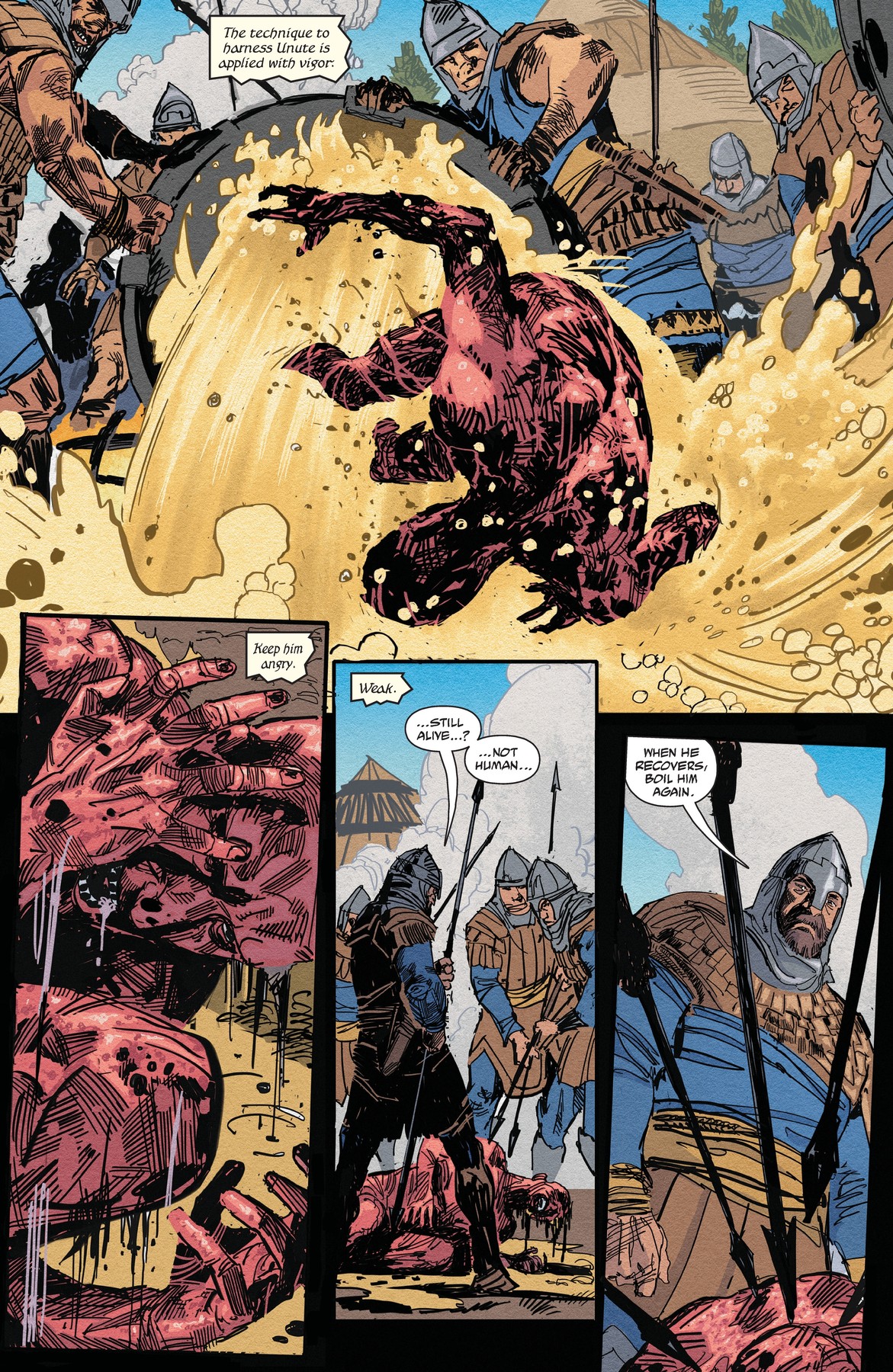
The Bulgar leaders and warriors are the unnamed members of a Bulgar group manipulated by the historical Unute cult during the opening of BRZRKR: The Lost Book of B #1. Their role is not to defeat B permanently. Under cult instruction, they capture or hold the immortal, repeatedly torture him through extreme injury and boiling, and maintain him in a controlled cycle of rage, weakness, death, and recovery until Genghis Khan arrives.[1][2]
The group is one of the clearest examples in BRZRKR of ordinary humans using accumulated knowledge rather than superior force to control B temporarily. The Bulgars understand that they cannot kill him in a lasting way. Instead they are taught to exploit the interval between destruction and regeneration. The cult narration explicitly states that the technique for harnessing Unute is being applied and that he should be kept angry and weak. When he recovers, they are instructed to boil him again.[2]
Their fate also reveals their subordinate place in the cult's larger plan. When the Mongols arrive, the Bulgars do not need to win a battle. They step aside. The cult narration praises them for following its directive, and B is effectively delivered into the path of Genghis Khan.[3]
Role in the story
Contact with Unute
The comic opens on a period in which B is already caught within a historical cycle of violence. A mounted group moves through a harsh landscape while cult narration explains that Unute is like the tide and the cycles of the moon. The central claim is that a repeating pattern can be understood, and once understood, exploited.[1]
The Bulgars become the practical demonstration of that theory. They have access to B's body at a point when he can be injured, temporarily incapacitated, and then subjected to the same treatment again.
The source does not explain exactly how the Bulgars first capture B, whether he approaches them voluntarily, whether the cult leads him into an ambush, or how long they have held him before the opening pages. Those details should remain unresolved.
Repeated boiling and mutilation
The most striking technique used by the group is repeated boiling. B is immersed in a large vessel while the captors observe his destruction and recovery. The sequence is accompanied by language about keeping him angry and weak and repeating the process after he regenerates.[2]
The method is not random torture. It is a cycle designed around B's biology. Severe injury consumes time and energy. Rage keeps his violent compulsion near the surface. Recovery creates a window in which he is alive but not yet fully restored.
The Bulgars also use blades, arrows, restraints, and massed personnel around the process. None of these weapons can kill B permanently. Their value is in maintaining the cycle.
Fear as predictable behavior
Cult narration treats the Bulgars' fear as something that can be charted. The captors understand they are handling a being who is not human in any ordinary sense. Their dialogue shows disbelief at B's survival, but they continue following instructions.[2]
This tension is important. The group is not portrayed as fearless. Their obedience to the cult's method exists alongside fear of the captive.
The site's psychology and control pages should cross-link this episode as an example of how institutions can exploit B even when individual participants are terrified of him.
The cult's directive
The historical cult claims direct responsibility for the preparation. On the eve of Genghis Khan's arrival, the narrator says the Bulgar tribe has followed its directive flawlessly.[3]
This makes the Bulgars operational proxies. They possess local manpower and custody, while the cult supplies the conceptual method and desired timing.
A database relationship should therefore distinguish:
The Bulgars should not automatically be categorized as cult members. They are people following the cult's directive.
Arrival of Genghis Khan
When the Mongol force arrives, the story says the Bulgars do not need to fight. They need only step out of the way.[4]
The action confirms that the cult never intended the Bulgar group to be the long-term owner of B. Their role is transitional.
The Mongols enter what has been prepared and encounter the captive. Genghis Khan sees the impossible being and asks what kind of devil he is. B's violent response turns the encounter into slaughter.[4][5]
After the handoff
The surviving account does not provide a comprehensive accounting of every Bulgar after the Mongol arrival and does not establish that the tribe became extinct.
Their narrative function is complete once Genghis takes over the relationship with B. Later campaigns move into Mongol territory and imperial warfare.
Leadership
No Bulgar leader receives a confirmed personal name. Visual panels depict older or commanding figures, but costume, placement, and dialogue do not establish canonical titles for them. The named and unnamed fighters therefore remain part of the collective Bulgar group.
Methods of controlling B
Restraint
B is treated as a captive and subjected to controlled environments. Restraints help position him during periods of recovery.
Boiling
Repeated immersion inflicts catastrophic damage while taking advantage of the fact that B will regenerate.
Reinjury after recovery
The method depends on restarting the cycle as soon as B returns.
Provoking anger
The cult wants B angry. Rage is not merely an unwanted side effect; it is part of the desired state that will later make him useful to a conqueror.
Timing
The entire operation is scheduled around Genghis Khan's approach. Control without a strategic recipient would not fulfill the cult's plan.
Military culture and equipment
The Bulgars are depicted as mounted and foot warriors in cold-weather clothing, helmets, armor, bows, spears, blades, and other period equipment. The comic's historical setting is stylized and should not be treated as an archaeological catalogue.
Where the wiki discusses real Bulgar history, it should do so in a separate analytical box with independent historical sources. The character and faction article should remain grounded in the comic.
Relationship with Layo and the historical cult
The cult is the intellectual force behind the operation. Layo's attributed narration interprets the Bulgars' actions as part of a larger design involving Unute's cycles and Genghis Khan.
The precise means by which the cult gains their cooperation is not shown. Possible explanations such as religious authority, bribery, fear, or political alliance should not be presented as fact.
Relationship with B
The Bulgars treat B as a dangerous captive whose body can be cycled through injury and recovery. There is no meaningful friendship or negotiation depicted. Their relationship is coercive and experimental.
Their success is temporary. They never possess the ability to prevent B from eventually returning to full strength.
Relationship with Genghis Khan
The Bulgars become the staging ground for the Khan's encounter with B. They step aside rather than mount a defense, suggesting the encounter itself is the desired outcome.
The comic does not establish that the Bulgar group becomes a formal Mongol ally afterward.
Narrative significance
The group proves that B's immortality does not make him immune to control. It changes the type of control required. Humans cannot rely on the threat of death, but they can exploit regeneration, pain, timing, chemical need, and emotional states.
This idea connects the historical one-shot directly to the modern original series, where scientists and handlers attempt more sophisticated versions of the same project.
The Bulgars also demonstrate the cult's willingness to spend human communities as pieces in a long historical game. Their role is valuable to the cult only until B reaches Genghis Khan.
Status and fate
Unknown as a broader group. The individuals holding B are displaced by the Mongol arrival, but the source available here does not establish the extinction of the Bulgar tribe.
The camp before the empire arrives
The Bulgar leaders and warriors are the first human power in The Lost Book of B to believe that captivity can solve the problem of B. They have learned that he is dangerous, but they do not yet understand the scale of the danger or the history behind it. Their camp treats him as an enemy, a prize, and a potential bargaining object. The group is not presented as a nation with a complete political structure; it is a local force whose decisions are overtaken by the arrival of Genghis Khan.
Their uncertainty is part of the tragedy. The warriors bind and restrain B as though a stronger chain will eventually make him ordinary. The cult's hidden influence has already shaped the circumstances of his capture, so the Bulgars are acting inside a plan they do not fully see. They become useful to people who understand B's history better than they do, then lose control when a larger army appears.
Captivity and the loss of choice
B's treatment in the camp echoes the series' larger pattern of instrumentalization. The Bulgars do not ask who he wants to be. They ask what can be done with him and whether another power will pay for him. Their restraints and threats are practical responses to a terrifying prisoner, but they also reveal how quickly fear turns a person into an object.
When Genghis arrives, the Bulgar leaders discover that control was temporary. The Mongol army can absorb the camp, take the captive, and decide B's future without negotiating with the people who captured him. Their displacement is therefore not just a military defeat. It is the moment when a local power realizes that the existence of B has attracted an empire.
A people outside the frame
The comic leaves the wider Bulgar population beyond the immediate camp. That silence matters. The named or visible leaders cannot stand for every person who shares their language, territory, or history. Their fate is uncertain, and later stories may still reveal survivors or descendants. What is established is narrower and more powerful: this group holds B, is confronted by Genghis, and is consumed by a chain of events prepared by the hidden cult.
Appearances
- BRZRKR: The Lost Book of B #1 - captors and cult-directed handlers of B before his encounter with Genghis Khan.
- BRZRKR: Bloodlines Vol. 2 - collected edition containing the story.
- Later Bloodlines collections - edition appearances.
Canon limitations
Unknown details include personal names, leadership titles, exact settlement, political structure, reason for cooperating with the cult, duration of B's captivity, and later fate.
The label Bulgar tribe comes from the cult narration in the comic. The wiki should not automatically equate the fictional group with a specific modern ethnic or national population without a separate historical analysis.
Operational sequence
For timeline and database purposes, the Bulgar episode should be represented as a controlled sequence rather than a single generic captivity event. First, B is in a vulnerable or recovering condition. Second, Bulgar handlers maintain custody and use severe injury to prevent stable recovery. Third, the cult observes or narrates the pattern and insists that anger and weakness are desirable. Fourth, the arrival of Genghis Khan becomes the scheduled exit condition. Fifth, the Bulgars step aside and allow the next phase to begin.
This sequence matters because it shows that the cult's definition of "harnessing" B is different from permanent imprisonment. The objective is to control the transition between states. In modern systems language, the Bulgars are not the endpoint; they are a staging layer.
Leadership and agency
Even though the source does not name a Bulgar leader, the group should not be portrayed as having no agency. They make practical decisions, maintain dangerous equipment, watch B regenerate, and continue despite fear. Their cooperation with the cult means someone within the group accepts instructions and enforces them. What cannot be established is the title, identity, or motive of that person.
The wiki can represent this with an UNNAMED_BULGAR_COMMAND_AUTHORITY structured record if needed for event logic, but it should not surface as a faux-canonical biography. This approach preserves database completeness without turning editorial labels into lore.
Violence as premodern experimentation
The ethical constant is equally important. The subject does not consent. Historical cult experimentation and modern laboratory exploitation occupy different technological worlds but share the assumption that B's body can be treated as a resource.
Real-world history boundary
The term Bulgar can invite extensive outside historical reconstruction. That material should live in a separate contextual section or analytical article. The fictional page should not assert which Bulgar polity, ruler, migration branch, or precise territory is intended unless the comic establishes it. Doing so would create false precision and could cause later continuity conflicts.
The safest canonical description remains: a Bulgar tribe or group, named as such by the cult narration, operating in the historical setting of The Lost Book of B.
Recommended entity structure
The public page can remain collective while the backend stores discrete records for the Bulgar Encampment, Boiling Vessel, Cult Control Technique, and Mongol Arrival. This matters because those objects and events recur conceptually across other attempts to control B. The boiling vessel is not important because of its metallurgy; it is important because it is part of a repeatable method built around regeneration.
A timeline entry should also separate B's capture from the moment Genghis arrives. The comic provides no exact duration, so the interval should be marked UNKNOWN_DURATION rather than estimated from weather, beard growth, or panel count.
Moral position in the story
The Bulgars are perpetrators of extreme torture, but the cult also uses them. That does not erase their agency. It creates a layered responsibility model similar to other BRZRKR institutions. The article can describe the cruelty of their actions while still documenting that a hidden organization designed the larger operation. This is preferable to casting the tribe as either innocent puppets or sole masterminds.
Search alias note
Use Bulgar tribe, Bulgar captors, and B's Bulgar captors as aliases pointing to the canonical collective article. Do not create a separate Bulgar leaders page until the source identifies a leader by name or title.
References
[1] Keanu Reeves and Matt Kindt, BRZRKR: The Lost Book of B #1 (BOOM! Studios, 2024), opening cult narration describing Unute's cycles and exploitability, digital page image 0004.
[2] Reeves and Kindt, The Lost Book of B #1, Bulgar captors repeatedly boiling and injuring B under a stated technique intended to keep him angry and weak, digital page images 0006-0007.
[3] Reeves and Kindt, The Lost Book of B #1, cult narration stating the Bulgar tribe followed the directive flawlessly as Genghis Khan approaches, digital page image 0009.
[4] Reeves and Kindt, The Lost Book of B #1, narration that the Bulgars need not fight and only need to step aside for the Mongol arrival, digital page image 0010.
[5] Reeves and Kindt, The Lost Book of B #1, B's violent first encounter with Mongol warriors, digital page image 0011.
Collected edition
The story is collected in BRZRKR: Bloodlines Vol. 2 (BOOM! Studios), which identifies B's broader arc as becoming a pawn of Genghis Khan and later breaking free.