Selected scenes
BRZRKR in pictures.
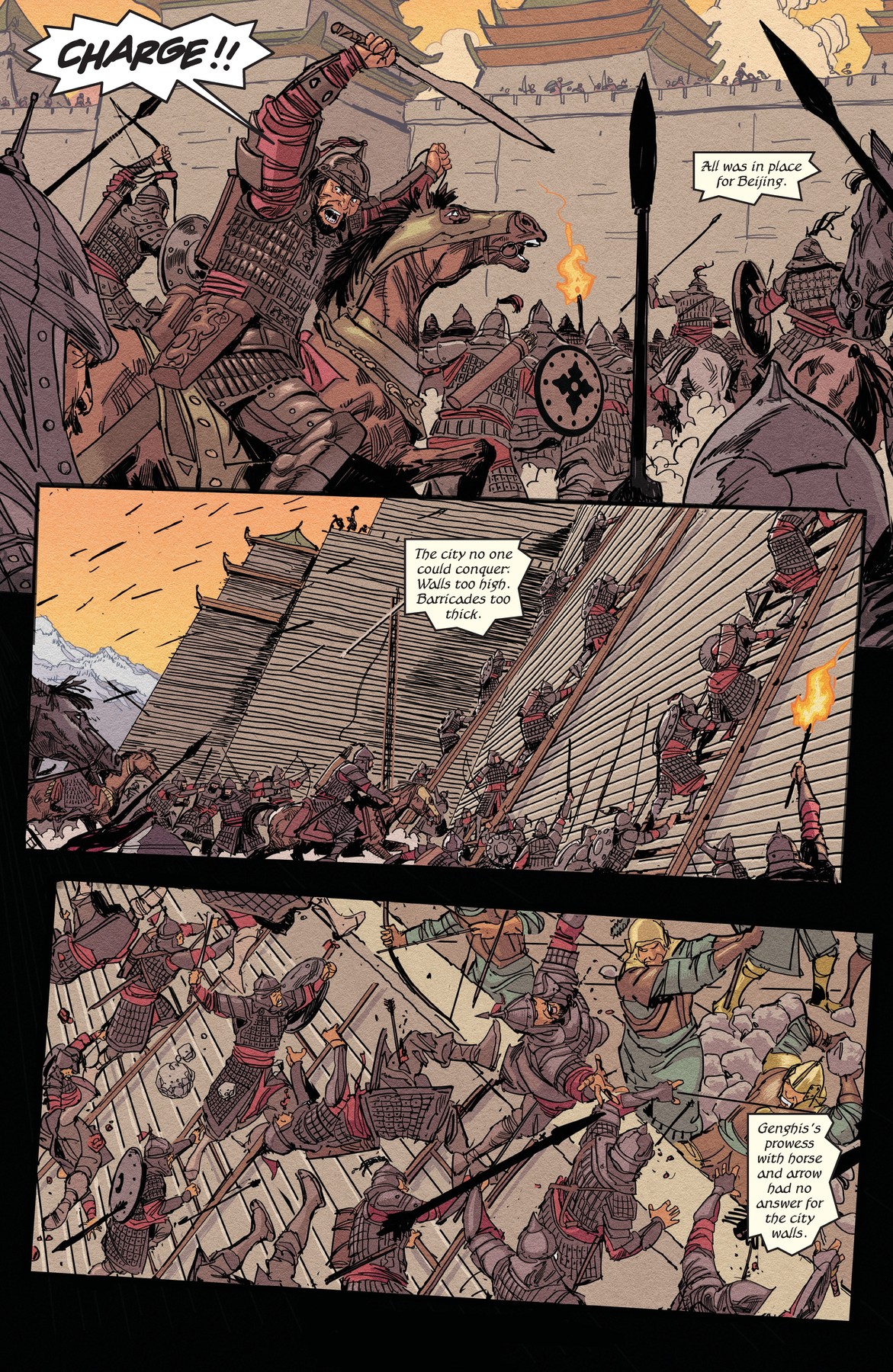
Spoilers: This article discusses the siege sequence in BRZRKR: The Lost Book of B #1.
Overview
The defenders and civilians of Beijing are the unnamed soldiers and inhabitants trapped inside the major fortified city attacked by Genghis Khan, the Mongol army, and B during BRZRKR: The Lost Book of B #1. The story introduces the city as a target that the Khan's normal advantages cannot easily overcome. Its walls are too high and barricades too strong for horse-and-arrow warfare to produce a straightforward victory.[1]
The siege becomes one of the story's most disturbing demonstrations of how B's presence fits into a larger system of human warfare. Mongol soldiers die in large numbers during repeated assaults. Their corpses are then loaded into siege engines and thrown over the walls so that disease, decomposition, and fear can attack the population even where arrows cannot reach.[2]
The source does not name an individual defending commander, city official, soldier, physician, merchant, or civilian. The proper wiki treatment is therefore a substantial collective profile linked to the Siege of Beijing event, not a set of invented biographies.
The fortified city
A problem for Mongol warfare
The comic's narration identifies Beijing as the city no one could conquer. Genghis Khan's skill with horse and arrow has no answer for its walls and thick barricades.[1]
This introduction gives the defenders a strategic identity before the reader sees individual faces. Their greatest weapon is the city itself. Fixed fortification neutralizes mobility and forces the Mongol army to fight under conditions where defenders can exploit height, cover, and prepared positions.
The encyclopedia should create a dedicated location article for Beijing in BRZRKR that records only what the comic depicts. A separate sidebar may compare that portrayal with real medieval Chinese history, but the fictional page should not be rewritten to fit an external chronology.
Defenders on the walls
The visual sequence shows massed troops fighting around fortifications. Defenders can inflict casualties on attackers approaching walls and barricades. The comic does not establish unit names, uniforms with textual labels, or individual commanders.
The defenders' anonymity is thematically useful. They are not rivals built up as villains. They are people trying to stop an invading army whose arsenal now includes an immortal combatant.
The Mongol assault
Weeks of losses
The siege continues long enough for Mongol losses to accumulate. The narration explicitly says weeks of heavy casualties are not without purpose.[2]
This phrasing shifts the perspective from individual death to strategic resource. The dead Mongol soldiers become part of a plan to break the city.
Bodies as weapons
The Mongols load corpses into large siege engines and launch them over the defenses. The story calls out disease and stench as the intended effect.[2]
For the people inside Beijing, this tactic collapses the distinction between battlefield and civilian space. A wall can keep cavalry out, but it cannot keep out contaminated bodies thrown over it.
The city's civilian population therefore becomes a direct target of the siege method even when individuals never carry weapons.
Public-health catastrophe
The comic does not provide a medical account of which diseases spread, how quickly symptoms appear, or how many people die from illness rather than direct combat. Those details must not be invented.
What can be stated is that the attackers deliberately attempt to use decay and disease to undermine the city from within. The site should classify the event under biological or disease warfare within BRZRKR, while avoiding claims that require modern epidemiological precision.
B's role
B gives the Mongol campaign a combat capability ordinary soldiers do not possess. He can suffer injuries that would kill a siege attacker and continue after regeneration. The story's wider battle montage depicts him participating in victories credited to Genghis Khan.[3]
For the defenders, this creates a nightmare opponent. A wall is valuable because attackers pay a severe cost to approach it. B can pay that cost repeatedly.
Defenders
Military role
The defenders hold fortifications and oppose the Mongol assault. They should be stored in the database as a collective military entity.
Equipment
The art shows period weapons and fortification warfare. Exact weapon nomenclature should be conservative unless visually certain.
Command
No named city commander is established in the directly available source. Real historical commanders should not be inserted into the comic continuity merely because they might fit the period.
Casualties
Exact numbers are unknown. The later campaign imagery and publisher description indicate B helps devastate enemies of the Mongol Empire, but the comic does not provide a numerical casualty ledger for Beijing.
Civilians
Presence inside the siege
A major fortified city necessarily contains people beyond its soldiers, and the story's disease tactic only makes narrative sense because people live behind the walls. The user has correctly requested city defenders and civilians as separate categories within one page.
Exposure to siege weapons
Civilians are exposed to projectiles, fire, disease, hunger, panic, and the consequences of breaches. Not every category is individually quantified in the comic, so the article should describe only what is depicted or directly implied by the siege method.
Noncombatant status
This preserves the ethical distinction between people defending the city with weapons and those merely living in the target zone.
Relationship with Genghis Khan
Genghis seeks to conquer the city as part of his expanding campaigns. The defenders are the obstacle to that ambition. Civilians are part of the population subjected to the resulting siege.
The comic's cult narrator presents Genghis as a conqueror whose appetite can be fed with victory. Beijing is therefore both a strategic target and part of the hidden cult's larger interpretation of how rulers can be guided.
Relationship with the Mongol army
The relationship is direct military opposition for defenders and attacker-victim relationship for civilians. Mongol casualties become instruments of further attack when corpses are launched into the city.
Relationship with B
B fights on the Mongol side during the broader campaign. The source does not show him conducting diplomacy with city leaders or distinguishing every individual target by military status.
The siege contributes to the moral crisis that eventually makes continued service under Genghis Khan untenable for B.
Relationship with Layo and the cult
The cult claims a hidden role in putting B under Genghis Khan's command. If that account is correct, the people of Beijing suffer consequences of a plan they cannot see.
The cult does not need to be physically inside the city to be causally connected in its own historical narrative.
Historical naming and canon discipline
The comic calls the target Beijing. Modern readers may know that medieval Chinese capitals and city names changed across dynasties. The wiki should not silently substitute a different name.
Instead:
This maintains fidelity to the source while still allowing serious historical analysis.
Narrative significance
The siege demonstrates several recurring BRZRKR themes.
First, it shows the difference between individual and institutional violence. B is one extraordinary killer, but conquest on the scale of a city requires armies, siege works, logistics, and policies that affect entire populations.
Second, it shows how human ingenuity can be as horrifying as B's supernatural body. The corpse tactic is created by ordinary people. B is not the source of every atrocity around him.
Third, the sequence places B inside historical systems whose consequences extend beyond the people he personally strikes. Even when he is not the person loading a siege engine, his service helps the conquest proceed.
Status and fate
The exact fate of every defender and civilian is unknown. The campaign is presented as part of Genghis Khan's sequence of victories, and the city suffers severe attack. The article should not claim that every inhabitant is killed unless the full source states so.
A city seen from behind its walls
The Beijing sequence is important because it gives B a battlefield in which he is not the central authority. Genghis Khan commands from outside the walls, the Mongol army supplies the pressure, and the defenders make decisions from inside a city built to resist invasion. B enters the campaign as an extraordinary weapon within the attacking force, but the defensive architecture changes how his power is perceived. A body that can cross a battlefield does not automatically make a wall irrelevant. The siege still requires time, supplies, engineering, and the willingness to spend human lives.
The civilians make that cost visible. The story does not give the city a full census or a list of named families, yet the presence of ordinary inhabitants prevents the battle from becoming a contest between two commanders. Beijing is a lived place. People depend on the walls, the defenders depend on the people behind them, and every breach threatens more than a military position. The absence of individual biographies is therefore not an absence of consequence; it is a reminder that the campaign is told from the viewpoint of an army that has already reduced a city to an objective.
B inside the Mongol war machine
B's participation complicates the ordinary image of a siege. He is not simply a soldier following a line of command. Genghis sees him as a weapon whose value lies in his ability to do what an army cannot: enter danger repeatedly, survive, and return. The defenders experience the result as a human-scale disaster. A man who should have been stopped by an arrow, a blade, or a fall keeps advancing, and every failed attempt to stop him becomes part of the attacker's legend.
The sequence echoes the ancient pattern established in Olos. A ruler finds B, places him inside a military system, and turns his survival into proof of the ruler's power. Beijing shows the pattern at imperial scale. The city is not destroyed because B has a personal grievance against its people; it is threatened because a commander has decided that B's body can help achieve a strategic end.
Memory after the siege
The defenders and civilians remain mostly unnamed, but their presence affects how Layo and B remember the campaign. The Mongol story is preserved as a triumph, while B carries the sensory memory of bodies, noise, and the repeated demand to continue. The difference between public victory and private memory is one of the series' recurring historical tensions. A city can become a line in an imperial history while remaining a wound in the mind of the immortal who helped destroy it.
Appearances
- BRZRKR: The Lost Book of B #1 - defenders and inhabitants of the fortified city besieged by Genghis Khan's forces and B.
- BRZRKR: Bloodlines Vol. 2 - collected edition containing the story.
- Later Bloodlines collections - edition appearances.
Canon limitations
No named city defender or civilian has been confirmed in the source subset reviewed for this build. The city population, exact casualty count, ruler, command structure, and disease are not stated.
Life behind the walls
The comic gives only fragments of civilian experience, but the structural reality of the scene is clear enough to document without invention. A fortified city contains people who cannot simply ride away when an imperial army surrounds it. Once disease-bearing corpses begin crossing the walls, distance from the battlements no longer guarantees safety. The entire urban space becomes part of the battlefield.
The wiki should resist the temptation to create emotional anecdotes for unnamed families that the source never shows. Instead, it can be comprehensive through systems: food supply, health risk, wall defense, fire, crowd movement, and exposure to siege projectiles can be indexed only where visually or textually supported. Completeness comes from disciplined evidence, not fictional supplementation.
Defenders as a collective character
Like Olos's soldiers, the Beijing defenders are most meaningful as an institution. Their success at holding the walls long enough to force new Mongol tactics demonstrates that they are militarily effective even though the final campaign turns against them. The line that horse and arrow have no answer for the fortifications is implicitly praise for the defensive system.
The event page should therefore avoid framing the city as passive. The Mongols suffer weeks of losses precisely because defenders and fortifications impose a cost.
Civilian harm and B's moral burden
The presence of noncombatants helps explain why B's eventual crisis of loyalty cannot be reduced to whether he enjoys fighting soldiers. Service under Genghis places his violence inside wars whose effects extend to people he may never personally confront. An immortal seeking ways to forget is participating in systems that create new memories worth suppressing.
This provides a strong internal link from the Beijing page to Perfect Memory, Opium Suppression of B, Psychological Effects of Immortality, and B's Relationship with Violence.
Historical-analysis policy
A future accuracy article may compare the siege with real Mongol attacks on northern Chinese capitals and discuss the historical use of disease, siege engines, and naming conventions. That material should be separately sourced and visually distinguished from canon. The biography/faction page must always answer a simpler question first: what does the BRZRKR comic say happened?
This layered approach lets the site become historically sophisticated without allowing outside scholarship to overwrite the fictional primary source.
Recommended sub-entities
The mature database should separate Beijing Defenders, Beijing Civilians, Beijing Fortifications, and Siege of Beijing even if only the first two share this public-facing profile at launch. That lets appearances and casualties attach to the correct layer. A defender seen on a wall can be related to the military entity without turning every inhabitant into a combatant, while disease effects can attach to the civilian population and city event.
The location page should also track uncertainty around naming and historical correspondence. The story name remains Beijing. A field such as HISTORICAL_CORRESPONDENCE_STATUS = ANALYTICAL_ONLY can prevent a later researcher from replacing the canonical label in search results or internal links.
Aftermath as an open field
The issue's campaign structure establishes conquest and devastation but does not give a civic epilogue from inside the city. The fate of survivors, rebuilding, political administration after capture, and long-term demographic effects remain unknown.
References
[1] Keanu Reeves and Matt Kindt, BRZRKR: The Lost Book of B #1 (BOOM! Studios, 2024), narration identifying Beijing and explaining that its walls and barricades defeat the normal advantages of horse and arrow, digital page image 0019.
[2] Reeves and Kindt, The Lost Book of B #1, weeks of Mongol losses and use of corpses in siege engines to weaponize disease and stench, digital page image 0022.
[3] Reeves and Kindt, The Lost Book of B #1, later campaign montage depicting B within Genghis Khan's victories, digital page images 0026-0027.
Collected edition
BRZRKR: Bloodlines Vol. 2 (BOOM! Studios) collects The Lost Book of B #1 and provides the official collected context for B's service to Genghis Khan.