Selected scenes
BRZRKR in pictures.
Spoilers: This article discusses the complete events of BRZRKR: Poetry of Madness #1.
Overview
The guards, courtiers, attendants, and cult converts of Atlantis form the human institutional background of BRZRKR: Poetry of Madness #1. Most are unnamed, but collectively they show how the kingdom functions around King Azaes and B, how the population's dependence on the immortal protector shapes Atlantean culture, and how Vizane's religious movement penetrates the royal court before the fall of the city.[1]
These figures should not be flattened into a single faction. The comic depicts several overlapping social groups: gold-clad royal guards and attendants loyal to the crown; courtiers and citizens who celebrate B's victories and participate in palace life; and black-and-red followers of Vizane who become a distinct cult organization. Some individuals may move between these categories, especially as Azaes adopts Vizane's religion, but the source does not identify each conversion or establish that every court member belongs to the cult.[2]
For wiki architecture, the best treatment is a substantial collective article supported by structured minor-character records. Individual unnamed guards, attendants, ritual participants, and courtiers can receive appearance IDs for relationship tracking without creating dozens of thin biography pages.
Social structure around the Atlantean crown
The story presents Atlantis as an extremely wealthy, culturally renowned, and heavily defended city. Its political life centers on the monarchy of King Azaes, while B functions as the decisive military protector who makes the kingdom almost untouchable by conventional invasion.[1]
Royal personnel appear in formal spaces, at the city gates, during celebrations, around Azaes, and at the northeastern tower. Their costumes help distinguish roles visually. Gold armor and clothing are associated with the crown's guard and attendants. Vizane's faction uses black and red ceremonial clothing with repeated spiral and eye-like motifs.[2]
The distinction is narratively important. Atlantis does not fall because the entire state openly chooses Cthulhu. The disaster grows from the infiltration or conversion of part of the court under a king whose authority legitimizes Vizane's movement.
The King's Guard
Zubatai identifies herself as squire to the king's personal guard and tells the foreign warriors at the gates that refusal to surrender will bring the king's guard against them.[3]
The invaders initially assume she means the visible human soldiers. Zubatai points instead to B. This reveals a layered meaning. Atlantis has ordinary guards, but its ultimate defensive asset is the immortal attached to the crown.
Gold-clad soldiers appear throughout the story carrying spears, swords, shields, and other weapons. They maintain palace security, accompany the king, restrain Zubatai during the cult confrontation, and later fight or attempt to survive during Cthulhu's attack.[4]
The comic does not name a captain, commander, rank structure, unit size, or recruitment system. It also does not clarify whether the human King's Guard is a permanent professional army, aristocratic household force, or mixed civic military.
The wiki should therefore avoid invented ranks such as "Captain of the Guard" unless a later primary source provides them.
B as the true strategic defense
Although Atlantis possesses guards and fortifications, B makes ordinary military comparison almost meaningless. Invading forces arrive in enormous numbers, but B destroys them while the city watches.[5]
The human guard's role is therefore partly ceremonial and administrative. They can control gates, escort people, restrain ordinary humans, and support the monarchy, but they do not match B's battlefield capacity.
This dependency has political consequences. Azaes's kingdom grows accustomed to the idea that no outside enemy can seriously threaten it because B is present. That confidence becomes dangerous when the threat comes from inside the court.
Courtiers and palace life
The adult Azaes presides over a socially active court. Courtiers gather around him, attend celebrations, drink, socialize, and participate in the new practices that emerge under Vizane's influence.[6]
Zubatai jokes with B about attending an orgy, and B refuses. The exchange suggests that sexual revelry has become normalized in at least part of elite court culture during the period when Zubatai believes Azaes is changing.[7]
The comic does not identify which courtiers are traditional members of Azaes's household and which are Vizane's converts. Nor does it establish that the social festivities themselves are inherently supernatural. The important point is the broader cultural shift around the king.
Public celebration of B
Outside the palace, Atlanteans gather in large numbers after B's victories. Horns announce the end of battle, and the population cheers the visibly wounded immortal as he begins to regenerate.[8]
Zubatai explains that the people hunger for the blood-soaked spectacle he provides and that his adventures are a major source of public fascination. She also insists that the affection is reciprocal. B engages with the crowds on victory days and appears to love Atlantis in return.[8]
This popular devotion exists alongside formal religion. Zubatai says B stands next to Poseidon in the city's pantheon hierarchy, although B himself does not present as a conventional god.[9]
The guard and court therefore operate in a civilization where military heroism, monarchy, civic spectacle, and religion overlap around the same immortal figure.
Vizane's arrival in the court
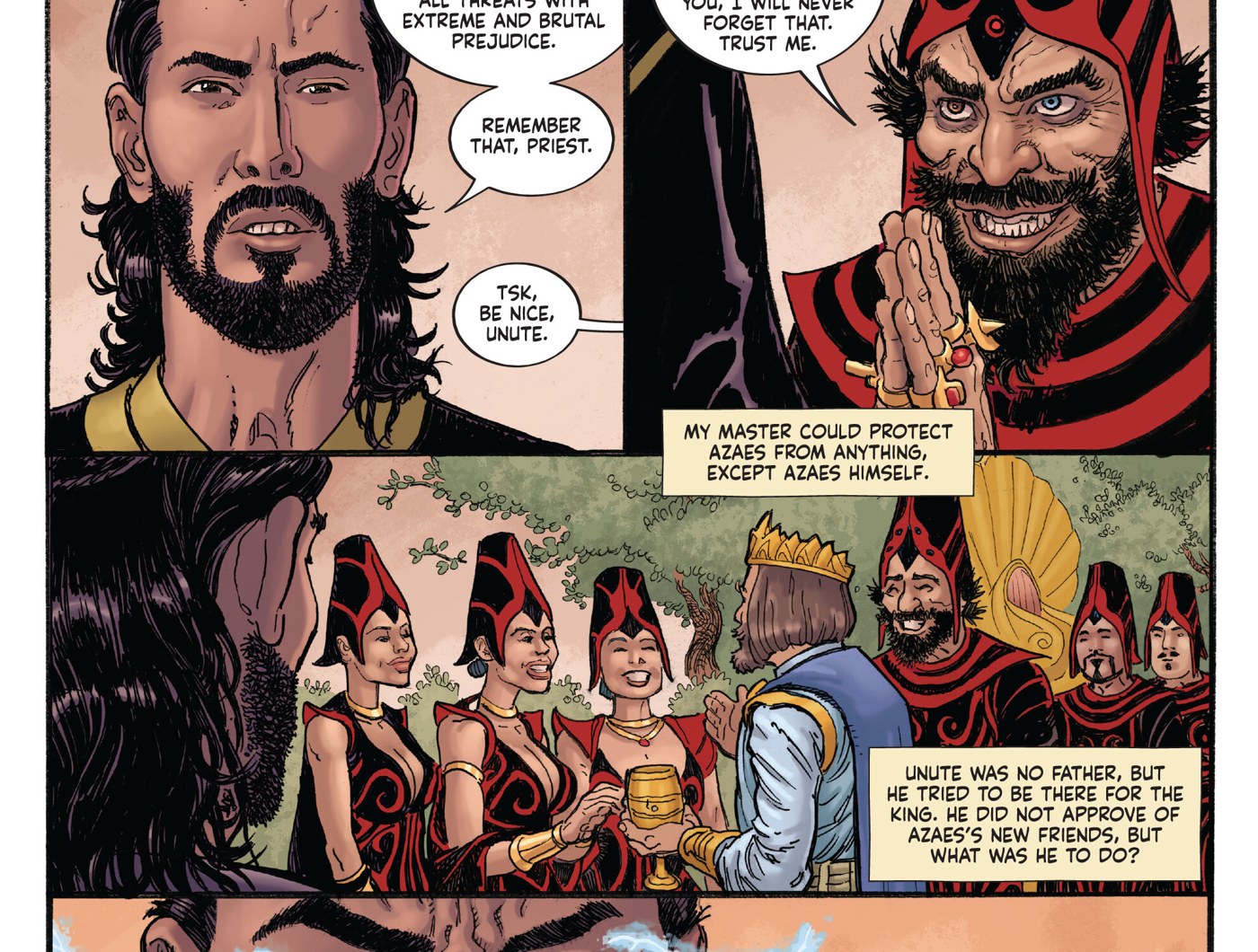
Vizane is introduced directly to B by Azaes. Several black-and-red-clad attendants or followers appear around the priest and king, showing that the movement already has an organized visual presence inside royal space.[2]
B is immediately hostile to Vizane and tells him that his duty to the crown includes eliminating threats. The warning suggests B sees the priest as a danger before the rest of the court does.[2]
Zubatai later records that Azaes's new religion extends beyond the normal authority of the King's Guard. This observation matters because it signals an institutional shift. A separate source of loyalty is now operating inside the monarchy.
Cult converts within royal authority
By the time B confronts Vizane at the northeastern tower, Azaes is surrounded by Vizane's red-and-black followers and gold-clad royal personnel.[10]
The scene makes exact faction boundaries difficult to determine. Some guards obey Azaes while the king supports Vizane. Others may be cult converts. The comic does not name individuals or provide private beliefs.
For database purposes, unnamed figures should be tagged by visual affiliation at the moment depicted, not by assumed permanent ideology. A gold-clad guard can be recorded as ATLANTEAN_GUARD, while a red-and-black ritual participant can be recorded as VIZANE_FOLLOWER. If an individual is visually continuous across scenes, the record can note possible overlap with a confidence flag.
Restraint of B and Zubatai
When B rejects the cult's plan, supernatural thorned growths trap him. Royal guards also seize or restrain Zubatai.[11]
This is the clearest point at which the monarchy's ordinary personnel become functionally complicit in the ritual. Even if not every guard understands Vizane's true objective, they enforce Azaes's order against the two people most actively opposing the cult.
The scene should connect to a dedicated event article, Restraint and Bloodletting of B, which can list both magical and human participants.
Ritual cultists
Vizane's committed followers wear black and red ceremonial robes and gather around the obelisk. They collect B's blood in cups and drink it because Vizane claims the immortal blood will mark them as faithful and protect them from their god's wrath.[12]
Their participation is active. They are not merely spectators. They assist in preparing the ritual, accept Vizane's prophecy, and remain at the site when the gateway opens.
No individual cultist is named in the issue. Their motives beyond faith in Vizane's promises are not explored. Some may seek immortality, some may seek religious revelation, and some may simply obey the king. Only the collective belief system is explicit.
The gateway and collapse of faction boundaries
Once Cthulhu emerges, the distinctions between guard, courtier, cultist, and civilian cease to offer protection. The entity attacks indiscriminately.[13]
Gold-clad royal personnel fight or flee. Vizane's followers are struck by debris, tentacles, alien material, and B's violence. The cult's claim that B's blood will cause divine wrath to pass over the faithful proves false in practice.[12][13]
Azaes is mortally wounded. Vizane is killed by B. The city itself is consumed after Cthulhu's death.
The institutional story therefore ends with total collapse. The monarchy cannot command the entity. The guard cannot defeat it. The cult cannot control it. The court cannot survive it.
Known and recurring unnamed roles
The site can maintain structured minor records for visually important but unnamed figures, including:
- gold-clad King's Guard soldiers at the northeastern tower;
- palace attendants standing with Azaes;
- guard personnel who restrain Zubatai;
- horn blowers who signal B's victory;
- citizens and court spectators celebrating B;
- black-and-red ritual attendants beside Vizane;
- cup bearers collecting B's blood;
- cultists stationed around the obelisk;
- survivors visible during the early stages of Cthulhu's attack.
These identifiers are descriptive database labels, not canonical names.
Military equipment
Atlantean guards use swords, spears, shields, armor, and ceremonial or battlefield clothing in gold tones. The city also possesses large defensive architecture and appears capable of supporting organized armies.[3][5]
No weapon receives a personal name in the guard sequences. Generic equipment should remain structured weapon records unless it becomes plot-significant.
B's primordial-ore sword is an exception because it becomes a key in Vizane's ritual and deserves an independent artifact page.
Religious identity and cult affiliation
The comic distinguishes traditional Atlantean religious imagery from Vizane's movement. Poseidon appears in imagery and hierarchy associated with the city, while Vizane introduces an occult tradition centered on Aklo, prophecy, B's blood, the obelisk, and Cthulhu.[9][12]
It would therefore be inaccurate to call all Atlantean religion "the cult." The cult is a specific movement operating within a broader civilization that already possesses its own religious framework.
The website should create separate pages for Atlantean Religion, Vizane's Religious Movement, and Cthulhu Worship in Atlantis if enough source material is available.
Relationship with King Azaes
The guard and court derive authority from Azaes. His conversion or alignment with Vizane changes how those institutions behave. Once he orders B to listen and obey, ordinary royal authority becomes a shield for the cult.[10]
This makes Azaes's role more consequential than that of a private convert. The cult does not need to conquer the palace from outside. It gains access through the king.
Relationship with B / Unute
B is simultaneously military protector, public hero, semi-divine cultural figure, and individual attached to the court. Some Atlanteans cheer him. Guards depend on him. Courtiers socialize around him. Cultists later drain his blood.[8][12]
The shift from celebration to exploitation is one of the most important social arcs in the story.
Relationship with Zubatai
Zubatai belongs to the crown's institutional structure while also serving B directly. Her position lets her recognize the split between traditional royal duty and Vizane's movement. She is eventually restrained by guards acting under the cult-aligned king, illustrating the breakdown of her own institution.[11]
Casualties and fate
The final casualty count is unknown. The story depicts mass death during Cthulhu's attack and then the physical dissolution of Atlantis under the creature's dying remains.[13][14]
Most unnamed guards, courtiers, and cultists should therefore be listed as presumed dead unless a panel clearly shows survival beyond the catastrophe. Zubatai is a confirmed survivor. B is a confirmed survivor. No other named Atlantean is clearly established as surviving in the supplied issue.
The database should not mark every background figure individually dead unless the source shows the death. Use group-level event participation and a population-level presumption rather than false precision.
Historical significance
These unnamed figures reveal why Atlantis matters beyond its named cast. They show a functioning society dependent on B, a monarchy capable of public ritual and military organization, and a court vulnerable to ideological capture.
They also provide the human scale of the fall. Atlantis is not only Azaes, Vizane, Zubatai, and B. It is thousands of people whose ordinary roles vanish when the city is destroyed.
Appearance and visual taxonomy
Royal guard
Gold armor, helmets, shields, spears, swords, and royal insignia dominate guard design.
Court personnel
Courtiers wear varied civilian and ceremonial clothing reflecting the wealth and cultural diversity of Atlantis.
Vizane's cultists
Black-and-red robes, tall pointed headdresses, spiral motifs, and repeated circular symbols create a strong faction identity.
A visual guide page should allow readers to distinguish these groups without implying that clothing alone establishes individual belief across every scene.
Appearances
- BRZRKR: Poetry of Madness #1 - throughout the Atlantis sequence, from the opening invasion through the fall of the city.
- BRZRKR: Poetry of Madness Pen & Ink #1 - alternate presentation of the same story.
Canon limitations
The comic does not provide a complete roster, guard ranks, court offices, cult membership list, army size, casualty total, or map of palace institutions. It also does not establish that every gold-clad guard rejects Vizane or that every red-and-black figure began as a courtier.
These uncertainties should be represented in the database using affiliation confidence rather than resolved through guesswork.
References
[1] Keanu Reeves and Steve Skroce, BRZRKR: Poetry of Madness #1 (BOOM! Studios, 2023), opening description of Atlantis, foreign invasion, monarchy, and defensive structure, digital page images 002-006.
[2] Reeves and Skroce, BRZRKR: Poetry of Madness #1, Vizane's introduction at court with black-and-red followers among royal personnel, digital page image 016.
[3] Reeves and Skroce, BRZRKR: Poetry of Madness #1, Zubatai's identification as squire to the king's personal guard and her ultimatum to invaders, digital page image 004.
[4] Reeves and Skroce, BRZRKR: Poetry of Madness #1, guards and court personnel during the northeastern tower confrontation and later destruction, digital page images 019-036.
[5] Reeves and Skroce, BRZRKR: Poetry of Madness #1, B's destruction of the invading army and the role of Atlantis's visible defenders, digital page images 003-012.
[6] Reeves and Skroce, BRZRKR: Poetry of Madness #1, palace life and Azaes's court, digital page images 014-017.
[7] Reeves and Skroce, BRZRKR: Poetry of Madness #1, Zubatai inviting B to a court orgy while reporting the reliquary theft, digital page image 017.
[8] Reeves and Skroce, BRZRKR: Poetry of Madness #1, public celebration of B after battle, digital page images 012-013.
[9] Reeves and Skroce, BRZRKR: Poetry of Madness #1, Zubatai's statement placing B beside Poseidon in Atlantean religious hierarchy, digital page image 012.
[10] Reeves and Skroce, BRZRKR: Poetry of Madness #1, Azaes, Vizane, gold-clad guards, and cultists at the northeastern tower, digital page images 018-019.
[11] Reeves and Skroce, BRZRKR: Poetry of Madness #1, restraint of B and physical restraint of Zubatai during the cult confrontation, digital page images 020-023.
[12] Reeves and Skroce, BRZRKR: Poetry of Madness #1, cultists drinking B's blood and preparing the sword-obelisk gateway ritual, digital page images 021-023.
[13] Reeves and Skroce, BRZRKR: Poetry of Madness #1, Cthulhu's attack and mass casualties among cultists, guards, and the city, digital page images 024-042.
[14] Reeves and Skroce, BRZRKR: Poetry of Madness #1, final dissolution of Atlantis beneath Cthulhu's dying remains, digital page images 043-045.