Selected scenes
BRZRKR in pictures.
Spoilers: This article discusses the complete events of BRZRKR: Fallen Empire #1.
Overview
Asana's people and handmaidens are two related but not identical groups connected to Queen Asana in BRZRKR: Fallen Empire #1. Asana's birth people are an unnamed society from the far side of the great desert whose elders fought Olos before arranging a treaty that sent Asana to King Arnak as a political offering. They preserve history through tattooing, select soldiers in childhood, and remain the community Asana invokes when she explains why she manipulates B against Washukanni.[1][2]
The handmaidens of Olos are members of Asana's royal household after she becomes queen. At least one helps her secretly visit B by distracting dungeon guards. After Asana escapes, King Arnak pressures the handmaidens and prison staff and discovers that the queen left willingly.[3][4]
Later pages show a group assisting Asana in the staged abduction that deceives B. Their connection to her birth people is strongly supported by the use of newly applied black-hand markings associated with her culture, but the comic does not explicitly identify every participant as a palace handmaiden. A definitive wiki should therefore preserve the distinction. The safest architecture is one substantial umbrella page with two sub-entities: Asana's Desert People and Olos Handmaidens, plus a separate event entity for the Staged Abduction of Asana.[5]
Asana's birth people
Homeland beyond the great desert
Asana tells B that she was born far from Olos, on the other end of the great desert. The story does not provide a canonical ethnonym, city name, kingdom name, or precise map location for her people. They should therefore remain Asana's people or Asana's desert people until another primary source supplies a formal name.[6]
The lack of a name does not make the culture undefined. Asana provides several of the most specific cultural details in Fallen Empire. Her people use the body as an archive. Women carry history in tattoos on their backs. Soldiers are chosen at approximately ten years old and marked by blackened hands. These details become crucial to the plot because B later recognizes that the ink on supposed attackers was fresh.[1][5]
History-keeping through tattoos
Asana's back tattoo is unfinished. She explains that the markings tell a story and hopes that one day her own body will preserve an ending in which she was both prisoner and queen, won freedom, and lived happily. The practice connects private identity with collective history. A person's body can become a record that political destruction cannot easily erase.[1]
This tradition should link directly to the site's planned Historical Recordkeeping in BRZRKR and Asana's Tattoos lore pages. It also provides a deliberate parallel with the Acastan monks, who preserve history in external records and stone. Asana carries one kind of archive on her body, then later seeks another kind of archive from the monks.
Child selection and black-hand soldiers
Asana says soldiers are chosen at the age of ten and their hands are tattooed black in childhood. The source does not explain the selection process, training period, whether service is compulsory, whether women can be selected as soldiers, or what rank the marking indicates.[1]
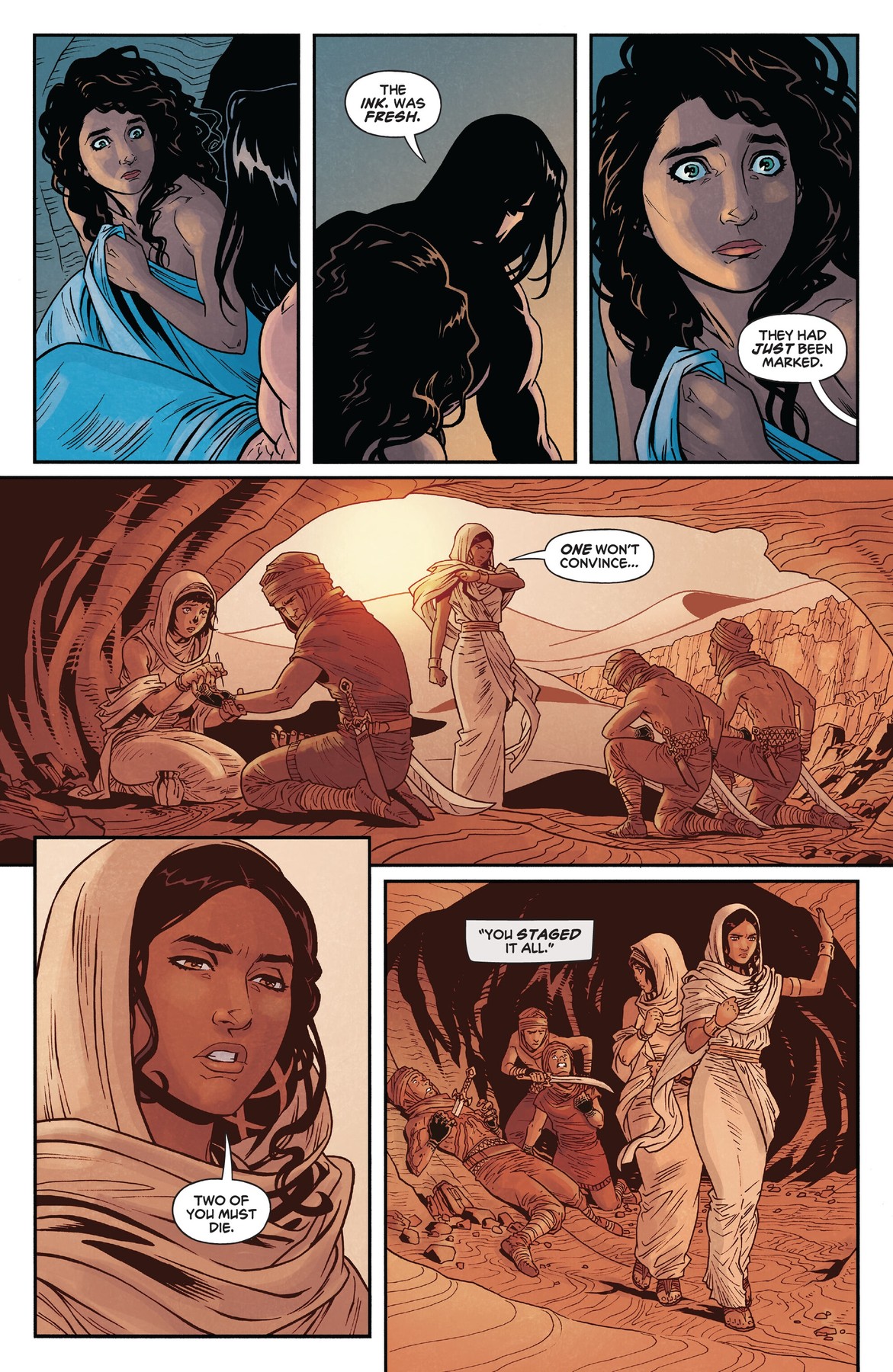
The tattoo is nevertheless one of the story's most important physical identifiers. B remembers black hands in the apparent attack scene. His perfect memory later allows him to recognize that the ink was too fresh to belong to people marked since childhood.[5]
The detail turns cultural knowledge into forensic evidence. Asana initially relies on B knowing enough about her people to identify the marks. She underestimates the precision with which he remembers them.
The council of tribes
Asana's grandparents belong to a council of tribes. Before her birth, Olos expands outward and collides with the desert peoples. Thousands die in a long conflict described as a war of sand and blood. The elders eventually seek to end the fighting by making an offering to Olos. Asana is that offering, married to Arnak as part of a treaty.[2]
The council is not fully defined. The comic does not say how many tribes belonged to it, whether Asana's grandparents were leaders of the whole council or representatives of one tribe, or whether the council continued to operate after the treaty.
What is clear is that Asana grows up understanding her life as a political instrument. She tells B that her purpose was to bring peace to the desert. Her later decision to use B repeats the logic imposed on her by the elders.[2]
The Olos handmaidens
Service in the royal household
As queen, Asana has handmaidens inside Olos. Their exact number, ranks, names, and origins are not stated. They operate close enough to the queen to become involved in activities Arnak does not know about.
At least one handmaiden distracts dungeon guards so that Asana can secretly visit B. This makes the household part of the resistance to the king's confinement of the immortal.[3]
The scene establishes trust. Asana cannot conduct the visits entirely alone. Someone in her service is willing to risk punishment by helping her bypass the prison system.
The escape from Olos
Asana eventually asks B to take her away. When the pair disappear, Arnak initially assumes the immortal abducted the queen. The king then pressures Asana's handmaidens and the dungeon guards. Their testimony or the evidence extracted from them reveals that Asana chose to leave.[4]
The source does not show precisely what Arnak does to the handmaidens when he "presses" them. The wording should not be inflated into a specific torture method unless future material makes it explicit.
Handmaiden as disguise
After Olos is destroyed, Asana survives and later disguises herself as a handmaiden. She presents herself to the Acastan monks as the kingdom's lone surviving handmaiden rather than its queen. B eventually identifies the deception.[7]
This choice shows how socially invisible the handmaiden role can become. Queens attract historical attention. Servants can disappear. Asana tries to survive by stepping into the identity of someone whose presence beside power would ordinarily be overlooked.
For wiki architecture, the "Surviving Handmaiden of Olos" must redirect to Queen Asana, not remain a separate character page.
The staged abduction conspiracy
Fabricating evidence
Asana later decides to use B against Washukanni. The plan depends on creating a scene that will survive scrutiny by someone with perfect memory. Participants prepare black-hand markings, blood, bodies, and physical evidence suggesting a violent attack.[5]
When B eventually reconstructs the memory, the flaw becomes obvious. The ink is fresh. The hands were only just marked.
Sacrificial deaths
The flashback shows members of the conspiracy deciding that a single death will not make the scene convincing. One woman states that two must die. The group is willing to sacrifice its own participants as evidence.[5]
This is one of the darkest details associated with Asana's people. They are not merely applying false tattoos. The plan treats human lives as props in a political deception.
It also mirrors Asana's childhood history. The tribal council once offered Asana herself to secure peace. Later, a group aligned with her sacrifices other people to create the conditions for another attempt at peace. The mechanism changes, but the principle of using individuals for a collective objective remains.
Were the conspirators handmaidens?
The issue does not provide a clean label. The people shown in the staged-abduction flashback have desert clothing and newly marked hands associated with Asana's culture. Some are women. Because the comic earlier establishes loyal handmaidens, it is tempting to collapse the groups.
The encyclopedia should not do so without evidence. The preferred model is:
Relationship with Asana
Asana is both product and leader of these networks. Her birth people shape her understanding of duty, peace, sacrifice, and historical memory. Her handmaidens provide practical personal loyalty inside Olos. The conspirators later help execute her most consequential plan.
The relationships are not simply supportive. Asana's people first use her. She later persuades or directs members of the same cultural world to participate in another sacrifice. That circularity is central to Fallen Empire.
Relationship with King Arnak
The desert council gives Asana to Arnak through treaty, making the king the political beneficiary of their decision. The handmaidens later work within his palace but at least some help Asana evade his authority.
After the escape, Arnak's interrogation of the household reveals the queen's voluntary role.
Relationship with B
The groups influence B indirectly. A handmaiden helps Asana reach him in prison, facilitating the relationship that leads to his escape. Later, staged evidence created by Asana's allies manipulates B into destroying Washukanni.
B's perfect memory ultimately exposes the deception because he remembers the cultural meaning and condition of the tattoos.
Relationship with Washukanni
Asana claims the Washukanni are responsible for her disappearance, but the evidence is staged. Her allies manufacture the appearance of an attack in order to direct B at the rival kingdom. The resulting massacre destroys Washukanni.
The article should never state that Asana's people and Washukanni are the same population. The comic treats them as distinct political groups.
Culture and identity
The most reliable cultural facts are tattoo-based recordkeeping, the black-hand soldier marking, the tribal council, desert geography, and the historical conflict with Olos. Clothing, architecture, weapons, and other visual details can be catalogued from panels but should not be assigned symbolic meanings without textual support.
Status and fate
No named handmaiden or member of Asana's birth people receives a confirmed independent fate. Olos is destroyed. Washukanni is destroyed. In the ending B tells Asana that the desert is empty of soldiers, nomads, kings, and queens.[8]
That statement suggests catastrophic loss across the region, but the database should distinguish it from a census. The broader status of every person born among Asana's tribes remains unknown unless later canon establishes survivors.
The inheritance of sacrifice
The history of Asana's people is built around a painful contradiction. Their elders seek peace, but the peace is purchased with Asana's life. The same culture that teaches her to carry history on her skin also teaches her that a single person can be offered to protect thousands. Asana later repeats that logic when she permits members of her circle to die in a staged abduction. The story does not say that her people are uniquely cruel; it shows how a reasonable desire to end a war can create a custom in which individual consent is always negotiable.
That inheritance helps explain Asana's relationship with B. She recognizes that he is being used by Arnak, yet she initially imagines that she can use him for a better purpose. Her private visits begin with sympathy and develop into a plan. The handmaidens who help her are loyal to a queen and to a woman who has been treated as a political object. Their loyalty is real, but it does not protect them from becoming part of another person's calculation.
Marks that become evidence
The black hands of Asana's soldiers are one of the clearest examples of culture becoming plot evidence. A mark that once signified childhood selection and a lifetime of service is copied in minutes to make a false crime scene. B notices the difference because he understands that a cultural identity cannot be manufactured by appearance alone. The ink's freshness exposes the lie, even though the revelation comes after Washukanni has already suffered.
The moment also gives the tattoo tradition a tragic double meaning. Marks preserve a people's past, but they can be imitated by someone who wants to weaponize that past. Asana's history is used first to identify her people and then to frame them. The deception damages not only B and Washukanni; it turns a sign of belonging into a tool of accusation.
What survives the desert
The comic ends without naming a surviving council, handmaiden, or soldier from Asana's birth culture. B's statement that the desert is empty is a judgment formed after catastrophic violence, not a census of every settlement. The most honest reading is that the region's political world has been shattered. Whether small communities, refugees, or descendants remain outside the story is unresolved.
That unresolved space keeps Asana's people from becoming a single tragic backdrop. They have a political history, a way of recording memory, a system of marks, and relationships that continue to influence the present even after their cities and armies disappear. Their culture survives in Asana's body and in the choices she makes, but the comic refuses to claim that one survivor can stand for everyone who came before her.
Appearances
- BRZRKR: Fallen Empire #1 - cultural history, handmaiden assistance, treaty background, staged-abduction conspiracy, and Asana's later handmaiden disguise.
- BRZRKR: Fallen Empire Pen & Ink #1 - alternate presentation of the same story.
- BRZRKR Bloodlines collections - collected appearance.
Political and cultural significance
Asana's birth culture gives Fallen Empire a second model of power alongside monarchy. Olos concentrates authority in a king, court, soldiers, prisons, and walls. Asana's people are described through tribes, elders, council deliberation, embodied memory, and negotiated sacrifice. The source does not portray either structure as morally pure. The council's desire to end war is understandable, but its solution is to use Asana's life as diplomatic currency.
This context explains why Asana's later choices cannot be reduced to simple ambition. She has been raised inside a political culture where individual sacrifice for collective survival is thinkable and perhaps expected. When her staged abduction requires participants to die so the evidence will convince B, the method is horrifying but not disconnected from her own history. The same logic that once made her an offering now makes others expendable.
History carried on bodies
The tattoo tradition deserves structured visual documentation because it operates as more than costume design. A woman's back can carry history, and a soldier's black hands communicate a life role established in childhood. The wiki should store these as CULTURAL_PRACTICE entities linked to Asana's people, not as magical marks. Nothing in the story establishes supernatural properties for the tattoos.
The marks also create one of the strongest continuity links between culture and plot. B's perfect memory is powerful because he does not merely recall faces. He recalls the condition of ink. The fresh tattoo becomes proof that a supposedly inherited identity was manufactured for the attack scene.
The problem of collective responsibility
The page should not state that every member of Asana's people supported her plan. The comic depicts a conspiracy involving some participants, while the wider population is never polled or shown consenting. Likewise, the tribal council that gave Asana to Arnak belongs to an earlier generation. A rigorous article separates the actions of elders, handmaidens, conspirators, soldiers, and the broader unnamed population.
That separation will matter if later BRZRKR stories revisit the region. New characters can be added to the correct sub-entity without rewriting the entire culture as a single moral actor.
References
[1] Mattson Tomlin and Rebekah Isaacs, BRZRKR: Fallen Empire #1 (BOOM! Studios, 2023), Asana's explanation of tattooed histories and black-hand soldiers selected in childhood, digital page images 0025-0028.
[2] Tomlin and Isaacs, Fallen Empire #1, history of the war of sand and blood, Asana's grandparents on the tribal council, and her use as a treaty offering, digital page images 0028-0029.
[3] Tomlin and Isaacs, Fallen Empire #1, narration describing the queen's secret visits and a handmaiden distracting prison guards, digital page images 0018-0019.
[4] Tomlin and Isaacs, Fallen Empire #1, Arnak's questioning of handmaidens and dungeon guards and discovery that Asana left willingly, digital page image 0021.
[5] Tomlin and Isaacs, Fallen Empire #1, fresh black-hand ink, staged abduction, and conspirators' decision that two participants must die to make the evidence convincing, digital page images 0040-0041.
[6] Tomlin and Isaacs, Fallen Empire #1, Asana's statement that she was born on the other side of the great desert, digital page image 0022.
[7] Tomlin and Isaacs, Fallen Empire #1, revelation that the elderly surviving handmaiden is Asana in disguise, digital page image 0047.
[8] Tomlin and Isaacs, Fallen Empire #1, B's final statement describing the desert as emptied of soldiers, nomads, kings, and queens, digital page image 0049.