Selected scenes
BRZRKR in pictures.
Spoilers: This article discusses the ending and framing narrative of BRZRKR: Fallen Empire #1.
Overview
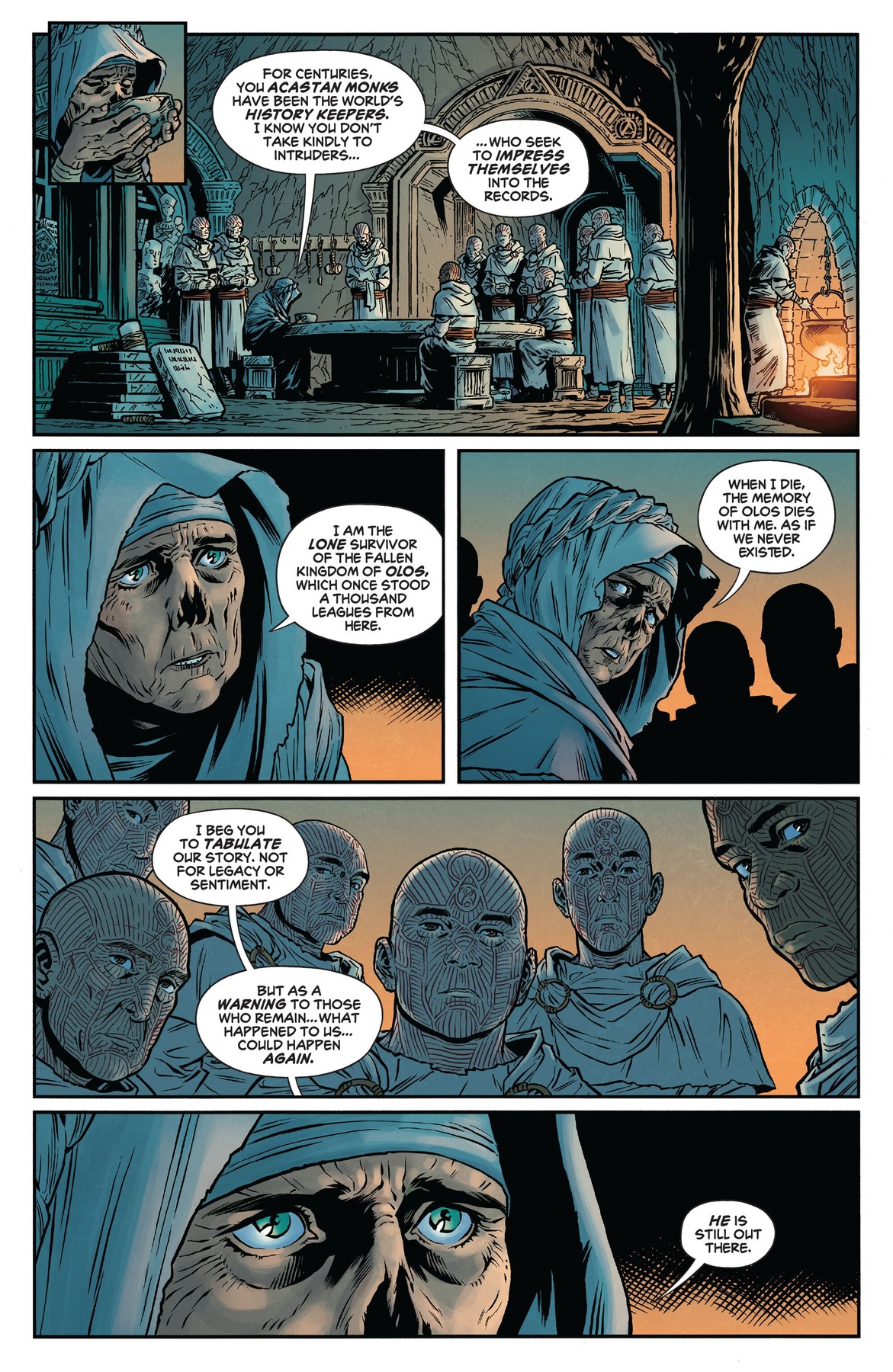
The Acastan monks are a centuries-old order of history keepers who appear in the framing narrative of BRZRKR: Fallen Empire #1. An elderly Queen Asana, disguised as a surviving handmaiden of Olos, travels to their archive after decades of hiding and asks them to preserve the history of the destroyed kingdom. She describes the Acastans as the world's history keepers and expects them to engrave or otherwise enter the account into durable records.[1]
Their appearance is brief but unusually important to the larger BRZRKR knowledge system. The monks represent an institution built around historical continuity rather than conquest. They listen to a survivor, prepare to record a civilization that has vanished, and become the mechanism through which the narrative of Fallen Empire could pass into later history. B interrupts that process. He arrives after Asana's story has been told, kills the monks present, confronts Asana, and prevents the record from becoming the redemptive legacy she hopes to create.[2][3]
The Acastan episode also establishes a central rule for the wiki's own handling of ancient BRZRKR history: sources inside the story are not automatically neutral. Asana brings the monks a first-person account shaped by guilt, concealment, and self-interpretation. The monks can preserve testimony, but preservation does not convert testimony into omniscient fact. The page should therefore distinguish directly depicted events from Asana's narration and later correction by B.
Spelling verification
The canonical spelling is Acastan.
In the user-supplied digital edition, Asana directly addresses the group: "For centuries, you ACASTAN monks have been the world's history keepers."[1] The spelling appears in the primary comic and should control the canonical slug.
Recommended implementation:
History
Centuries of historical preservation
Asana says the Acastan monks have served as the world's history keepers for centuries. Her choice of destination implies their reputation extends far beyond a local community. She believes they have the institutional authority and technical means to make a destroyed kingdom part of the historical record.[1]
The issue does not explain who founded the order, what religion it follows, how its archives are organized, whether there are multiple monasteries, or what languages the monks use. A comprehensive page must leave these areas open.
Their visible environment contains carved or inscribed material, stone tablets, work surfaces, hanging objects, shelves, and a permanent architectural space suited to preservation. These visual details can support image design and location documentation, but the article should avoid turning them into a fully invented archival technology.
Arrival of the supposed survivor
An elderly woman reaches the Acastan site after a long journey. She claims to be the longest survivor of the fallen kingdom of Olos, which once stood a thousand leagues away. She tells the monks that when she dies, the memory of Olos will die with her as if the kingdom never existed.[1]
Her request is deliberate. She does not ask them to preserve the story for sentiment or glory. She says she wants it recorded as a warning to those who remain, so that what happened to Olos can happen to no one again.[1]
This framing turns the Acastan order into the audience within the story. The monks hear the same history the reader receives.
Listening to the fall of Olos
Asana recounts the history beginning with Olos's prosperity and King Arnak's war with Washukanni. She explains the death sport that brought B inside the walls, B's imprisonment, her own secret contact with him, their escape and relationship, her origins among the desert peoples, the staged abduction, the destruction of Washukanni, and the destruction of Olos.[4]
The monks are not depicted interrupting the account with extensive interrogation. Their function is reception and preservation. This does not mean they verify every claim independently.
Beginning the record
After hearing the account, the monks begin impressing or engraving the history into their records. Asana believes she has succeeded. Olos will not be forgotten.[2]
The moment links directly to her people's tattoo tradition. Earlier, history is carried on bodies. Here, history is transferred into an institutional archive intended to outlive the body of the final witness.
B's arrival
B appears before the preservation process can become secure. He attacks the monks. The issue depicts him killing the Acastans present and disrupting the archive.[2]
His motive becomes clearer during the confrontation with the elderly narrator. B knows the history contains a final deception. The woman is not a nameless handmaiden. She is Queen Asana.[3]
Historical correction
B tells Asana that Olos had no survivors except her. The statement forces the Acastan frame to be reinterpreted. The monks had been recording testimony from the principal political actor whose decisions helped cause the catastrophe, not an ordinary servant who escaped it.[3]
This does not make the entire history false. Much of the story is directly depicted and confirmed by B's own memory. It does mean that the narrator concealed her identity and attempted to shape how the final record would understand her place in events.
For the wiki, this is an ideal example of why source metadata matters. Claims from the framing narrative should include NARRATOR = ASANA, while B's correction can be attached as CONTRADICTS_IDENTITY_CLAIM.
Destruction of the record
Asana asks B to let the tablets remain. She admits her guilt and says preserving the history can be her purpose. B rejects the attempt to turn preservation into absolution.[5]
The exact physical fate of every tablet is not shown with enough precision to claim that all Acastan historical material is destroyed. What is clear is that B attacks the monks present and prevents Asana's Olos record from functioning as she intended.
The wider Acastan order may or may not survive elsewhere. The issue supplies no answer.
Role and culture
History keepers
The only explicit institutional role is historical preservation. Asana treats it as a centuries-old vocation and assumes the monks can take testimony and impress it into records.
Monastic identity
The term monks indicates an organized ascetic or religious identity, but the comic does not identify a deity, doctrine, vows, hierarchy, abbot, or ritual system. Do not invent a religion for them.
Archival practice
The monks appear to work with durable inscriptions and tablets. Their environment supports a visual language of engraved memory. Exact materials and catalogue systems are unconfirmed.
Attitude toward outsiders
Asana says she knows the monks do not take kindly to intruders. Yet they allow her to speak after she identifies herself as a survivor with historically important testimony.[1] This suggests the archive is protected but accessible under extraordinary circumstances.
Relationship with Asana
Asana chooses the Acastans because she believes their record can outlive her. The monks become the custodians she needs after Olos's own institutions are gone.
Her concealment complicates the relationship. They agree to preserve a story without knowing the narrator is the queen whose strategy triggered the destruction. Whether they would have treated the testimony differently if they knew is unknown.
Relationship with B
B's relationship with the order is hostile in the only depicted encounter. He arrives, kills the monks present, and interrupts Asana's preservation project.[2]
The story does not establish an ancient rivalry between B and the Acastans. Their deaths are tied specifically to the Olos record and Asana's attempt to preserve it.
Relationship with historical memory
The Acastans are one of several BRZRKR institutions concerned with preserving B-related history. Their role should connect to:
- Zubatai's chronicling of B in Atlantis.
- Caldwell's ancestral cult preserving and manipulating historical knowledge.
- Asana's people's tattoo histories.
- Layo's historical narration in The Lost Book of B.
- Government scientific records in the modern series.
These systems preserve different kinds of truth. The Acastans are especially valuable as a neutral-seeming institution that becomes vulnerable to a biased narrator and then physical destruction.
Appearance
The monks are depicted in layered pale robes with red-brown belts or sashes. Several have shaved heads and elaborate facial or cranial markings. They work in a dark stone interior filled with records and carved objects.
No individual Acastan monk is named. Visual variation should not be used to create canonical identities.
Status and fate
The monks present during Asana's visit are killed by B. The status of the wider Acastan order is unknown. The phrase "for centuries, you Acastan monks" suggests an institution larger than a single person, but the comic does not show another branch or surviving monastery.
The article should not claim the order is extinct.
The order's place in the ancient world
The Acastans matter because they are one of the few institutions in BRZRKR whose purpose is to preserve events rather than win them. Olos keeps records to support royal power; Caldwell's lineage keeps records to control access to B; the Acastans receive testimony from a stranger because they believe a vanished people still deserves to be remembered. Their work is quiet, but it gives history a chance to outlast the rulers who made it.
Their quietness should not be mistaken for detachment. The monks accept a dangerous visitor, listen to a story of war, and begin carving the account into a permanent form. They are willing to make another person's grief part of their labor. The scene suggests an ethic of custodianship: the record belongs to the dead as much as to the person who brings it. That ethic is why Asana seeks them out and why B attacks them. If the account survives in a durable form, Asana can control the first version of the story told after Olos is gone.
The interrupted testimony
Asana's meeting with the monks is constructed like a confession. She travels a great distance, presents herself as a survivor, and asks the order to preserve a warning. The framing lets the reader hear the history before seeing the correction. B's arrival changes the status of everything the monks have heard. He does not provide a second complete account, but his recognition of Asana and his anger expose the limits of her version.
That interruption is central to the Acastans' dramatic function. They do not fail because they are careless historians. They are attacked before they can ask questions, compare witnesses, or finish the record. Their deaths turn the archive into part of the tragedy. The monks are not merely background figures killed to raise the stakes; they are the people who might have given Olos a history beyond the queen's self-defense.
What the monks leave behind
The fate of the wider order is unknown, but the story leaves a strong impression of material continuity. Stone, carved surfaces, and repeated marks imply that the Acastans expect records to survive individual lifetimes. Their methods contrast with Asana's tattoos, which keep history on the body, and with B's memory, which keeps history in a mind that cannot forget. Each method has a vulnerability. Bodies die, minds can be manipulated by grief, and archives can be destroyed by violence. The scene places all three forms of memory in the same moral frame.
Appearances
- BRZRKR: Fallen Empire #1 - framing-narrative history keepers who receive Asana's testimony and are attacked by B.
- BRZRKR: Fallen Empire Pen & Ink #1 - alternate presentation of the same events.
- BRZRKR Bloodlines collections - collected edition context.
Canon limitations and unresolved questions
Unknown: founder, religion, hierarchy, number of monasteries, location name, archive size, languages, exact method of inscription, whether the markings on their faces are religious or cultural, and whether any Acastans survive B's attack elsewhere.
The wording "a thousand leagues" comes from Asana's statement about Olos's former location relative to the archive. It should not be converted into exact modern coordinates.
The meaning of the tablets
The Acastans give the Olos story a second life because they understand that survival is not the same as victory. Their tablets cannot restore the city, reverse B's violence, or absolve Asana. They can preserve the sequence of choices that led there. That act matters in a world where rulers and warriors repeatedly turn history into a justification for the next campaign.
Their work also makes the archive feel fragile in a way B is not. Stone can be burned, a chamber can be attacked, and a witness can be silenced. The monks' commitment is therefore courageous without being romantic. They know that preserving a warning may place them in danger, but they continue because forgetting would allow the same logic to return without a name.
A community rather than a faceless order
Although the story shows the Acastans as a group, the scene carries the texture of a community: people sharing a chamber, listening to a confession, and responding to a history that is larger than any one life. Their lack of individual names does not make them interchangeable. It shows how historical work is often carried by many people whose labor disappears when a finished text is treated as if it made itself.
Asana wants the tablets to become her final purpose. B rejects that purpose because he recognizes the danger of allowing a dead kingdom to become an instrument in the story of the person who helped destroy it. The monks stand between those positions. They preserve the account without deciding that preservation is the same as forgiveness.
References
[1] Mattson Tomlin and Rebekah Isaacs, BRZRKR: Fallen Empire #1 (BOOM! Studios, 2023), Asana's arrival, canonical "Acastan" spelling, description of the monks as centuries-old history keepers, and request to tabulate Olos as a warning, digital page image 0005.
[2] Tomlin and Isaacs, Fallen Empire #1, Acastan monks beginning the record and B's arrival and attack, digital page images 0045-0046.
[3] Tomlin and Isaacs, Fallen Empire #1, B revealing that the supposed surviving handmaiden is Queen Asana, digital page image 0047.
[4] Tomlin and Isaacs, Fallen Empire #1, full embedded narrative of Olos, digital page images 0006-0044.
[5] Tomlin and Isaacs, Fallen Empire #1, Asana asking that the tablets remain and B's rejection of preservation as her new purpose, digital page images 0048-0049.