Selected scenes
BRZRKR in pictures.
Spoilers: This article covers B's recovery imagery and the derived-life stories in BRZRKR.
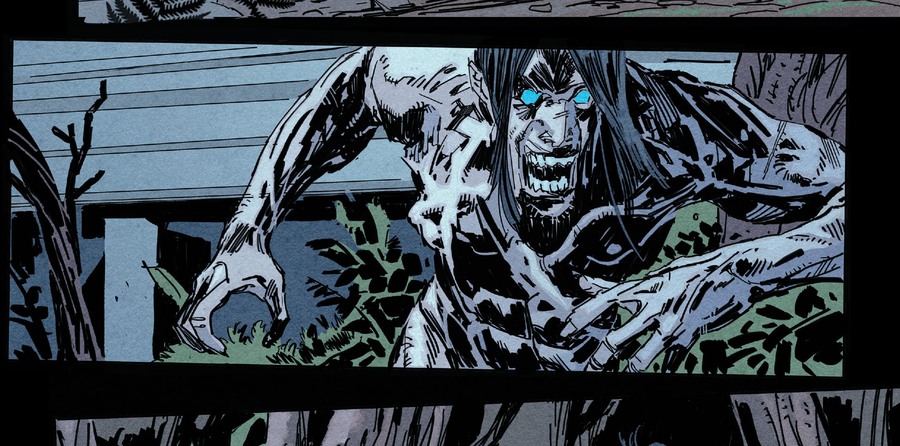
The regenerative cocoon is the temporary state in which B's body is enclosed or reduced while it rebuilds itself after catastrophic injury. BRZRKR does not present regeneration as a clean flash of healing. At its most extreme, B's body becomes an incomplete mass that must gather itself before a recognizable human form returns. The cocoon is the visual language for that interval: life continues, but identity is hidden inside a body that other people can mistake for an object.
Between death and return
B's injuries can destroy the shape that lets witnesses recognize him. A soldier sees a corpse, a scientist sees tissue, and an enemy sees a victory. The cocoon exists between those interpretations. B is not permanently dead, yet he is not able to speak, choose, or defend what is happening to him. The state reveals the vulnerability that ordinary battles conceal.
The process is also why B's survival is not painless. The body must rebuild itself from damage while the mind remains connected to the experience. When the cocoon opens, B carries the memory of what happened. Regeneration restores the body, not the lost time or the people who died while he was unable to act.
The ocean recovery
The Bleeding Tide gives the cocoon its most striking setting. B is found in a chained box beneath the ocean as a deformed mass with a heartbeat. The Captain's crew does not discover an intact warrior waiting to be rescued. It discovers a body that is still returning and must decide whether to bring it aboard.
The underwater cocoon changes the social meaning of regeneration. A government team has equipment and orders; the Captain has a ship, a crew, and uncertainty. B's body is both a rescue and a danger. The people who carry him to the surface can become caretakers or owners depending on what they do after he wakes.
The window of extraction
The cocoon creates a period in which B is most vulnerable to other people's intervention. In Light Draws Breath, rogue scientists siphon protoplasm from B while he is rebuilding after a Bronze Age battle. They exploit the fact that the body will continue its recovery even after material is taken away.
The theft turns a biological interval into the beginning of another life. The new being created from the protoplasm has no inherited memory of B, but it inherits the danger of being made from a body that could not consent. The cocoon is therefore not only a healing stage. It is a place where institutions can interrupt a person's return and redirect the results.
What the cocoon retains
The comic establishes that the cocoon can support the restoration of B's body, but it does not say that every piece inside it contains a full consciousness. Separated tissue can retain regenerative potential and become material for a derived body without becoming a second B. The distinction keeps the cocoon from turning into a magical duplication chamber.
B's memories may continue through the process, but the scenes do not provide a complete neurological explanation. The body and mind remain connected enough for B to return as himself, while the exact relationship between tissue, memory, and Source influence remains unknown.
A body mistaken for an object
The cocoon repeats a pattern that has followed B since childhood. People see an extraordinary body and assign it a purpose before asking what the person wants. In the prehistoric village, the changed child becomes a weapon. In a laboratory, the cocoon becomes a sample. At sea, it becomes cargo. The external form changes, but the risk is the same.
Diana's work offers a counterexample. She understands that B's physical recovery cannot be separated from the fear and memory attached to it. Her questions treat the body as a doorway to a person rather than as an answer that can be removed from him.
Limits and costs
The cocoon does not make B invulnerable. He can be restrained, trapped, or removed from the fight while regenerating. The process may take an unknown amount of time, and it can leave B without agency. Other people can move him, cut him, study him, or assume he is dead. Regeneration protects against final death while creating temporary conditions of helplessness.
Nor does the cocoon repair social consequences. A city can fall while B is rebuilding. A crew can be attacked because it carries him. A laboratory can create another life. The body returns into a world that has changed during the interval.
Relation to mortality
B's desire for mortality includes a desire to end the cocoon cycle. He does not merely want to avoid pain. He wants a death that cannot be converted into another experiment or another command. The final transfer matters because it changes the assumption that every destroyed body will return and can therefore be used again.
The cocoon also gives the mortality decision visual force. B has spent millennia returning from a state that looks like death. When he becomes mortal, the people around him must accept that the next cocoon may never open. The difference makes his final protection of the family finite and chosen.
Significance
The regenerative cocoon is BRZRKR's image of survival before survival becomes a victory. It shows B's body doing what it was made to do while the person inside is unable to control the meanings others attach to the process. The cocoon can be a refuge, a prison, a laboratory, or a ship's cargo. Its significance lies in the question that follows every return: who was allowed to decide what happened while B was becoming whole?
That question also explains why witnesses often misread B after a battle. A body that closes its wounds seems to promise an ending without consequence, yet the narrative repeatedly shows consequences accumulating around him. Allies wait, enemies regroup, and institutions record the interval as an opportunity. The cocoon therefore belongs to the series' larger argument that extraordinary biology never removes ordinary responsibility. B still has to choose what he will do after the healing is finished, and the people who carry him still have to decide whether they are rescuing a person or preserving a weapon.
[1] BRZRKR: The Bleeding Tide #1 and Light Draws Breath #1, B's reconfiguration, ocean recovery, protoplasm extraction, and derived life.