Selected scenes
BRZRKR in pictures.
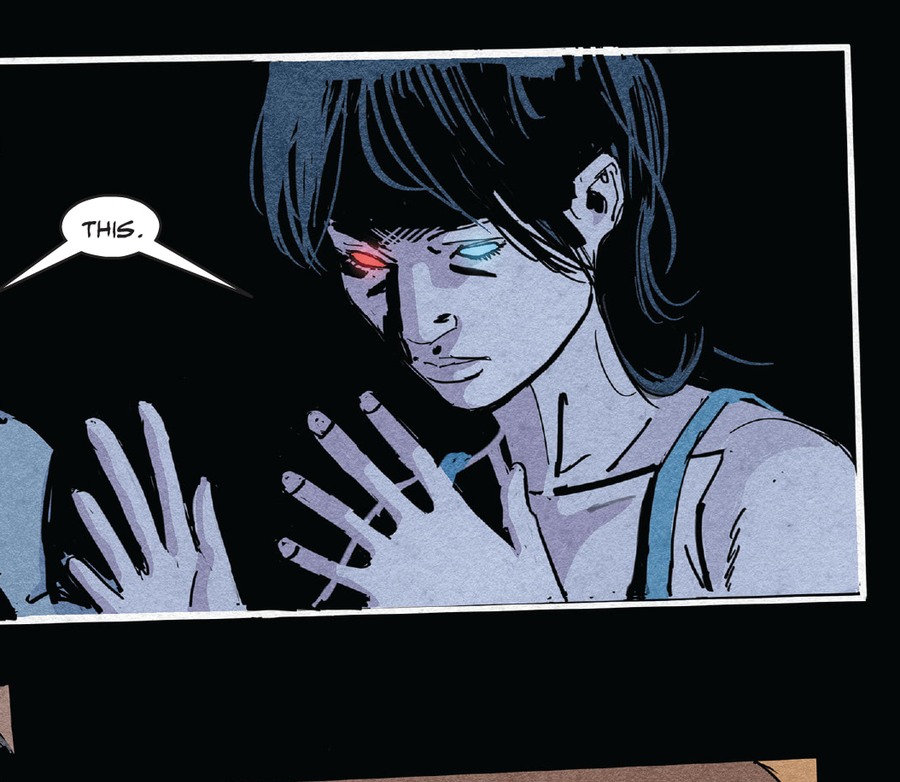
Spoilers: This article covers the visual inheritance shown in BRZRKR #12.
Red-and-blue heterochromia is the unusual eye coloration shown in B and Diana's children after their birth. The detail is small compared with the battles and Source contact surrounding it, but BRZRKR uses it as a concentrated sign of inheritance. The children's eyes make visible what the story has spent twelve issues treating as an invisible question: B's altered biology has entered a family that will continue after him.
A visual clue rather than a diagnosis
The comic shows the coloration clearly enough to connect the children to B's history, but it does not provide a medical name beyond the visible difference. The eyes are not accompanied by a laboratory explanation, a genetic chart, or a list of guaranteed abilities. They are evidence of a changed lineage, not a complete diagnosis.
That restraint keeps the children from becoming objects of study. B has spent his life being looked at by people who want to classify him. The final issue lets the reader notice the children's difference without allowing any character to turn it immediately into a command. The eyes belong first to the children, then to the larger mystery.
Relation to B
B's own body carries visible signs of a life that does not fit ordinary human expectations. His scars, physical endurance, and repeated regeneration have made him recognizable across eras, even when names and languages change. The children's eye colors offer a different kind of recognition. They do not repeat the adult B's appearance; they show a family resemblance translated into a new generation.
The contrast matters. B's body is marked by violence and use. The children's eyes appear in a moment of birth and protection. The same extraordinary history is present, but its emotional setting is different. The visual cue invites hope while preserving the fear that someone will eventually interpret it as a weapon's serial number.
The Source and inheritance
The children are born after the series links B's condition to the Source or Pollinator. That timing makes the eyes part of the wider Source mystery, but it does not prove that the Source selected the children or designed their exact appearance. Their traits can be read as the biological consequences of B's altered body, the conditions of conception, or a combination of factors that the comic never separates.
The story's uncertainty is deliberate. The Source is not presented as a parent who gives the family a complete instruction manual. B has to confront the intelligence without receiving an answer to every question. The children's eyes carry the same ambiguity. They are connected to the cosmic event, but they are not reduced to cosmic property.
What the colors may suggest
The red-and-blue pairing can evoke the two sides of the series' central conflict: violence and care, body and consciousness, earthly history and cosmic contact, mortality and return. Those associations are interpretive rather than confirmed abilities. The comic does not say that red eyes grant one power and blue eyes another, or that the colors map neatly onto B and Diana.
What the image definitely does is make difference visible. The children cannot pass as ordinary in the eyes of anyone who knows the family history. If they are separated from their parents, the trait could become a way to identify them. A visual inheritance can protect a family by proving connection and endanger it by making a person easy to find.
The children's first appearance
The eye color appears during a sequence already crowded with revelations: B's mortality, Diana's transformation, the births, the attack on the safehouse, and the final departure. The detail could have been omitted without changing the immediate action. Its inclusion tells the audience that the ending is not only about what B loses. It is also about what remains in the children.
The image slows the story for a moment. The children are not only consequences of a cosmic experiment or symbols of a future sequel. They are present, looking back at the adults who have tried to protect them. Their gaze reverses the usual direction of BRZRKR's science. Instead of adults examining B, the future looks at the people who made its future possible.
Identity beyond appearance
B's enemies repeatedly mistake a visible trait for a complete identity. His strength makes him a weapon; his survival makes him a god; his title makes him an instrument. The children's eyes create the same risk in miniature. A future institution could identify them by color and assume that it knows what they are.
Diana and B's responsibility is to teach the children that a sign is not a destiny. The eyes may announce a relationship to B, but they do not dictate whether the children will fight, hide, heal, or refuse every role offered to them. Their appearance is inherited. Their choices will not be.
Open questions
The issue does not establish whether the heterochromia remains through later development, whether it appears in every child of B's line, or whether it carries a physiological effect. It does not identify a separate Source symbol or explain why the colors are red and blue. Future stories could connect the eyes to powers, contact, or ancestry, but the original series leaves that connection suggestive rather than settled.
The lack of explanation also keeps the detail from becoming a spoiler-code for every future appearance. A character may resemble the children without being one of them, and a child may inherit the biology without displaying the exact same colors. The story has shown a family trait, not a universal test.
Significance
Red-and-blue heterochromia is BRZRKR's quietest image of legacy. The bodies around B have always been measured by what they can survive. His children's eyes offer another measure: what a life can carry forward without repeating the old purpose. They are evidence that the Source's intervention did not end with B, but they are also a reminder that inheritance belongs to the person who receives it.
[1] Reeves, Kindt, Garney, Crabtree, and Robins, BRZRKR #12, the children's birth, eye coloration, accelerated development, and departure.