Selected scenes
BRZRKR in pictures.
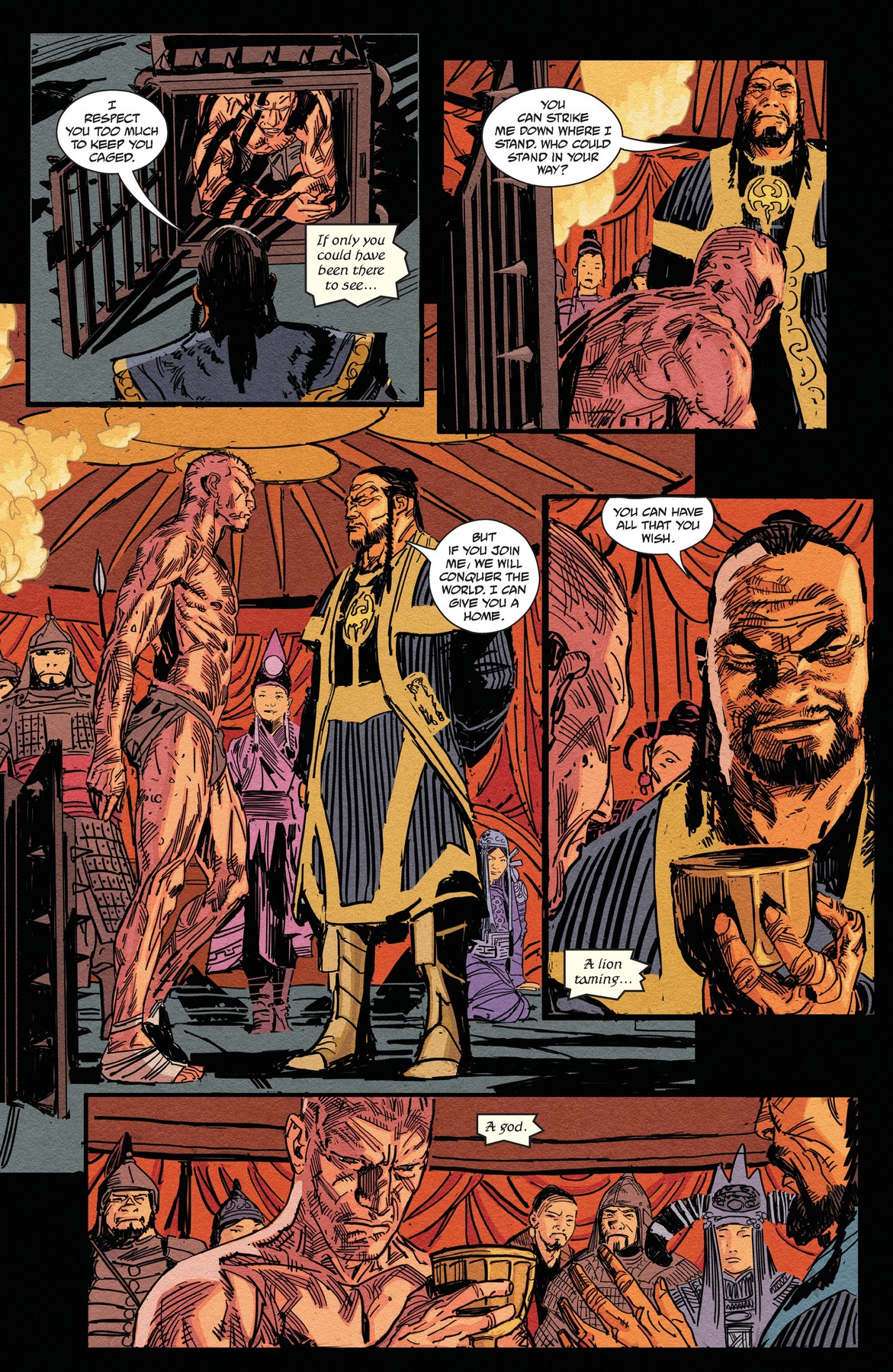
Spoilers: This article covers B's use of opium during the historical Mongol-era material.
Opium's effect on B is one of the clearest examples of a substance that changes the experience of immortality without curing it. During the Mongol-era storyline, opium reduces pain and suppresses part of B's violent compulsion, making it easier for him to serve as a weapon for Genghis Khan. The relief is real, but it carries a cost. The substance makes B more usable to an empire while deepening the dependence that keeps him inside its campaigns.
Pain without final death
B's body heals from injuries that would kill another soldier, but healing does not remove the sensation of injury. He can feel a blade enter, a bullet tear through him, or a limb be destroyed. The body repairs itself after the fact. Opium alters the interval between harm and recovery by muting some of what B experiences.
That difference matters because B does not seek painlessness in the abstract. He wants an end to the cycle that makes every battle repeatable. Opium offers a temporary escape from the sensation while leaving the body, the memories, and the institutions around him unchanged.
The Mongol military system
Genghis Khan recognizes B's strategic value. An immortal warrior can enter a siege, survive an impossible assault, and return to the next campaign. Opium makes that service easier to demand because B can tolerate the battlefield without the full immediacy of pain and compulsion.
The substance therefore belongs to the empire's logistics as much as to B's body. It is a tool for maintaining a soldier who should not exist. The army can treat the relief as evidence that B has become manageable, while B experiences it as a condition of remaining in service.
Suppression is not freedom
Opium suppresses some of the violent pressure but does not give B independent control over his purpose. He may be calmer, less reactive, or less overwhelmed by pain, yet the command structure remains. The empire still decides where he goes and what he must do. A quieter weapon is still a weapon.
This distinction anticipates the modern government bargain. Drugs, contracts, therapy, and technology can change B's behavior without changing the underlying power relationship. Diana's work is different because she wants B to choose, not merely to become easier to direct.
Memory and dependence
B's perfect memory makes temporary relief complicated. Opium may soften the immediate sensation, but it does not erase the battles that follow. He remembers the people killed while he was under the empire's command and the decisions made while he was chemically altered. The substance can change the present without giving him a different past.
Dependence also creates vulnerability. If B needs opium to remain calm or to tolerate service, the person controlling the supply acquires power over him. The empire can call the arrangement medical, strategic, or merciful. The result is still coercive when withdrawal or pain becomes the price of refusing an order.
B's break from Genghis
B's eventual break from Genghis is a refusal of the system that combines survival, opium, and conquest. He does not leave because the drug has failed to work. He leaves because relief has become part of the mechanism that keeps him from choosing. The decision carries moral weight because it cannot undo the battles fought under the empire.
The departure also shows that B's violent compulsion is not an excuse for every action. The substance may reduce pressure, but B remains responsible for how he responds to the people and institutions around him. His refusal is a beginning rather than an absolution.
Relation to the berserker state
Opium's effect helps define the berserker state by contrast. The state is a recurring pressure toward violence shaped by biology, trauma, and training. Opium can suppress part of the pressure, but it does not confirm that a separate personality exists. B remains himself while experiencing a different level of compulsion and pain.
The story keeps the distinction important for later science. A drug can change symptoms without revealing the complete mechanism. The modern program may use the historical account to form hypotheses, but no substance becomes a universal treatment simply because it helped B for a period.
The cost to the body and mind
The historical material does not turn opium into a glamorous solution. Relief can be necessary and still be dangerous. B's body may withstand doses that would harm an ordinary person, but the emotional and political cost remains. A commander who knows B can be numbed may ask him to endure even more violence.
The substance also changes the relationship between B and the people who administer it. Care can become control when the patient cannot refuse. B's later desire for mortality is partly a desire to stop living inside arrangements where every form of help carries a claim.
Open questions
The story does not provide dosage, duration, medical details, or a complete account of B's dependence. It does not establish that opium affects every aspect of the berserker state or that the Mongol-era use is repeated in all later periods. The strongest claim is narrative: the substance reduces pain and compulsion enough to support imperial service while failing to make B free.
Significance
Opium's effect on B shows how an institution can turn relief into a weapon. The substance helps B endure, but it also helps Genghis Khan keep using him. BRZRKR treats the difference between symptom control and liberation as morally decisive. A person may be less afraid, less in pain, or less compelled and still be serving someone else's purpose. B's break from the empire begins when he refuses to confuse temporary relief with a life of his own.
This episode also gives the historical sections a physical texture. The empire's power is not only cavalry, territory, and command; it is the ability to manage the sensations of the one fighter whose endurance makes impossible campaigns seem possible. B's altered state can be read as a battlefield advantage by the men around him, while the reader sees the bargain from inside the body. The drug makes service possible without making service just, and that distinction remains central to B's later attempts to decide who may use him.
[1] Supplied BRZRKR historical material concerning B, Genghis Khan, opium, the berserker state, Mongol campaigns, and B's break from the empire.