Selected scenes
BRZRKR in pictures.
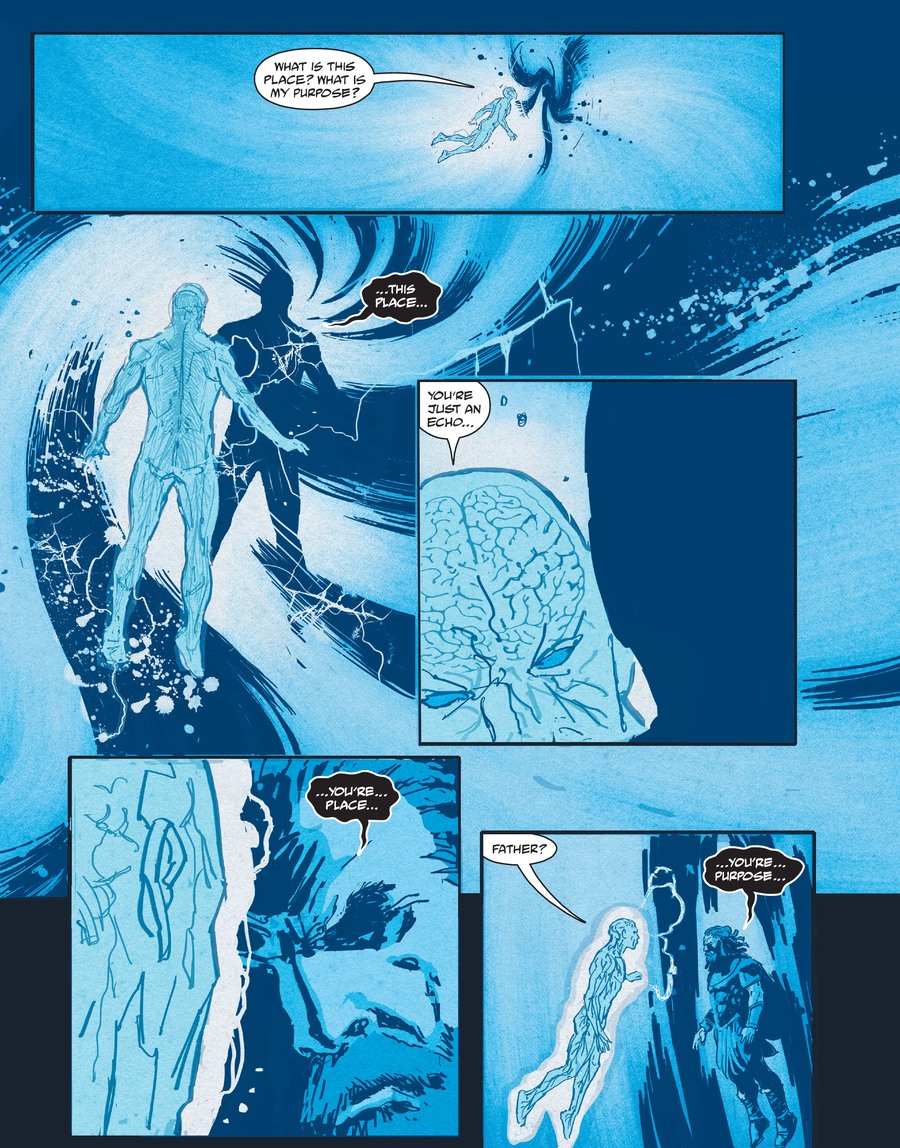
Spoilers: This article covers the biological clues discussed by Diana and the government program in BRZRKR #2-12.
Impossible amino acids are one of the modern program's attempts to describe why B is not an ordinary human organism. The phrase sounds precise, but the comic uses it as a clue rather than a complete diagnosis. B's tissue contains molecular structures that should not exist within the biological assumptions of the researchers studying him. Those structures help explain why ordinary injury, disease, and aging do not behave normally in his body, yet they do not explain who made him or what the Source wants.
A scientific name for an ancient event
The clue arrives after the story has already shown the lightning contact and the accelerated development of B's childhood. A prehistoric mother prays in a cave; an impossible energy event follows; a child changes faster than the people around him can understand. Centuries later, scientists translate the result into chemistry. The order matters. The amino acids are not the beginning of B's story. They are a later language for a much older experience.
Diana's work treats the structures as evidence that B's body was altered at a fundamental level. The researchers are not looking at a stronger version of ordinary muscle or a more efficient immune system. They are looking at matter assembled according to rules that do not fit their laboratory expectations. The word “impossible” records the limit of the observers as much as it records the properties of the sample.
What the molecules help explain
The amino acids are associated with regeneration, unusual durability, and B's resistance to the ordinary consequences of trauma. They also help the program understand why a sample can retain biological value after it is separated from B. If the structures remain active in tissue, then a fragment might become the beginning of an experiment rather than a dead remnant.
That possibility drives the pursuit of artificial immortality. Scientists compare B's blood, tissue, and healing responses. Caldwell sees an opportunity to reproduce the condition. Diana sees a person whose body is being taken apart in the name of an answer. The chemistry sits between those positions. It is evidence that can be used ethically or exploited, depending on what the people handling it believe B owes them.
Not a complete formula
The comic never says that impossible amino acids alone create immortality. They are one part of a larger set of clues that includes quantum molecules, lightning contact, Source-linked energy, memory, and the biological relationship between B and Diana's children. Removing one clue from that network produces a misleading explanation. A vial of B's tissue is not a guaranteed cure, and a laboratory that can identify unusual molecules has not automatically learned how to make a body live forever.
This distinction becomes crucial with Franken-B. The derived body is assembled through several kinds of intervention. The result is not proof that a single chemical recipe can reproduce B's identity. It is evidence that B-derived material can participate in the creation of another life when combined with machines, research, and a powerful external system. The molecular clue opens the door; it does not walk anyone through it.
Quantum language beside chemical language
Diana and the program move between chemistry and quantum theory because neither vocabulary is sufficient by itself. The amino acids describe what can be observed in tissue. Quantum molecules describe behavior that seems to involve scale, probability, and connection beyond ordinary biology. The contact realm then presents a condition in which body, energy, memory, and distance become difficult to separate.
The series does not resolve the tension by declaring one language correct and the other false. Science is shown as a series of translations. A researcher names the pattern that a machine can measure. B remembers the event that created it. The Source remains outside both descriptions. Each perspective is useful, and none has the whole truth.
Children and inheritance
The amino-acid clue becomes more personal when B and Diana's children are born. Their bodies develop rapidly, and their unusual eyes suggest a relationship to the conditions that made B. The comic does not provide a genetic report, but it shows that B's altered biology can enter a family history without producing another identical adult berserker.
That difference is important. Inherited material can create possibility without dictating a destiny. The children are not simply copies of B, and their future is not a laboratory result. They leave the safehouse as people who will have to decide what their bodies mean. The molecular evidence therefore becomes an inheritance question: will the next generation be treated as a family or as a resource?
The Source and the limits of matter
Impossible amino acids point toward the Source without reducing the Source to a chemist. The lightning contact associated with B's conception suggests intervention from outside the human world. Later contact sequences imply that the Source can alter biological conditions directly. Yet the comic never shows a complete manufacturing process or gives the Source a technical explanation that a human scientist could reproduce.
The absence of a formula is not a gap that the story forgets to fill. It protects the difference between origin and mechanism. Knowing that a body contains unusual matter does not answer why the body was made, whether the Source intended B to be a weapon, or whether the same change can happen again. Those are moral and cosmological questions, not only laboratory questions.
Consequences for the government program
The discovery changes the government's bargaining position. B is no longer merely an unusually resilient operative. He is a living exception with material that could alter military research. That makes the contract more dangerous because the program's interest can survive any individual mission. Even if B refuses an order, someone can argue that his tissue remains useful.
Diana's ethical resistance gains force from this fact. She is not opposing harmless curiosity. She is opposing a system that can turn a person's injury into a permanent research supply. Caldwell's cult history shows that the desire to possess the material is older than the modern state. The science changes the equipment, not the underlying claim of ownership.
Open questions
The issues leave the exact amino-acid structures unnamed, the reason they remain stable, and the extent to which they exist in B's children unresolved. It is also unclear whether the molecules are produced continuously, whether they require Source contact, or whether they are a fixed consequence of the original lightning event. No complete medical explanation is given for the transfer to Caldwell or for the bodies produced through later experiments.
Significance
Impossible amino acids give BRZRKR a material image of the series' central conflict. B's body is genuinely different, but difference does not make it public property. The molecules explain why institutions are interested and why their explanations keep failing. They are a scientific clue embedded in a family tragedy: matter can reveal how a life was changed without granting anyone the right to decide what that life is for.
[1] Reeves, Kindt, Garney, Crabtree, and Robins, BRZRKR #2-4, B's conception, biology, and early regeneration clues.
[2] Reeves, Kindt, Garney, Crabtree, and Robins, BRZRKR #7-12, separated material, artificial research, children, and Source contact.