Selected scenes
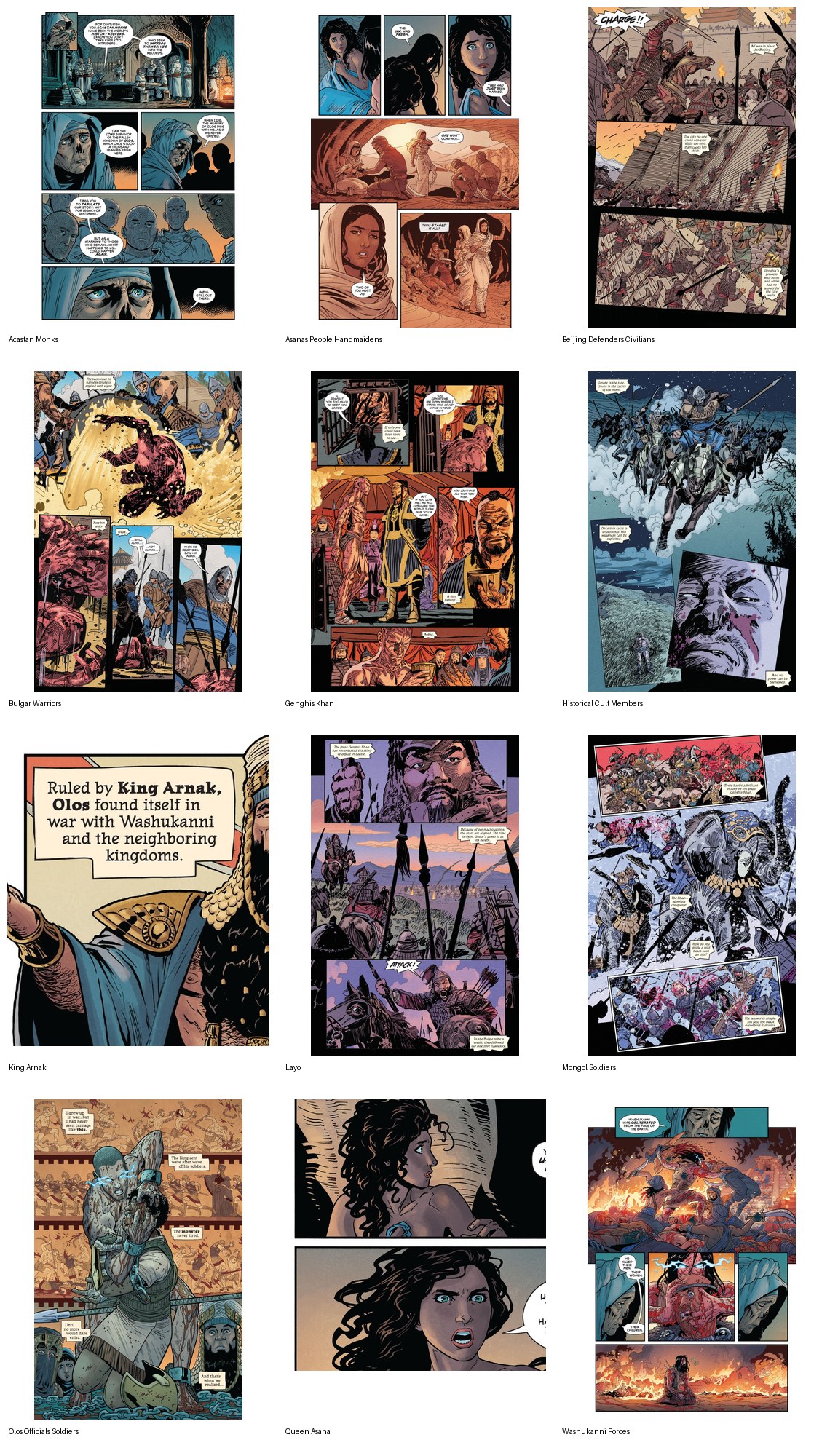
BRZRKR in pictures.
Spoilers: This article discusses the sensations and inherited pressures associated with Lugalṭur and B-derived life in The Lost Book of B.
Bad Ecstasies is the phrase associated with the overwhelming sensations that can accompany B-derived life. It is not a clinical diagnosis and not a confirmed separate superpower. The phrase describes a condition in which perception, regeneration, inspiration, pain, and compulsion arrive with such force that ordinary language cannot contain them. In the story of Lugalṭur, the experience makes inherited potential feel intoxicating and frightening at once.
Ecstasy without comfort
The word ecstasy usually suggests pleasure or spiritual elevation. BRZRKR complicates it by adding “bad.” A body connected to B can experience extraordinary intensity without receiving happiness. Sensation may be heightened, regeneration may feel miraculous from the outside, and inspiration may seem like revelation, while the person inside the body feels trapped by the force of it.
The phrase therefore belongs to the moral language of the series. A power that feels sublime to an observer can be painful to the person experiencing it. B's regeneration is often celebrated by the people who benefit from it; B remembers the wounds. Lugalṭur's bad ecstasies extend that difference into a new life.
Lugalṭur's inheritance
Lugalṭur is derived from B's regenerative material but develops a separate identity. He does not receive B's complete memory or a finished set of instructions. The inherited potential arrives before he has the experience to understand it. Sensation can become a guide and a threat, making it difficult to distinguish instinct from command.
The condition helps explain why Lugalṭur seeks recognition from B. He wants to know whether the feelings inside his body are part of a family, a side effect of creation, or a purpose imposed by the people who made him. B cannot provide a simple answer because his own body has never been simple. Their relationship grows through the willingness to admit that neither person controls the whole inheritance.
Power and compulsion
Bad ecstasies should not be equated with B's berserker state. The experiences may overlap in their intensity, but the phrase does not confirm a second personality or a separate demon. It names a pressure that can push the body toward action while leaving the person responsible for deciding how to respond.
This distinction matters for Lugalṭur's autonomy. If every troubling sensation were treated as an external command, he would have no moral agency. If every sensation were treated as a voluntary choice, his difficulty would be dismissed. The story occupies the harder middle: inherited biology creates pressure, and a person must still learn what to do with it.
Theosebeia's protection
Theosebeia's care gives Lugalṭur a place in which the sensations can be survived without immediately becoming useful. She does not demand a demonstration of strength before offering protection. That decision contrasts with B's childhood training, where every sign of power became a reason for harder tests.
Her refuge cannot remove the condition. It changes the surrounding interpretation. Lugalṭur can learn that a body capable of violence is still allowed to rest, speak, and be uncertain. The protection is therefore part of the treatment even though the story never uses a medical model.
Inspiration and danger
Lugalṭur's experiences can inspire historical figures and later legends. A witness may interpret unusual perception as prophecy, or a moment of regeneration as divine favor. The bad ecstasy becomes public myth while remaining private distress. This is one reason the character's history is difficult to recover. The stories preserve what observers saw and lose what Lugalṭur felt.
B knows this pattern from his own life. Atlantis, Olos, and the American stories turn his body into public meaning. Lugalṭur's experience repeats the process on a smaller scale. The difference is that he may have a chance to recognize the mythmaking early enough to resist it.
Relation to alchemy
The phrase belongs to the alchemical branch, where substances, machines, and bodies are used to approach life extension. Alchemy treats transformation as both physical and spiritual. Bad ecstasies show the risk of transformation without a stable ethical framework. A body may become more capable while the person becomes less certain of what is happening.
The story does not claim that historical alchemy produced a real clinical state called Bad Ecstasies. It uses the phrase as a fictional expression of the experience associated with B-derived life. The boundaries between experiment, revelation, and suffering remain intentionally porous.
What the phrase does not prove
Bad Ecstasies do not prove that every descendant of B will experience the same condition, that Lugalṭur shares every one of B's abilities, or that the Source directly controls his sensations. The phrase does not turn an ambiguous feeling into a confirmed cosmological mechanism. It remains tied to the character and the scenes in which the experience is described.
Significance
Bad Ecstasies give BRZRKR a language for the cost of inherited power. They show that a new life can receive extraordinary ability without receiving a map for living with it. Lugalṭur's story matters because he is not asked merely to survive the sensation. He is allowed to become a person who can decide whether the sensation will define him.
The phrase is especially revealing because it refuses the easy vocabulary of superhero origin stories. There is no clean awakening, no uncomplicated gift, and no promise that greater strength will produce greater happiness. The experience is ecstatic in the sense that it exceeds ordinary limits, but bad because the excess is frightening and isolating. By attaching those two words to Lugalṭur's inherited condition, the story keeps attention on the body as lived experience rather than treating it as a spectacle for other characters.
[1] Reeves, Kindt, Garney, Crabtree, and Robins, BRZRKR: The Lost Book of B. #1, Lugalṭur, derived life, inherited sensation, alchemy, and historical inspiration.