Selected scenes
BRZRKR in pictures.
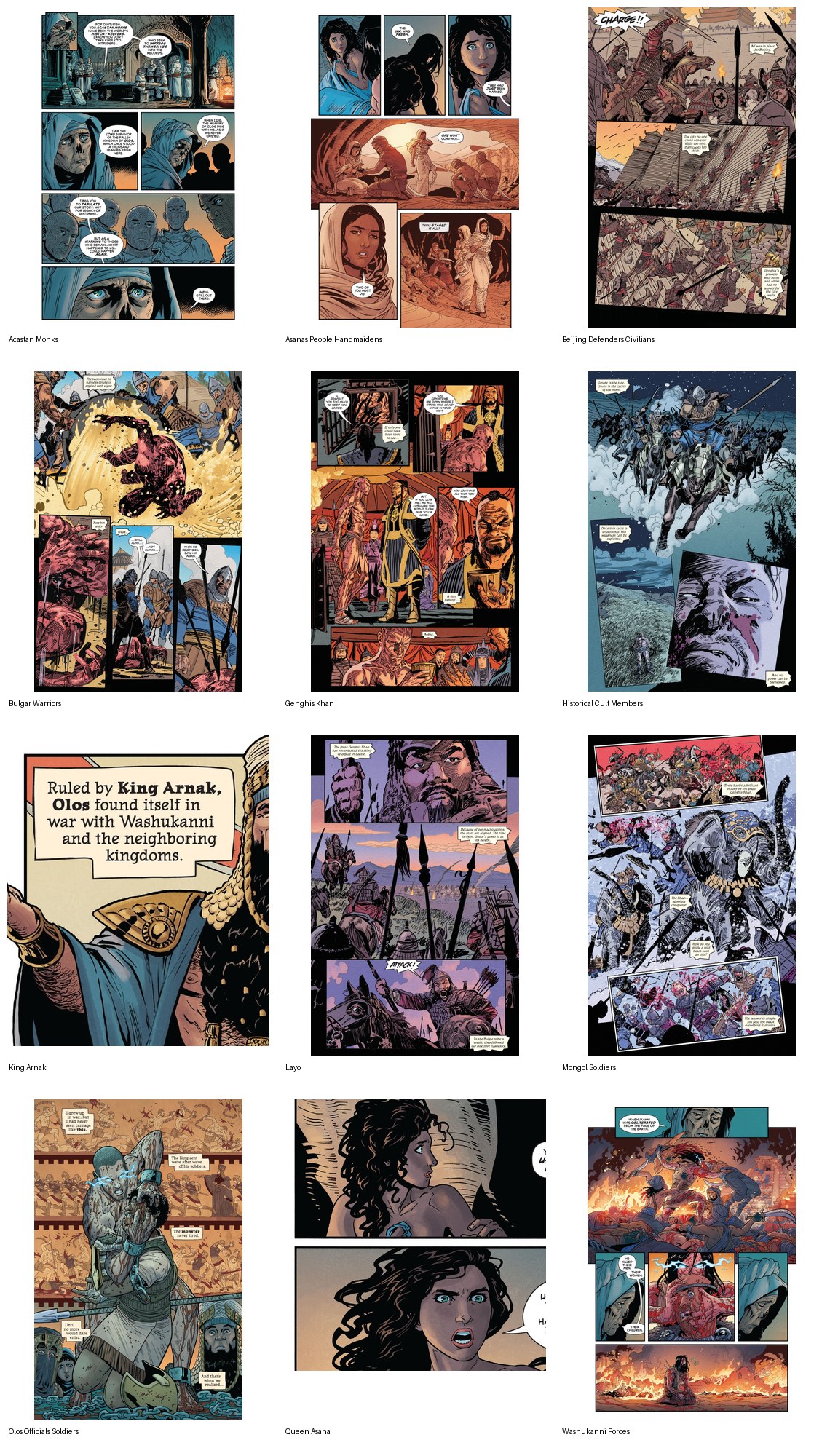
Spoilers: This article covers B's American historical appearance at Mine Creek.
Mine Creek Battlefield is a real American site that BRZRKR uses as the setting for one of B's later historical appearances. The battlefield places an immortal inside a documented conflict without making him the author of that conflict. B enters as a participant and witness. The soldiers around him experience a single day of violence; B carries the memory forward into a life that will outlast the causes for which they fought.
History and fiction together
The name Mine Creek anchors the story in the Civil War-era geography of the Kansas–Missouri border. The fictional scene is layered over that historical ground. The battle exists independently of B, Maybell, Winston Tunt, and the other figures associated with the American branch. This distinction protects the human scale of the historical event. B's presence adds a strange witness; it does not make the battlefield a secret chapter of his biography alone.
The setting also changes how B's immortality looks. In Atlantis and Olos, rulers and cults can turn him into a mythic or royal figure. At Mine Creek, firearms, cavalry, smoke, mud, and confused movement make survival look like one more impossible fact in a field already full of death. A soldier who sees B rise may remember a miracle or a monster. The battle provides no time for a complete explanation.
B among ordinary soldiers
B's body gives him a tactical advantage, but the battlefield does not become safe. He is still surrounded by people who can die permanently. Every choice to advance through gunfire changes the risk for the soldiers near him. The immortal can break a line, recover from a wound, and continue; the people following him cannot assume the same protection.
That difference creates the same moral tension as the modern government missions. B is useful because he can absorb danger, and his usefulness tempts commanders to spend him. The historical setting strips away the language of a contract and leaves the raw calculation visible. A body that cannot stay dead becomes a reason to ask the mortal bodies around it to move forward.
Memory after the battle
The battlefield's most important consequence is not a strategic result. It is the memory B carries after the soldiers are buried and the political language changes. He can remember faces that their families eventually lose to time. Perfect memory makes the battle a continuing presence rather than a closed chapter.
The scene therefore belongs to B's long cycle of love and loss. He may not know every soldier's name, but he knows what it feels like to stand among people who expect the day to be their last. His own survival does not make their deaths less real. It makes him the person left to remember the difference.
The American route
Mine Creek connects to Fort Scott, Flint Hills, the Kansas Territory, the Missouri Ozarks, and Winston Tunt's estate. These locations create a route through the American stories, but they are not a single uninterrupted map. Each place supplies a different relationship between B and the communities around him.
At the fort, institutions organize force. In the hills and woods, rumor and escape dominate. At the estate, private wealth shapes local power. At Mine Creek, B appears inside a public battle whose historical identity is already fixed. The route shows how B can be official, hidden, or legendary without becoming a different person.
The danger of heroic memory
Battlefield legends often reduce a complex conflict to a few heroic images. B's survival invites that reduction. A witness could remember an invulnerable fighter and forget the people who were frightened, exhausted, or unwilling to be there. BRZRKR resists that simplification by keeping B's action inside a human event. The battlefield is not a stage built for him.
The story also refuses to make B morally clean simply because he fights beside people who need help. His history includes violence undertaken for rulers and causes he later rejects. Mine Creek is another moment in which he chooses how to act within a conflict he did not create. The choice matters, but it does not absolve every earlier decision.
Relation to B's identity
The battlefield contributes to the many identities B accumulates. He can be a soldier to the men around him, a stranger to civilians, and a supernatural rumor to those who see the aftermath. The titles do not replace one another. They overlap because B remains present while the surrounding communities change.
That overlap is why the American material belongs beside Atlantis, Olos, and the modern program. Each setting gives B a social role and then exposes the limits of that role. A battlefield can call him a comrade without understanding him. A king can call him a possession without owning him. A government can call him an asset without ending his desire for freedom.
Open questions
The story does not supply every detail of B's movements at Mine Creek, identify all soldiers who meet him, or state how long he remains in the region. It does not make him responsible for the battle's historical outcome. Those limits keep the fictional appearance respectful of the setting's real history.
Significance
Mine Creek Battlefield gives BRZRKR one of its clearest images of immortality inside ordinary history. B can survive the violence that ends other lives, but he cannot make the battlefield's losses temporary. He leaves the field carrying a memory that no victory can resolve. The place matters because it shows the cost of turning a real conflict into a legend about an impossible man.
The battlefield after the charge
The significance of Mine Creek is also visible in what happens after the movement of troops stops. A battlefield is a landscape of abandoned equipment, wounded people, and families who will receive incomplete news. B's regeneration can make the action look reversible, but the field around him remains full of consequences that cannot be healed. The contrast gives the American story its particular melancholy. B can walk away from the smoke; the people who live near the battlefield have to rebuild a life around what the smoke left behind.
The scene also tests B's relationship to anonymity. In a royal court, he is named and displayed. At Mine Creek, he may be seen only briefly, and the witnesses have no reason to believe that the man who rises after an injury will remain the same person they meet in another decade. A local story can preserve the image while losing the name. B's perfect memory preserves the reverse: the name may disappear, but the person does not.
The battlefield therefore contributes to the series' treatment of historical truth. Real places provide the ground; fictional memory provides an additional human perspective. Neither layer cancels the other. B is important because he sees the violence through an impossible span of time, but the soldiers and civilians remain important because the battle is theirs even when he is present.
The moment also clarifies why B's historical appearances should not be read as a secret autobiography of every war. He is present in a particular scene because the story is interested in the contrast between finite combat and an immortal witness. The battlefield remains larger than his legend. That humility is what lets the setting function as history rather than as another stage built only to display his strength.
[1] Supplied BRZRKR American-era material associated with Mine Creek, the Kansas–Missouri border, B's appearance, and the surrounding historical route.