Selected scenes
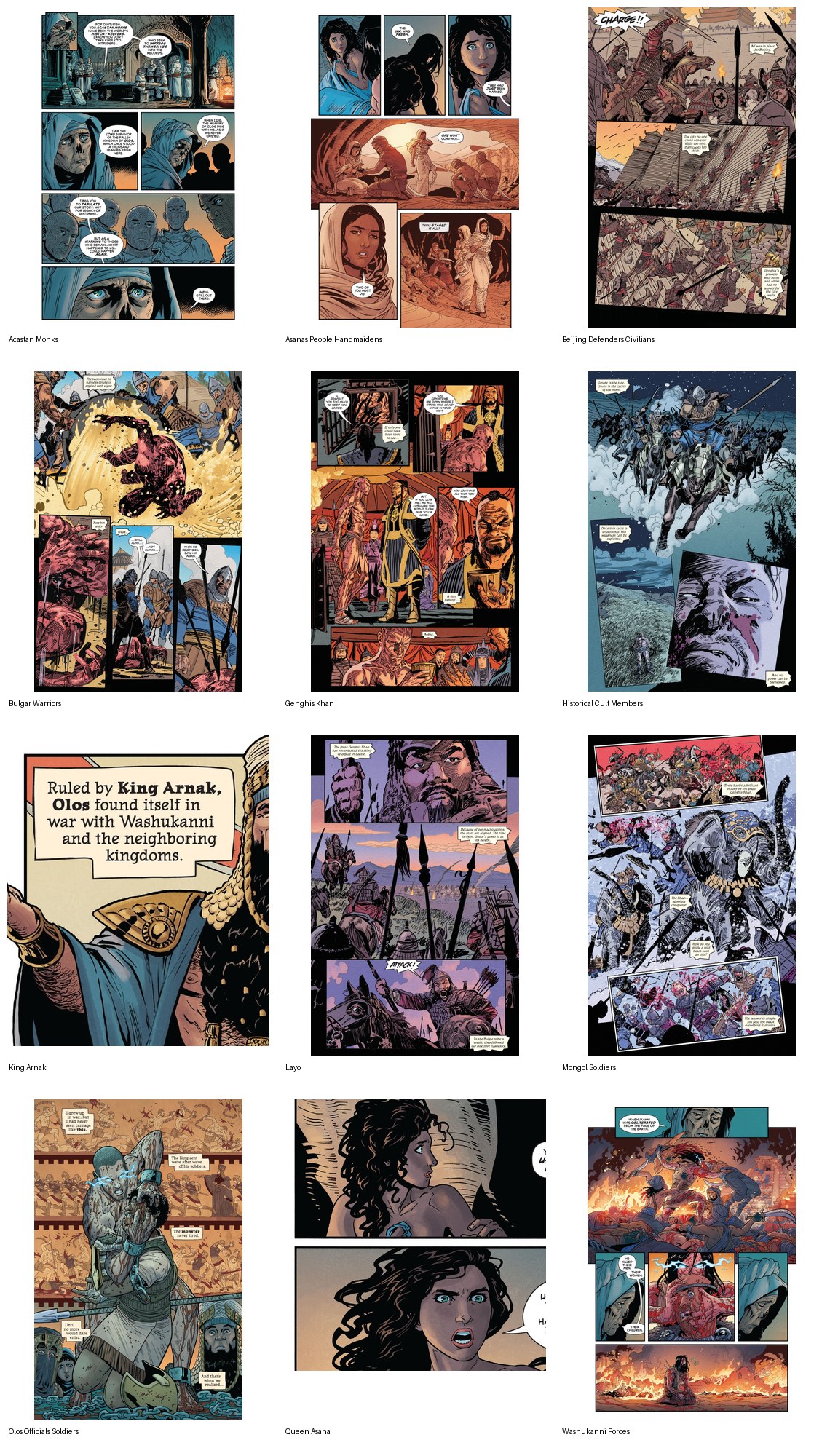
BRZRKR in pictures.
Spoilers: This article covers the American historical material associated with B, Maybell, and the Kansas–Missouri border.
Fort Scott is one of the real-world American settings through which BRZRKR places B inside nineteenth-century violence. The fort is not presented as a fantasy kingdom or a supernatural laboratory. Its importance comes from the pressure of ordinary history: military authority, contested territory, civilians, abolitionists, traders, and armed men whose decisions affect lives whether or not B is present. The fictional story uses that setting to examine how an immortal can become a legend without becoming the cause of every event around him.
A real place carrying fictional memory
The American one-shot material preserves the name Fort Scott as a historical anchor. B's presence belongs to the fictional layer, while the fort's existence belongs to the real history of the region. That distinction keeps the story from rewriting the past around a single extraordinary figure. B enters a world already shaped by conflict, and his actions become one thread in a larger fabric.
The place therefore has two kinds of weight. For the characters, Fort Scott is a military and social location with routes, orders, and people who must decide whom to trust. For B, it is another period in which institutions try to turn a body that cannot die into an advantage. The fort's walls can organize force, but they cannot determine what B remembers after the soldiers are gone.
The border conflict
Fort Scott is connected to the Kansas Territory and the violence often called Bleeding Kansas. The story's fictional figures move through a landscape where political allegiance can become physical danger. Border ruffians, Free-State abolitionists, traders, and civilians do not share one view of the territory or one reason for being there.
B's presence does not simplify those divisions. He may fight beside people whose politics he does not share, protect someone whose cause he cannot endorse, or become a rumor that both sides use. An immortal body can survive a skirmish, but the communities around the skirmish still lose homes, family members, and trust. The setting keeps those ordinary costs visible.
B and the soldier's role
B has performed military roles for rulers and armies across history. Fort Scott gives him a smaller-scale version of the same demand. A commander sees a fighter who can be sent where another soldier would not return. The fort's structure encourages that calculation because military institutions are built to assign bodies to tasks.
Yet B does not become a simple member of the garrison. His age, memory, and unknown origin make him an outsider even when his strength is useful. Soldiers may see a comrade, a threat, or a story. The difference between those views can change in a single night, especially after an injury that should have been fatal is followed by B standing again.
Maybell and local knowledge
Maybell's connection to the American material brings a personal perspective to the region. She is not an official voice explaining the conflict from above. Her experience is shaped by what she sees, whom she trusts, and how the appearance of B changes the choices available to her. The Man in the Tree incident turns that local knowledge into legend.
The relationship between Fort Scott, Maybell, and the surrounding routes is not presented as a complete map. The locations are connected through memory and movement. A story heard at a trading post can alter how a person approaches the woods. A survivor can carry the image of B to another town. History travels through people as much as through roads.
The danger of turning history into myth
An immortal can make a period feel like a legend because he remains the same while the political world changes. The risk is that the legend will erase the people who did not survive. Fort Scott resists that erasure by remaining a real historical place with fictional events layered over it. B's presence is significant, but the territory's violence does not begin or end with him.
This balance also changes how B understands himself. He may be remembered as a guardian, a monster, or a soldier, but the fort contains people who never see the mythic version. They see a man entering a room, choosing whom to help, and leaving before anyone can ask where he came from. Their limited knowledge is not a failure. It is the ordinary human condition B has lived outside for most of his life.
Connections to Flint Hills and Mine Creek
Fort Scott belongs to a wider American route that includes Flint Hills, the Missouri Ozarks, Winston Tunt's estate, and Mine Creek Battlefield. Each site carries a different form of violence. The fort represents organized military presence; the hills and woods hold rumor and escape; Mine Creek places B near a documented battle. Reading the sites together shows how B moves between official history and private memory.
The route is not a claim that every scene occurs in one uninterrupted journey. It is a chain of settings through which the American stories explore B's relationship with territory and power. The real names anchor the fiction without eliminating uncertainty about the exact path.
Open questions
The story does not give a complete roster for Fort Scott, specify B's precise dates there, or identify every encounter among Maybell, Winston Tunt, and the soldiers. It does not turn B into the hidden author of the region's political history. The fort's value is thematic and local rather than encyclopedic.
Significance
Fort Scott shows BRZRKR placing an immortal inside a history that does not belong to him. The fort can use his body, and local people can turn his survival into a tale, but neither can erase the human conflict already present. B passes through the setting as witness and participant. What remains is not proof that he controlled the territory, but the memory of how an ordinary place looked when an impossible man entered it.
[1] Supplied BRZRKR American-era material associated with Fort Scott, Kansas Territory, Maybell, Winston Tunt, the Missouri border, and Mine Creek.