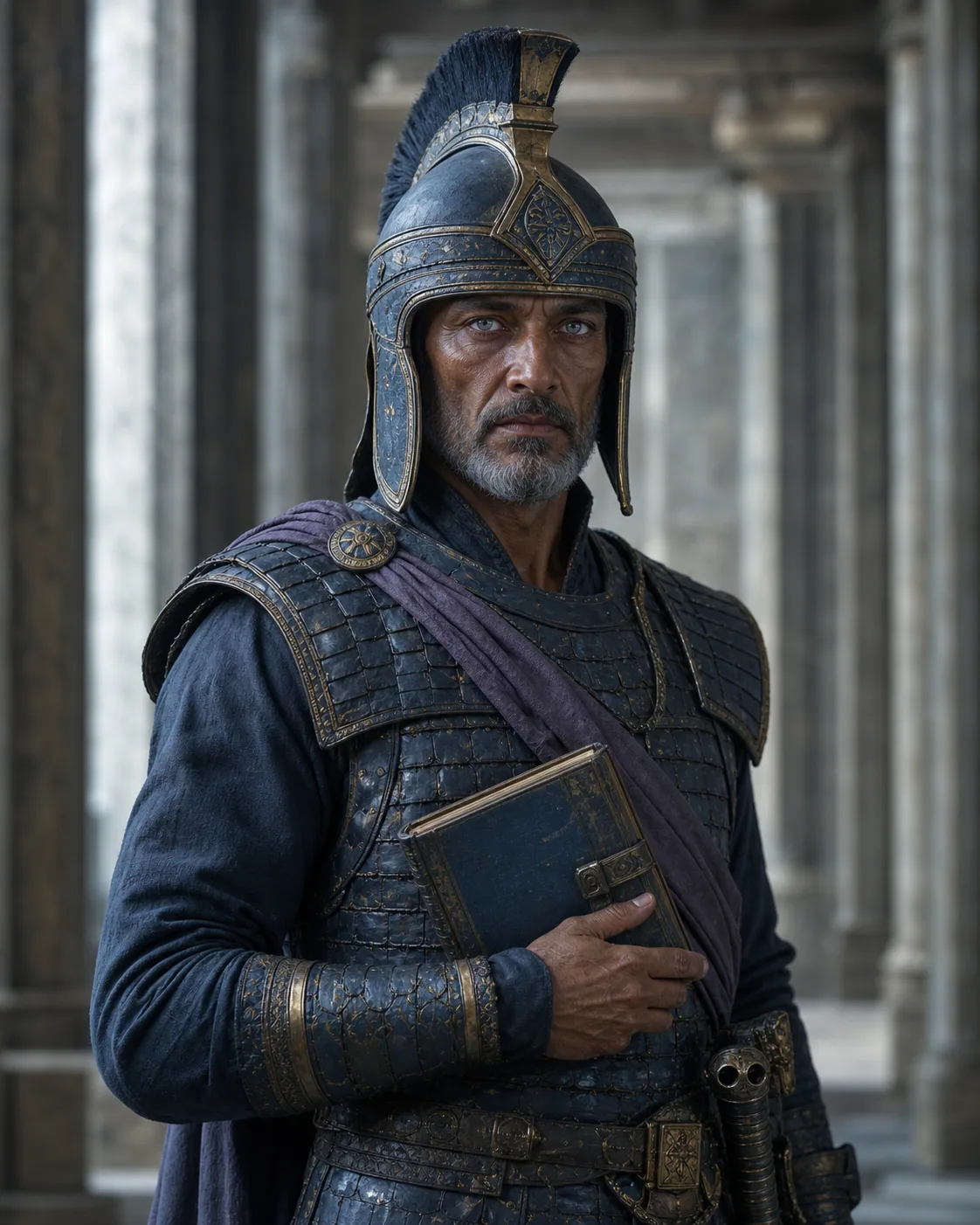
Selected scenes
BRZRKR in pictures.
Spoilers: This article discusses historical material and the complete events of BRZRKR: Poetry of Madness #1.
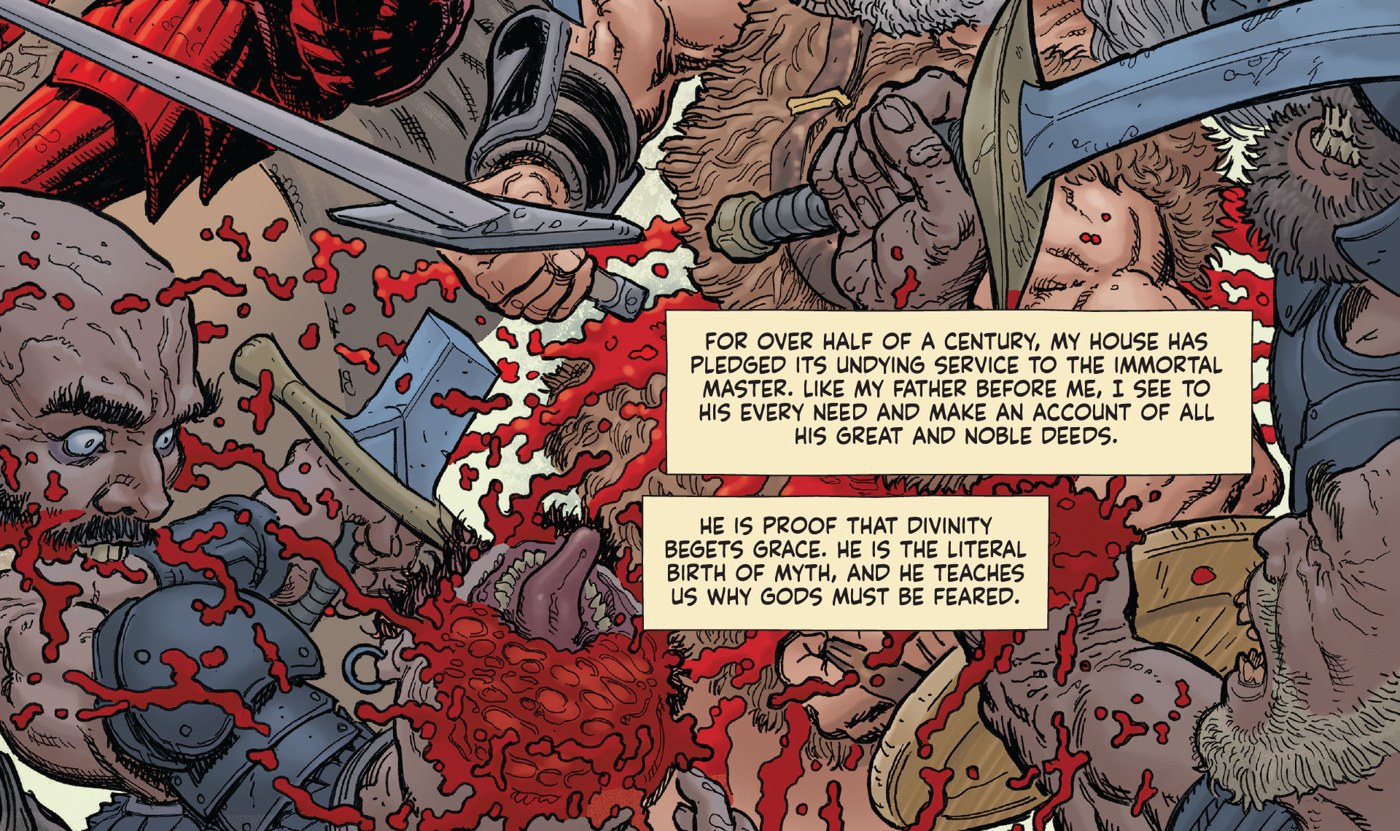
The comic does not provide a confirmed portrait of Zubatai's father. This contextual source image accompanies Zubatai's narration about her family's inherited service to B and must not be labeled as a depiction of the father.
Overview
Zubatai's father is an unnamed Atlantean man known only through the testimony of his daughter in BRZRKR: Poetry of Madness #1. He served B, known in Atlantis as Unute the Berserker, before Zubatai inherited the family's role. His importance lies less in direct action than in continuity of memory. Zubatai says that her house has pledged undying service to B for more than half a century and explicitly adds that her father served the immortal before her.[1]
He is also the source of one of the story's most important interpretations of B's relationship with King Azaes. According to Zubatai, her father believed B recognized his own history in the endangered child king after a coup killed Azaes's parents. B had seen many evil men bind a boy's fate to their ambitions, and he refused to allow the same pattern to consume Azaes. That interpretation helps explain why B remained in Atlantis instead of leaving after stopping the coup.[2]
The character is never named, receives no confirmed dialogue in a directly depicted scene, and may never be visually shown at all. A definitive wiki should therefore treat him as a historical character with limited direct evidence, not as a blank space to be filled by invented biography. His article can still be substantial because his existence establishes a hereditary service institution around B, provides the bridge between B's arrival and Zubatai's later chronicle, and demonstrates how stories about the immortal are transmitted across human generations.
The hereditary service of Zubatai's house
Zubatai introduces a small but highly significant institution when she explains her relationship to B. Her house, she says, has pledged undying service to the immortal for more than half a century. She then specifies that her father served him before she did.[1]
This detail proves that Zubatai's role is not an ordinary royal posting assigned by Azaes shortly before the story. It is inherited. The family has organized part of its identity around service to a man who does not age while generations of servants do.
For B, such an arrangement creates a recurring asymmetry. Human attendants inherit him as a responsibility, while he watches one generation replace another. Zubatai is therefore not simply "the next employee." She embodies the passage of time around an immortal who remains physically unchanged.
The phrase "my house" may indicate a recognized Atlantean family line or household. The comic does not clarify whether it carries noble status, military distinction, scribal tradition, or formal hereditary office. The safest description is a family or house with an inherited obligation to serve B.
Service to B
Zubatai describes her own duties as seeing to B's every need and making an account of his great and noble deeds. Because she says the family has pledged service and references her father as predecessor, it is reasonable to conclude that her father also personally served B.[1]
It is not safe, however, to assign every one of Zubatai's titles to him. The comic specifically calls Zubatai the king's honored chronicler and squire to the king's personal guard. It never explicitly says her father held the same court positions.
The story separates the fact of his service from the details of his daily work. Zubatai's father served B before she did, but the comic never says that he held her exact titles or performed every task she later describes. Hereditary continuity does not automatically mean identical duties. What survives is the family obligation itself and the understanding of B that grew out of long attention to his life.
Witness to B's Atlantean period
The father's service places him in or near one of the most unusual periods of B's life. Zubatai says the family's service has lasted more than half a century. B has become Atlantis's protector, a figure positioned next to Poseidon in popular religious hierarchy, while also living among ordinary people.[1][3]
The father therefore belongs to a generation that knew B not as a fleeting legend but as a permanent social presence. He would have seen an immortal remain while children became adults and rulers aged.
The comic does not show which battles he witnessed, whether he accompanied B outside Atlantis, or whether he personally recorded the great deeds Zubatai later references. Those possibilities should remain unresolved.
Knowledge of Azaes's childhood
Zubatai's most important statement about her father concerns the coup that killed Azaes's parents. She says a coup attempt claimed the lives of the king and queen, and the young Azaes was expected to die as well. B intervened.[2]
Zubatai then attributes an interpretation directly to her father. He said B saw his own tale of woe in the boy king's circumstances. B recognized that many evil men were binding their ambitions to the child's fate, and because B knew the cold comfort of being used as a tool, he would not allow that fate to consume Azaes.[2]
This is not merely background exposition. It reveals that the father thought deeply about B's psychology. He did not interpret B's defense of Azaes as random heroism or royal employment. He connected it to B's own trauma.
That suggests a degree of intimacy or accumulated observation. A servant who knows only B's battlefield behavior could describe his strength. Zubatai's father instead attempts to explain why B makes an emotionally significant choice.
Reliability as a historical source
The wiki's source hierarchy should classify the father's interpretation carefully. The coup itself is shown in flashback, but the claim about what B recognized in Azaes is introduced as "my father said." It is therefore an in-universe attributed interpretation.[2]
That does not make it unreliable. Zubatai's father had served B and may have known him well. His explanation is consistent with B's broader history of being weaponized by others. Yet the comic does not show B explicitly telling the father, "I stayed because Azaes reminded me of myself."
The correct phrasing is therefore:
Zubatai's father believed B identified with Azaes because both had been made instruments of other people's ambitions.
The incorrect phrasing would be:
B told Zubatai's father that Azaes reminded him of himself.
The difference matters because the father's explanation is part of the family's memory of B, not a statement made by B himself. It remains a thoughtful interpretation from someone who served him closely, and it helps explain why the defense of Azaes mattered without turning that interpretation into a private confession that the story never shows.
Relationship with Zubatai
Zubatai is the father's only known child. The comic does not mention other children, a spouse, or any extended family members.
His influence on Zubatai is visible through her work. She inherits service to B, preserves historical interpretation received from her father, and continues the family's commitment to recording the immortal's deeds.[1][2]
The relationship is therefore professional as well as familial. Zubatai does not merely inherit stories about B. She inherits a living relationship with the same person her father served.
This creates an unusual family dynamic. Most children inherit memories of their parents' employers or commanders. Zubatai can speak directly to the immortal subject of her father's stories because B remains alive and unchanged.
Relationship with B / Unute
B is the defining external figure in the father's known biography. The father serves him long enough, or closely enough, to form an interpretation of his motives around Azaes.[2]
The comic does not establish whether B considered him a friend, whether B mourned him, whether B personally appointed Zubatai as successor, or whether the transfer from father to daughter was automatic.
Because B later releases Zubatai from service after Atlantis is destroyed, it is possible that he views the family's obligation as something he can terminate. The story does not reveal whether he had previously accepted or resisted the hereditary arrangement.
The family relationship ends with a rare act of release. After Atlantis falls, B tells Zubatai that she no longer owes him service. The gesture cannot restore the generations spent in attendance, but it lets the final member of the house choose a life that is not defined by an immortal employer.
Relationship with King Azaes
The father is connected to Azaes through historical memory rather than a clearly defined court office. His statement about B's response to the coup indicates familiarity with the boy king's crisis.[2]
Whether he was physically present during the coup is not stated. He may have witnessed the aftermath, heard B's account, or reconstructed the event from palace testimony.
The article should not call him Azaes's tutor, adviser, chronicler, guard, or royal official without further evidence.
Possible role in the chronicler tradition
Zubatai's formal title as honored chronicler invites a reasonable question: did she inherit that job from her father?
The comic does not answer. Her father's ability to pass down a detailed interpretation of B and Azaes suggests involvement in preserving history, but ordinary family storytelling could explain the same evidence.
The database should therefore use:
- occupation: servant/attendant of B, confirmed;
- chronicler: unconfirmed;
- royal squire: unconfirmed;
- king's personal guard: unconfirmed.
This conservative approach preserves the possibility of later expansion without turning inference into canon.
Appearance
No panel can be securely identified as a direct depiction of Zubatai's father from the supplied issue.
The page discussing the family's service shows B in battle while Zubatai narrates that her father served before her. That image is contextual, not a portrait.[1]
A wiki should therefore display No confirmed depiction in the infobox image field unless later primary material identifies him visually.
Any original rendering should be labeled interpretive and should not imply canon-specific facial features, armor, age, or clothing that the comic never provides.
Personality
Very little direct characterization is possible.
His interpretation of B's defense of Azaes suggests empathy and attentiveness. He sees B's behavior through the lens of exploitation, trauma, and identification with a child being used by powerful men.[2]
It is also reasonable to say he participates in a family tradition of loyalty because Zubatai says her house pledges service to B. It is not possible to determine whether he personally embraced that obligation enthusiastically, resented it, or simply inherited it.
Claims that he was brave, scholarly, religious, military, humorous, stern, or affectionate should remain unwritten unless new evidence appears.
Historical significance
Zubatai's father is significant for four reasons.
First, he proves that B's stay in Atlantis lasts across human generations rather than a brief military campaign.
Second, he establishes that B acquires not only royal allies but an inherited household of attendants.
Third, his testimony provides the strongest psychological interpretation of B's decision to protect young Azaes.
Fourth, his existence makes Zubatai's final release from service more meaningful. When B thanks Zubatai and frees her after Atlantis falls, he is ending an obligation that predates her own tenure.[3]
Status and fate
The father's status during the main events of Poetry of Madness is not explicitly stated.
He is referred to in the past tense as someone who served B before Zubatai. That may indicate death, retirement, incapacity, or simple succession. The comic does not specify which.
The wiki should therefore use:
Status: Unknown. No confirmed death scene.
Because the story is ancient and the character is human, he is certainly deceased by the modern period of BRZRKR continuity, but that fact does not establish when or how he died.
Appearances
- BRZRKR: Poetry of Madness #1 - mentioned through Zubatai's narration as B's earlier servant and as the source of an interpretation concerning B and young Azaes.
- BRZRKR: Poetry of Madness Pen & Ink #1 - same story material in alternate presentation.
Canon limitations and unresolved questions
Unknown information includes:
- personal name;
- exact age;
- birthplace;
- appearance;
- spouse;
- parents;
- other children;
- exact job title;
- relationship to the Atlantean monarchy;
- whether he was a chronicler;
- whether he witnessed the coup;
- length of service to B;
- how service passed to Zubatai;
- cause and date of death;
- whether his records survived the destruction of Atlantis.
These unknowns should be preserved, not completed through invented lore.
The inherited duty of a court servant
Zubatai's father represents the generation that taught the Atlantean court how to preserve service through family. His work is not described as a personal quest for glory. He appears as a keeper of duties that connect a royal household to the people who protect it, interpret its history, and carry its orders into the world beyond the palace. Through him, Zubatai inherits a role before he inherits a name of his own.
That inheritance explains why Zubatai can move between the king, the city, and the strange figure of B with such confidence. He has been trained to recognize rank, ritual, and danger. He also knows that service can become morally unstable when a ruler mistakes protection for ownership. B is welcomed as a protector of Atlantis, yet the same court allows Vizane's movement to use his blood. The father's legacy therefore sits inside the story's question about whether loyalty protects a person or makes that person easier to use.
The father is not shown choosing the ritual, betraying B, or surviving the fall of Atlantis. His importance is quieter. He is the human link through which a political culture reaches Zubatai and through which the ancient court becomes a lived family history rather than a collection of titles. The comic leaves his name, private beliefs, and final fate unstated, but his presence gives Zubatai's loyalty a history that predates the catastrophe.
His service also gives the Atlantis story an intergenerational texture. B has lived long enough to become a memory inside one family, while the family itself changes around him. The father knows an earlier version of that relationship; Zubatai inherits its promises and its burdens. When Atlantis falls, the loss is not only a city losing a defender. It is a daughter losing the institution and parent that taught her how to stand beside him.
References
[1] Keanu Reeves and Steve Skroce, BRZRKR: Poetry of Madness #1 (BOOM! Studios, 2023), Zubatai's statement that her house has served B for more than half a century and that her father served him before her, digital page image 006.
[2] Reeves and Skroce, BRZRKR: Poetry of Madness #1, coup against Azaes's family and Zubatai's attribution to her father of the belief that B recognized his own history in the threatened boy king, digital page image 015.
[3] Reeves and Skroce, BRZRKR: Poetry of Madness #1, destruction of Atlantis and B's release of Zubatai from the inherited service relationship, digital page images 043-045.