Spoilers: This article discusses Zosimus's alchemical work, B-derived material, Lugalṭur, and the events of BRZRKR: The Lost Book of B.
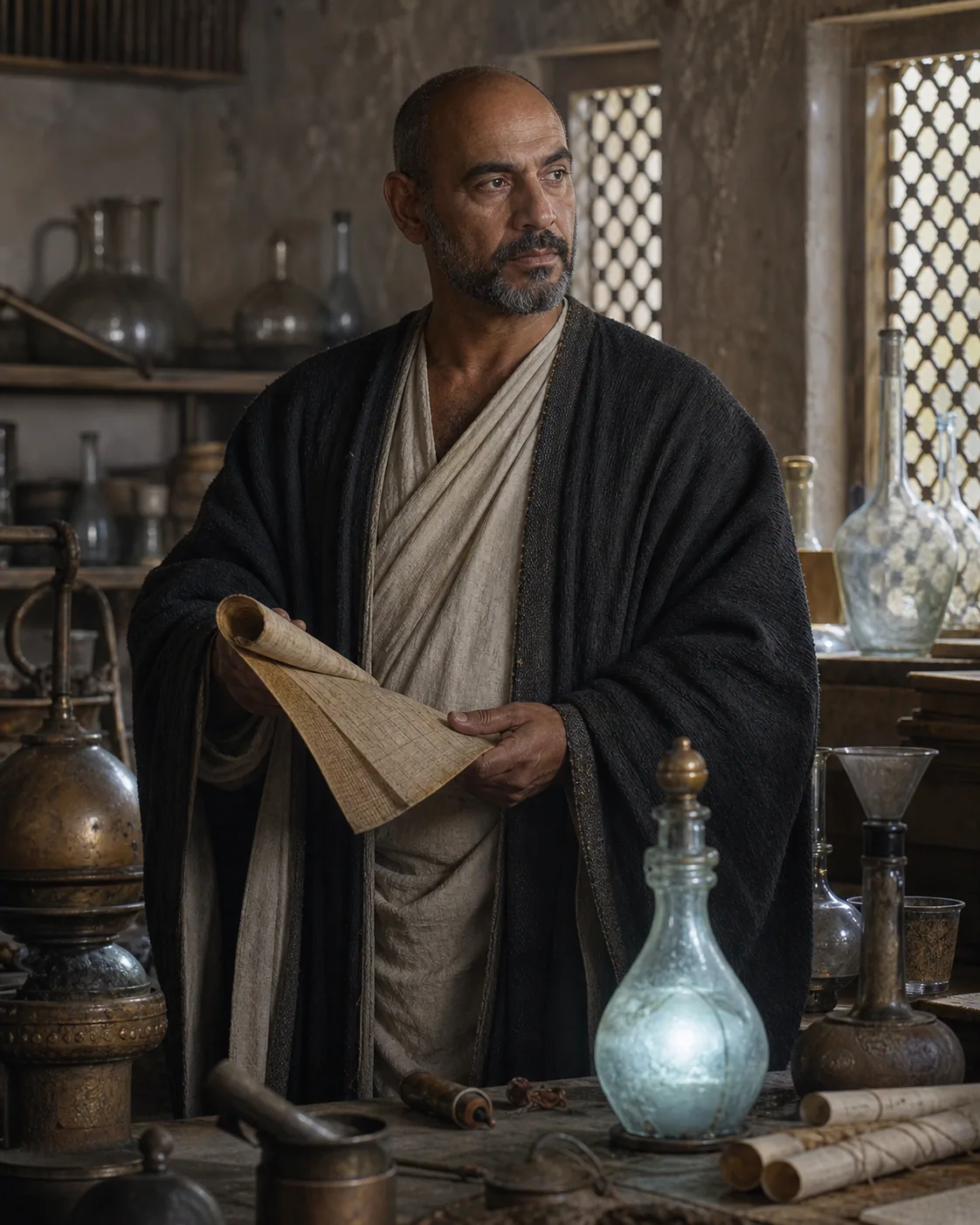
Zosimus is the late-antique alchemist whose work links B's immortal body to a human attempt to reproduce or extend life. He appears in BRZRKR: The Lost Book of B. as a figure surrounded by laboratories, substances, texts, and apparatus. His interest in B is not the same as the cult's prophetic devotion or Genghis Khan's imperial use of a living weapon. Zosimus treats the mystery as a material problem. If B can survive what no ordinary person survives, then perhaps the body contains a principle that can be isolated, transformed, and used.
That approach makes Zosimus one of the most important historical figures in the franchise's chain of reinterpretations. He does not explain B's origin. He does not create the Source. He gives later readers a language for the desire to defeat death through experiment. His work leads toward Lugalṭur, a being made from B-derived material, and the ethical question that follows: when a body becomes the means of making another life, who has the right to decide what that life is for?
The late-antique setting
Zosimus belongs to a world of laboratories, libraries, battlefields, religious practices, and imperial routes. The names around him—Alexandria, Oxyrhynchus, Domitianus, Hermeias, and the people who carry texts between cities—place the story in a historical landscape where knowledge moves through fragile human networks. A formula can be copied, mistranslated, hidden, or turned into a promise by someone who has never seen the original experiment.
The setting matters because Zosimus is not working in a modern institution with stable protocols and a public record of results. His laboratory is both a place of inquiry and a place of danger. Assistants, protectors, soldiers, and patients may understand different parts of the work. The apparatus can be impressive without being reliable. A successful transformation can still produce a person whose future no one has planned for.
B's presence disturbs the normal scale of alchemical ambition. Alchemists can debate the nature of matter, but B is a living body that has already passed through the problem they are trying to solve. He is not a legend copied from a tablet. He can be wounded, questioned, and used. Zosimus therefore encounters a mystery that refuses to remain safely symbolic.
Alchemy and the desire to defeat death
The alchemy associated with Zosimus uses terms such as prima materia, Azoth, and the Water of Life. These terms belong to the story's fictional treatment of alchemical thought. They do not form a real-world recipe, and the publication does not claim that historical alchemy produced B or Lugalṭur. Within BRZRKR, they organize an attempt to understand transformation, preservation, and the boundary between life and death.
Zosimus's ambition is understandable. Every human life ends, and every generation inherits the fear of losing knowledge and loved ones. B appears to offer an answer that has already escaped ordinary mortality. The danger is that the answer is treated as material before it is treated as a person. Once B's blood, tissue, or derived substance is placed on a table, the researcher can begin to imagine that the living body has become an ingredient.
The story does not reduce Zosimus to a cartoon villain. Curiosity, hope, fear, and pride can coexist in an alchemist. He may believe that understanding B could save lives or preserve wisdom. At the same time, the methods surrounding his work can expose others to coercion and experiment. The tension is important because BRZRKR's institutions usually begin with a reasonable desire and become dangerous when the people inside them decide that the desired result justifies ownership.
B as material evidence
Zosimus's relation to B is defined by the distance between a body and the meaning assigned to it. B is evidence that life can continue after catastrophic injury. He is also a man with memory, grief, and a history of being used. Zosimus's laboratory can measure the first fact while ignoring the second.
The distinction explains why B remains resistant to every attempt to turn him into an answer. His blood can be collected, his tissue can be separated, and his history can be copied into a text, but none of those actions reproduces the whole person. Zosimus may be able to identify a substance that behaves like part of B's body, yet he cannot extract the choices that make B responsible for what he does.
The material approach also creates an echo of B's childhood. His father named him Unute, a tool or weapon, before the child could choose a purpose. Zosimus's apparatus gives a different vocabulary to the same danger. A body becomes a thing to be shaped for a future decided by someone else.
The laboratory
Zosimus's laboratory is a place where intellectual ambition becomes physical. Vessels, heat, distillation, mixtures, inscriptions, and machines surround the work. The setting has the visual language of experiment, but it also carries the secrecy of ritual. A formula may be read as a philosophical statement in one room and as an instruction for producing a body in another.
The laboratory's boundaries are porous. Materials arrive from battles and markets. Ideas travel through older traditions and new translations. People who protect the work may be soldiers rather than scholars. The building is therefore connected to a wider network of power. It cannot be understood as a private study isolated from the wars, rulers, and cult histories around it.
The apparatus itself remains partly undescribed. That restraint prevents the story from turning the laboratory into a technical manual. What matters is the function: Zosimus is trying to force matter across a limit that ordinary bodies cannot cross. The result is not an abstract proof. It is a living being whose needs cannot be satisfied by the success of the experiment alone.
Lugalṭur's creation
Zosimus's most lasting consequence is Lugalṭur Dumu-Biritum. B-derived material is placed into a process that produces a new life, developing through a vessel or egg. The method combines biology, alchemy, and the desire to make an answer visible. The story leaves parts of the process unexplained, but it is clear that Lugalṭur is not merely a pile of copied tissue.
The creation raises a question Zosimus's method cannot settle. If the body comes from B, does B own the result? If alchemical work shaped the development, does the alchemist own it? If a protector keeps the new being alive, does protection become a claim? Lugalṭur's existence turns the laboratory's philosophical question into a moral emergency.
Zosimus may understand the derived body as evidence that B's condition can be transmitted. Theosebeia understands the developing person as someone who must be protected. Lugalṭur eventually understands himself as neither a failed copy nor a tool. The contrast between those views is the emotional center of the late-antique material.
Theosebeia's refusal of ownership
Theosebeia provides the counterpoint to Zosimus's ambition. She protects Lugalṭur when others could treat him as a vessel, specimen, or weapon. Her care does not erase the fact that the being was created through an experiment. It gives him time to become a person rather than allowing the experiment to decide his entire future.
Her relationship with Lugalṭur demonstrates what Zosimus's work leaves out. A life needs more than a successful reaction. It needs food, safety, language, trust, and the chance to make a decision that no one has written into the apparatus. Theosebeia does not claim that protection makes Lugalṭur hers. She understands that care is responsible for another person's survival without becoming possession.
That distinction also changes how Zosimus is remembered. His name is tied to the experiment, but the moral meaning of the experiment is shaped by the people who refuse to treat its result as property. Lugalṭur's independence becomes a judgment on the laboratory's original purpose.
B's encounter with the result
B eventually encounters Lugalṭur and recognizes the material connection. The meeting could have become a reunion in which the creator claims the creation, but B refuses that role. He knows what it means for a father or ruler to say that a body belongs to the person who made or trained it. Instead of commanding Lugalṭur, B releases him to make a life outside the purpose assigned by the people who produced him.
That decision does not absolve Zosimus or erase the danger of the experiment. It shows that a later choice can interrupt an older pattern. B cannot undo the creation, but he can refuse to extend the laboratory's ownership into the future. Lugalṭur is allowed to carry the history of his body without being trapped by it.
Zosimus and the cult
Zosimus's work sits beside the cult's historical interest in B but is not identical to it. The cult reads B through prophecy, lineage, and sacred purpose. Zosimus reads him through substance and transformation. Both approaches can lead to exploitation, and both can preserve fragments of truth. The story keeps them separate to show that the same immortal body can attract different institutions without those institutions sharing a single explanation.
The cult's influence may help explain why information about B reaches later investigators, but Zosimus's laboratory has its own intellectual and practical logic. A ruler can use an alchemist without understanding the theory. An assistant can copy a formula without knowing what it was meant to do. A surviving text can describe a transformation while leaving out the person who suffered through it.
The ethics of making life
Zosimus's character is most compelling when the alchemical ambition is read as an ethical problem rather than a puzzle with a final answer. Making life can be generous if it is done for the sake of the life made. It becomes coercive when the new person exists only to satisfy the maker's fear of death or need for power.
The story does not tell readers that all experiments are wrong. It asks what obligations begin when an experiment produces someone who can feel and choose. Zosimus's laboratory may discover a path through matter, but it cannot decide whether Lugalṭur is grateful, afraid, angry, or free. Those questions belong to the person who emerges.
B's body makes the issue unavoidable because he has already lived through the consequences of being assigned a purpose. The laboratory's success is therefore measured not only by whether Lugalṭur survives, but by whether he is allowed to outgrow the reason he was made.
Narrative significance
Zosimus expands BRZRKR's historical imagination. He brings the language of alchemy into a series otherwise shaped by prehistoric birth, ancient ritual, modern science, and cosmic contact. His work shows that the desire to defeat death has no single era or institution. It can appear as prayer, kingship, cult, experiment, or family inheritance.
He also creates the bridge between B's biology and a new person. Without Zosimus, Lugalṭur's story would not have the same philosophical pressure. The alchemist makes it possible to ask whether material origin determines identity. The answer given by the people around Lugalṭur is no: a body can carry a history without being owned by that history.
Zosimus's impact therefore extends beyond his laboratory. He changes the meaning of B-derived fragments from inert evidence into the possibility of another life. That possibility is dangerous, but it is also hopeful. The experiment produces a person who can leave the experiment's purpose behind.
What remains unknown
The material does not provide a complete biography of Zosimus, the exact dates of his work, the full design of the life-extension apparatus, or the later fate of every assistant and text connected to the laboratory. It does not settle how much of his method came from independent study and how much came through the cult's interest in B. The terms used by the alchemists are meaningful within the story but do not form a complete recipe.
Those limits keep Zosimus's importance focused. He is the figure who turns B's body into a late-antique experiment and whose work makes Lugalṭur possible. His legacy is measured not by a perfect solution to death, but by the moral challenge created when the solution becomes a person.
References
[1] Keanu Reeves and Matt Kindt, BRZRKR: The Lost Book of B. #1 (BOOM! Studios), Zosimus, alchemy, B-derived material, Lugalṭur, and the late-antique setting.
[2] Reeves and Kindt, The Lost Book of B. #1, Theosebeia's protection of Lugalṭur and B's decision to release him rather than claim ownership.