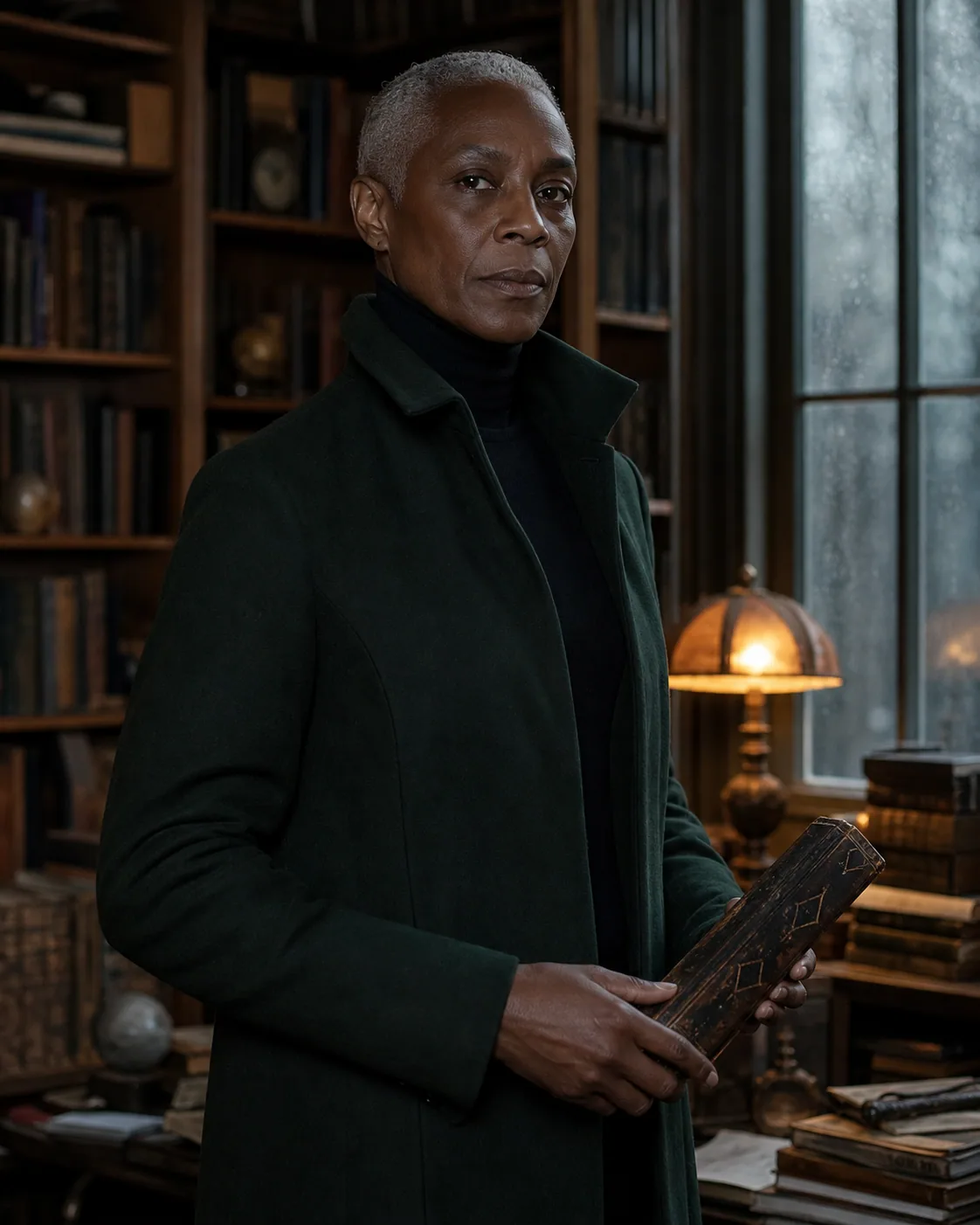
Spoilers: This article discusses Caldwell's clandestine killings and his search for Unute-related history in The Book of Elsewhere.
Overview
Weatherly Knighton is a named victim in The Book of Elsewhere. Caldwell remembers Knighton alongside Josh Barrientes and Jon Peters while describing the private killings he committed during his search for information about Unute, the ancient identity of B. The novel does not give Knighton a separate scene, a spoken line, or a complete personal history. Instead, the name appears inside Caldwell’s recollection of the people who stood between him and fragments of B’s hidden past.
That brief appearance gives Knighton an important place in the novel. Caldwell’s knowledge of Unute is not the result of a single official investigation. It has been assembled from people who may have encountered artifacts, texts, maps, traditions, or stories that connect an impossible figure to human history. Knighton belongs to that world of scattered custodians. The exact part Knighton played is unknown, but the death demonstrates the danger surrounding the material Caldwell wants to possess.
The novel names Knighton as Weatherly Knighton. The longer form Weatherly Kallina Knighton appears in secondary material, but the middle name is not established in the passage that introduces the character. No occupation, nationality, rank, title, family, or personal history is confirmed. Those absences are significant because Caldwell’s recollection deliberately groups several possible kinds of knowledge-holder together without assigning one profession to each person.[1]
Appearance in *The Book of Elsewhere*
Knighton appears through Caldwell’s memory rather than through a present-day encounter. Caldwell is thinking about the secret agendas that surround the Unit and about the people who may serve governments, religions, sects, private ideologies, or their own interests while appearing to pursue another goal. His thoughts turn toward the people he has killed while following his private investigation into Unute.
The names Josh Barrientes, Weatherly Knighton, and Jon Peters occur together in that recollection. Caldwell remembers approaching people who possess or protect information, realizing that they will not give him what he wants, and killing them. The passage describes several acts of violence across the remembered group, including strangulation and a blade entering between the ribs, but it does not assign one method to Knighton individually. Knighton’s death is therefore established as homicide by Caldwell while the precise method, location, and date remain unknown.[1]
The scene is important because Caldwell does not describe the victims as combatants in a conventional operation. They are part of the hidden human network through which he has been collecting evidence. Their deaths are private acts carried out for a purpose that Caldwell has not fully shared with the Unit. Knighton’s name turns that hidden history into a personal crime rather than an abstract research problem.
Name and identity
The novel’s confirmed name is Weatherly Knighton. The text gives no title or professional description that can be attached to the character alone. Caldwell considers a range of possible occupations for the people he has hunted: archaeologists, priests, map sellers, dealers in unusual objects, and information brokers. The passage presents these as possibilities within the group, not as a list that identifies Knighton’s job.
The uncertainty leaves several plausible lives open. Knighton may have encountered an object during archaeological work, inherited a religious tradition, sold a map or antiquity, or passed information between people who knew more about Unute than formal institutions did. None of those possibilities is confirmed. The novel’s restraint keeps Knighton from becoming a biography built out of a name and a guess.
The same restraint applies to gender and personal background. The name alone cannot establish a gender, nationality, age, or cultural identity. No family relationship, education, military service, or government employment is given. Knighton is a human character whose importance comes from the knowledge sought by Caldwell and the violence used to obtain it, not from an invented résumé.
Connection to Unute
Knighton’s connection to Unute is the central unanswered part of the character’s history. Caldwell’s recollection makes clear that the people he killed were connected to material or information about the ancient figure. The novel later describes figurines representing Unute, poems written in forgotten alphabets, and traditions that associate him with death and a primordial or “first” silence. Caldwell has been collecting such fragments across time and geography.
The passage does not state that Knighton owned the figurines. It does not say that Knighton wrote the poems, kept a specific map, guarded a particular site, or belonged to a named religious or academic group. The safest conclusion is that Knighton possessed, protected, or knew something Caldwell believed could advance his search. The object or information is not identified.
That uncertainty changes the meaning of the death. Caldwell is not simply removing an enemy from a battlefield. He is taking control of a chain of memory. The person disappears, while the clue may survive in Caldwell’s private collection. The novel therefore separates the survival of information from the survival of the people who carried it. B’s body can regenerate; Knighton’s mortal life cannot. Caldwell treats that difference as permission to destroy the custodian and keep the knowledge.
Knighton’s possible connection also places the character beside the novel’s larger history of Unute. Human societies have interpreted B as a weapon, a divinity, a monster, a protector, a historical king, or a scientific problem. A person who preserves one version of that history can become valuable to anyone who wants to control the story. Knighton represents one of those vulnerable points where a long, legendary past enters the modern world through a mortal life.
Relationship with Caldwell
Caldwell is Knighton’s only confirmed direct relationship. He is the person who remembers the killing and the person responsible for it. The relationship is therefore defined by predation rather than partnership. Caldwell wants access to knowledge; Knighton stands between Caldwell and whatever material or information he believes Knighton possesses.
Caldwell’s conduct reveals that his search for Unute is personal. He operates inside the government’s secret Unit, but he does not surrender every discovery to the institution. He decides which findings to share and which to keep. His recollection of Knighton, Barrientes, and Peters shows the method behind that private collection: identify a person who may know something, confront the person, and use violence when the information is not surrendered.
The novel does not describe a friendship, professional partnership, or previous personal history between Knighton and Caldwell. The killing may have followed a meeting arranged through research, collecting, religion, commerce, or intelligence, but the circumstances are not supplied. Caldwell’s memory establishes motive at the level of the Unute investigation without explaining the exact conversation that preceded the violence.
Knighton’s death also exposes Caldwell’s divided loyalties. The Unit may eventually benefit from information he has gathered, but that does not make Knighton a government employee or a Unit operative. A person’s knowledge can enter an institution after death even when the person never belonged to that institution. The distinction matters because Caldwell’s official role cannot be used to explain away the private crime.
Relationship with Josh Barrientes and Jon Peters
Knighton is named with Josh Barrientes and Jon Peters in the same passage. Their shared connection is Caldwell’s recollection of killing people involved in the hidden search for Unute. The novel does not state that the three knew one another, worked together, lived in the same place, or possessed the same kind of evidence.
The three names create a pattern without creating a social group. Barrientes, Knighton, and Peters may have come from different backgrounds and may have encountered different kinds of material. What unites them is the danger of becoming a custodian of history in Caldwell’s path. A collective reading of the passage shows the scale of Caldwell’s private investigation, while the individual names preserve the fact that each victim had a separate life.
This is one of the novel’s most effective uses of a brief character mention. Knighton does not need a long conversation to alter the reader’s understanding of Caldwell. The name is enough to show that his research has a body count and that the people who hold fragments of the past are not interchangeable.
Death
Knighton is already dead when Caldwell remembers the killings. The cause is homicide, and Caldwell is the killer. The novel does not give a date, location, witness, burial, or individual method. The remembered group is associated with strangulation and stabbing, but the text does not identify which act killed Knighton.
The death can be placed only relative to Caldwell’s recollection: it occurred before the present-day events in which he thinks about the victims. No exact historical year is available. Nothing in the passage indicates that Knighton regenerated, survived, or appeared elsewhere in the novel. The death is final within the information currently supplied by the prose continuity.
The emotional detail of the passage is also important. Caldwell remembers the victims realizing what is happening and reacting with surprise and fear. He remembers disappointment in their fading expressions and their efforts to hold on to whatever he is trying to take. The word suggests that the killings may have involved betrayal or a failed expectation, but the novel does not say whether Knighton trusted Caldwell or expected to survive the meeting.
Role in the novel
Knighton’s role is to make Caldwell’s hidden history concrete. A secret collection of artifacts and stories can sound like an intellectual mystery until the reader learns how the collection was built. Knighton’s name changes the scale of that mystery. The objects and texts connected to Unute have passed through mortal hands, and some of those people were killed so that Caldwell could continue his search.
Knighton also helps define the difference between B’s immortality and the lives around him. B’s history stretches across roughly eighty thousand years, but the people who remember him are vulnerable to ordinary death. A figurine or poem may survive the death of its custodian. Caldwell can preserve a clue while erasing the person who knew how to interpret it. That imbalance is one of the novel’s most disturbing ideas.
The character further complicates the meaning of archaeology and historical recovery. The ancient material in The Book of Elsewhere does not arrive through a simple chain of museums, universities, and authenticated discoveries. It moves through private collectors, religious traditions, dealers, maps, forgotten alphabets, and people who may conceal what they know. Knighton belongs to that compromised route from the past to the present.
Finally, Knighton reveals Caldwell’s autonomy. Caldwell is not merely an agent carrying out the Unit’s visible mission. He has a private purpose and a private collection. The victims named in his recollection show that his pursuit of Unute is willing to cross the boundary between research and murder. Their deaths give the later revelations about B’s history an ethical cost that cannot be separated from the information itself.
Continuity and appearances
Weatherly Knighton belongs to The Book of Elsewhere prose continuity. The character first appears through Caldwell’s recollection of the named victims. No independent dialogue or present-day scene is established in the passage. No appearance in the supplied BRZRKR #1-12 comic record or an adaptation is confirmed.
The longer form “Weatherly Kallina Knighton” remains a secondary name form rather than a fact established by the novel. The prose continuity is kept separate from the comic continuity because a shared Caldwell or a shared reference to Unute does not make every supporting character appear in both branches.
Unresolved aspects of Knighton’s life
The novel leaves Knighton’s occupation, family, nationality, age, personal beliefs, and earlier relationship with Caldwell unknown. It does not identify the exact object or text that drew Caldwell’s attention, the place where the killing occurred, or the route by which Caldwell found Knighton. It also does not say whether any of Knighton’s knowledge reached the Unit directly after the death.
Those absences do not make the character unimportant. They define the kind of history Caldwell has been collecting: partial, violent, and stripped from the people who carried it. A later BRZRKR publication could identify Knighton’s role or reveal a surviving connection, but the current novel supports only the name, the victim relationship, the Unute-related context, and the uncertain circumstances described above.
Memory, violence, and the value of a name
Knighton's name interrupts the abstraction of Caldwell's investigation. Ancient figurines, forgotten alphabets, and stories of Unute can be treated as fascinating evidence until the novel places a human casualty beside them. Knighton was not a symbol waiting to be interpreted. Knighton was a person whose life ended because Caldwell believed knowledge should belong to him.
The contrast with B is especially sharp. B's body repeatedly returns after catastrophic injury, while Knighton's death is presented as an ordinary human loss. Caldwell can preserve a clue from a mortal custodian and continue living with the result. Knighton cannot answer whether the clue was understood correctly. The imbalance makes the novel's archaeology ethically charged: the more valuable the object, the greater the temptation to forget the life that carried it.
Knighton also helps explain why Caldwell's private work is different from the Unit's official mission. The Unit may deploy B into violence as part of a visible operation, however compromised that bargain is. Caldwell's recollected killings happen away from that public chain of command. He is not protecting a squad or responding to an immediate threat. He is deciding that another person's refusal is an obstacle he has the right to remove.
Because Knighton is named with Barrientes and Peters, the memory becomes a pattern rather than an isolated crime. The three may have had different backgrounds, and the novel does not say they knew one another. Their shared role is that each held, protected, or knew something that connected to Unute's hidden past. The names keep the victims distinct while showing the reach of Caldwell's search.
The character's limited appearance is therefore not a reason to dismiss Knighton. It is the point. A single remembered name can change the meaning of a whole investigation when the reader understands what has been taken along with the knowledge. Knighton's impact on The Book of Elsewhere lies in making the cost of historical discovery impossible to ignore.
References
[1] Keanu Reeves and China Miéville, The Book of Elsewhere (Del Rey, 2024), Caldwell’s recollection naming Weatherly Knighton with Josh Barrientes and Jon Peters and describing the group’s possible occupations, deaths, concealed Unute-related material, and Caldwell’s selective sharing of information with the Unit. Pagination varies by edition.