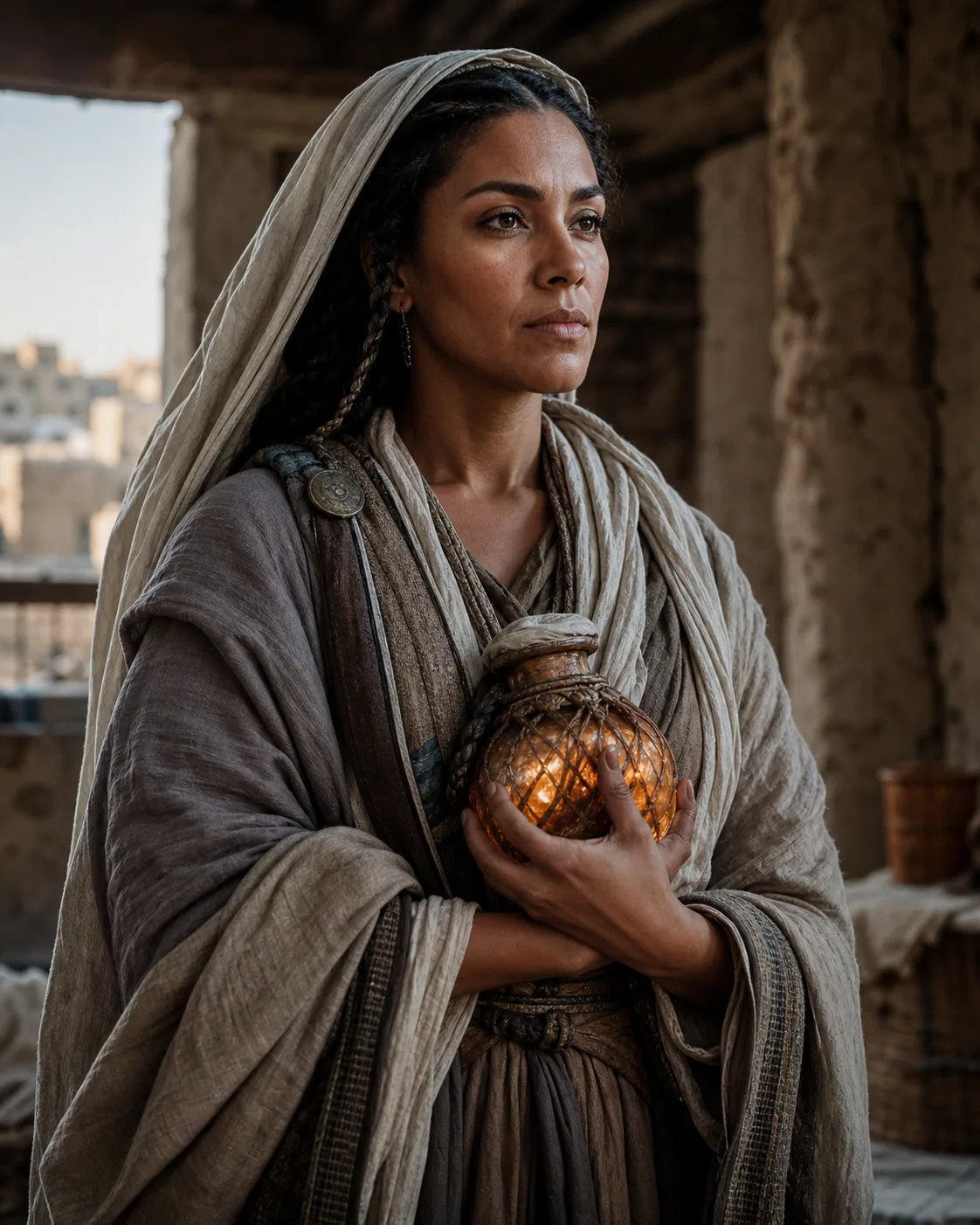
Spoilers: This article discusses Theosebeia's protection of Lugalṭur, Zosimus's alchemical work, and the events of BRZRKR: The Lost Book of B.
Theosebeia is the protector who recognizes Lugalṭur Dumu-Biritum as a developing person rather than a vessel, specimen, or weapon. She appears in the late-antique branch of BRZRKR: The Lost Book of B., where B-derived material has been placed inside an alchemical process intended to approach the secret of life. Theosebeia's decision to defend the result gives the story its moral center. A body may be made for one purpose, but the person who emerges from it is not required to fulfill that purpose.
Her role is easy to underestimate because she does not command an empire, build the apparatus, or possess B's extraordinary strength. Her power is relational. She creates the conditions in which Lugalṭur can survive long enough to develop language, memory, and a sense of self. In a world where rulers, cults, and alchemists repeatedly turn bodies into instruments, Theosebeia practices care without ownership.
The world around her
Theosebeia's story takes place among laboratories, battlefields, refuges, and routes connecting late-antique communities. Zosimus's work belongs to a culture of texts and experiments in which the Water of Life, Azoth, and prima materia are treated as possible ways through or around death. The surrounding world is not peaceful scholarship. Military power, religious authority, and the movement of valuable knowledge make the people associated with the experiment vulnerable.
The setting gives Theosebeia a difficult task. Protecting Lugalṭur is not simply a matter of hiding a child in a safe room. The people who want the derived being may have soldiers, formulas, money, or a claim that the experiment belongs to them. A refuge must move or remain concealed. Theosebeia has to read the danger around the laboratory while also responding to a person whose needs change as he develops.
Her courage is therefore practical rather than ceremonial. She is willing to stand between Lugalṭur and the people who would reclaim him, even when the claim is supported by the fact that they made the body. The story treats that willingness as an ethical act, not merely as another historical battle.
Lugalṭur before personhood is recognized
Lugalṭur begins as B-derived material enclosed in a vessel or egg. The process has an alchemical and biological character, but the exact method is not fully explained. To Zosimus and others involved in the work, the vessel can appear to be an experiment whose success will be measured by what it produces. To Theosebeia, the developing life is already someone who can be harmed.
That difference changes the meaning of every later event. If Lugalṭur is only a result, then moving him, examining him, or exposing him to further tests can be justified as part of the work. If Lugalṭur is a person in development, then the work creates an obligation to protect his future. Theosebeia chooses the second view before Lugalṭur can argue for himself.
Her decision does not depend on pretending that his origin is ordinary. She knows that he is connected to B and that the experiment has produced something extraordinary. The point is that extraordinary origin does not cancel personhood. A body made from another body can still become an individual whose life is not a continuation of the maker's intention.
Protection without possession
Theosebeia's relationship with Lugalṭur is defined by care rather than ownership. She feeds, hides, guides, and defends him, but she does not turn protection into a demand for permanent loyalty. This distinction is central to BRZRKR because many of B's relationships begin with someone claiming that control is necessary for safety.
B's father trains him as a weapon in the name of the tribe. Atlantis uses his blood to defend the city. Olos keeps him as a captive champion. The government program promises mortality in exchange for service. Theosebeia offers a different model. She accepts responsibility for Lugalṭur's survival without telling him that survival creates a debt that must be repaid through obedience.
That model is not effortless. A protector has power over a dependent person. Theosebeia can choose where Lugalṭur goes and who may approach him. Her care remains morally meaningful because the story shows her moving toward his independence rather than treating dependence as the ideal final state. She protects him until he can participate in the decision about what happens next.
The threat of the laboratory
The laboratory represents the danger Theosebeia resists. Its instruments and substances make life appear measurable. If the apparatus can produce a body, the people who operate it may believe they own the body. The story does not require every alchemist to be cruel for that danger to exist. The pressure comes from the logic of the experiment itself: success is defined by result, while the result has needs and wishes that the method cannot calculate.
Zosimus's work is not dismissed as meaningless. The alchemy creates real effects and gives the historical branch a language for transformation. Theosebeia's disagreement is about what follows the success. A person cannot remain a demonstration simply because the demonstration is impressive. Lugalṭur must be allowed to become more than evidence of what B's material can do.
Her protection therefore changes the alchemical question. The problem is no longer “Can B's life be reproduced?” It becomes “What responsibilities begin when the reproduction has a life of its own?” Theosebeia answers through action rather than theory. She keeps Lugalṭur alive, gives him time, and refuses to return him to people who describe him as property.
Relationship to B
Theosebeia's relationship with B develops through Lugalṭur. B is the material source of the new being, but he is not the architect of the experiment. When he learns what has been made, he has to decide how to respond to a person who carries part of his body and history.
Theosebeia's presence makes the choice more difficult and more humane. She has protected Lugalṭur without claiming him, and B can see what a different form of parenthood might look like. His own father treated origin as authority. Theosebeia treats origin as a reason to care, not a right to command. B's eventual decision to release Lugalṭur follows the path she has already made possible.
The relationship between Theosebeia and B is not presented as a romance or as a conventional family bond. They are connected by a shared responsibility to a person who could be destroyed by someone else's purpose. Theosebeia protects Lugalṭur from being owned; B refuses to own him once they meet. Together, their choices allow the derived being to leave the laboratory's shadow.
Lugalṭur's development
Theosebeia's work is measured over time. A single rescue would not be enough. Lugalṭur has to grow into a body that can move, remember, and speak. He has to learn that the people around him may want different things from him. He has to understand that B's history is connected to his own without making B the answer to every question.
Theosebeia gives him a stable relationship during that development. She is evidence that not every powerful adult sees him as an instrument. Her protection allows him to form a self before the wider world demands a use from him. That selfhood is what makes the later release meaningful. B is not freeing a blank vessel; he is recognizing someone who has already begun to become himself.
Her influence also teaches Lugalṭur that care can coexist with independence. She does not pretend that he can survive without other people, but she does not use dependence to keep him in a permanent child role. The goal of protection is the possibility of choice, not the preservation of the protector's authority.
The wider pattern of mothers and protectors
Theosebeia echoes B's mother without replacing her. B's mother prays for help and tries to shield her child from the meaning others attach to him. Theosebeia encounters a being already shaped by an experiment and tries to prevent that experiment from becoming his whole identity. Both women resist weaponization, but their circumstances differ.
The comparison makes visible how BRZRKR treats care across eras. A mother, a guardian, a scientist, or a ruler can claim to protect someone while also deciding what that person is allowed to become. Theosebeia's distinction is not that she has no power. It is that she directs power toward the protected person's future rather than toward the preservation of her own control.
This is why her role matters to B's family story even though she is not a blood relative. Family in BRZRKR can be created through responsibility, rescue, and the refusal to abandon someone. Lugalṭur's relationship to Theosebeia becomes part of the wider question of whether origin or care makes a parent.
The journey away from the apparatus
Theosebeia's protection moves Lugalṭur away from the laboratory and into a larger historical world. Roads, camps, and battlefields expose him to people who have no interest in the experiment's philosophy. They see a strange child, a rumor, or a possible weapon. Theosebeia has to keep him alive while helping him understand that the world will continue to define him through incomplete stories.
That journey gives the late-antique branch its movement. The issue is not only about a room where a body is made. It is about what happens when the body leaves the room and encounters history. Lugalṭur's existence can no longer be contained by the language of alchemy. He has to decide how to respond to B, to the people who pursued him, and to the name attached to his creation.
Theosebeia's role changes as he becomes more capable. She can still protect him from immediate danger, but she cannot choose his beliefs or his destination. The end of her work is not a triumphant claim that she has created the perfect child. It is the recognition that the child has become a person who must be allowed to walk beyond her.
Narrative significance
Theosebeia is one of BRZRKR's clearest answers to the problem of manufactured life. The series repeatedly shows people trying to use B's body to overcome mortality. Her story asks what a humane response looks like once the experiment succeeds. The answer is not to destroy the new being or to return him to the person who paid for the research. It is to protect his development and then respect his independence.
She also expands the meaning of strength. B can protect through overwhelming violence. Theosebeia protects through patience, concealment, movement, and the willingness to accept that the person she saves may leave her. Her actions are less spectacular than a battlefield, but they alter the future more deeply. Lugalṭur can choose because she refuses to make gratitude a chain.
The character therefore stands at the intersection of biology and ethics. B's material can be copied or transformed, but the meaning of the copy depends on how other people treat it. Theosebeia proves that the most important difference between a specimen and a person is not the substance of the body. It is whether someone is willing to recognize the body's right to a future.
What remains unknown
The material does not supply a complete account of Theosebeia's birth, training, family, religious commitments, or later life. It does not explain every detail of how she found Lugalṭur or how she learned to protect him. Her motives are visible through her actions, but her private history remains limited.
That restraint keeps her from becoming a simple symbolic saint. Theosebeia is a person making difficult decisions in a dangerous world. She may not be able to save everyone, and she may not understand every force pursuing Lugalṭur. What she does understand is enough: a life that began as an experiment cannot be returned to the experimenter as if it were an object.
References
[1] Keanu Reeves and Matt Kindt, BRZRKR: The Lost Book of B. #1 (BOOM! Studios), Theosebeia's protection of Lugalṭur, Zosimus's alchemical work, and the late-antique setting.
[2] Reeves and Kindt, The Lost Book of B. #1, Lugalṭur's development, B's encounter with him, and the decision to allow him an independent life.