Spoilers: This article discusses the Sorceress's relationship to the Captain, the idols and summons of The Bleeding Tide, and the conflict surrounding B's recovery.
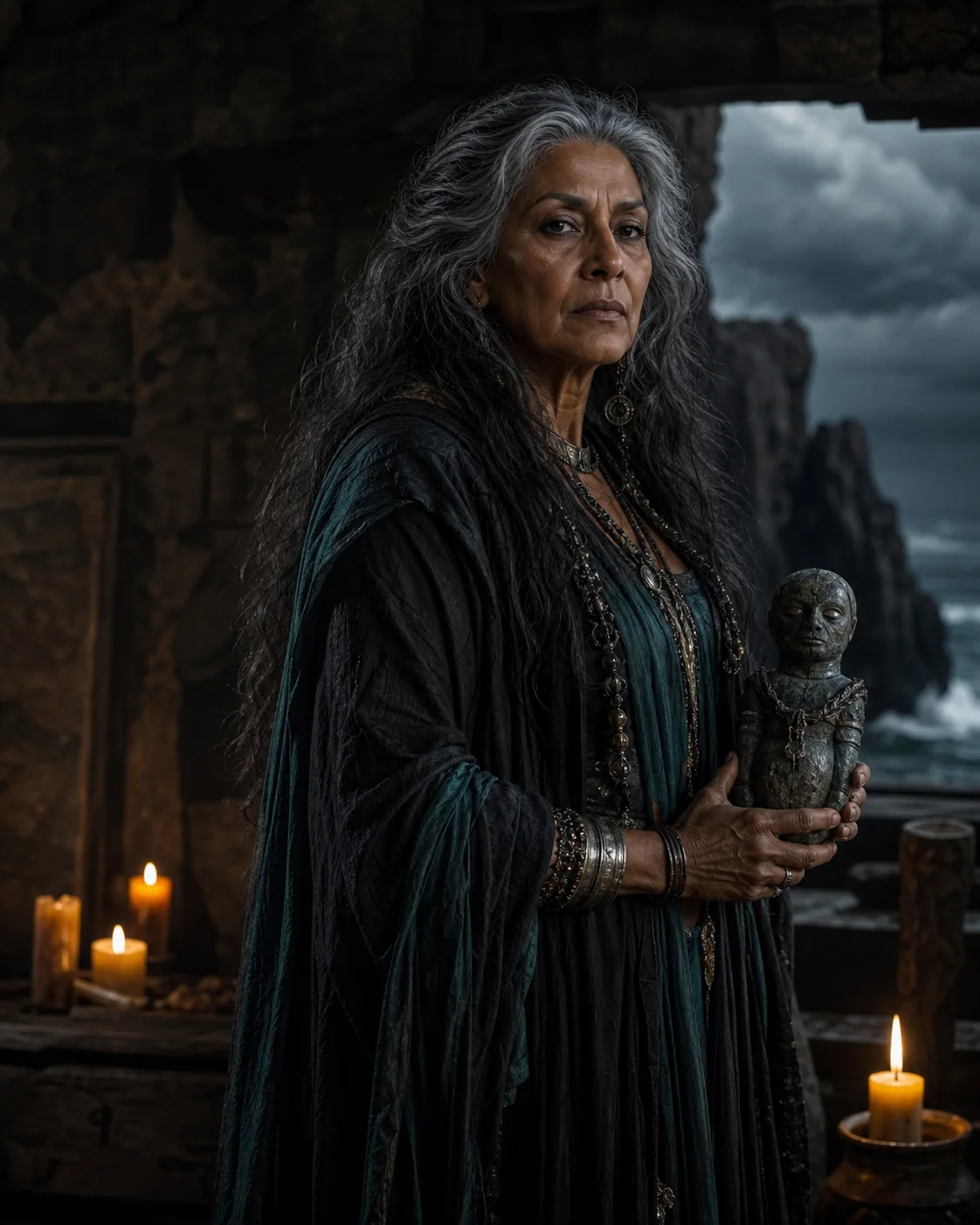
The Sorceress is the supernatural power at the heart of the maritime conflict in BRZRKR: The Bleeding Tide. Her personal name is not supplied in the material used here. She is identified by a title that emphasizes what she does: she works through ritual, inherited power, idols, and summoned beings rather than through the lightning-linked biology that governs B's regeneration or the machines of the B Program.
The Sorceress matters because she gives the one-shot a second kind of immortality to place beside B. The Captain's world is built around blood and family, while B's body carries an ancient transformation that scientists and cults attempt to exploit. Their systems can meet without becoming the same. The Sorceress's power is not a secret explanation for B, and B's presence is not proof that every supernatural tradition in the maritime branch descends from the Source.
A power inherited through secrecy
The Sorceress's influence is felt through objects and places before her complete history is explained. Idols, ritual spaces, a stronghold, and summoned creatures make her power physical. The symbols are not decoration. They carry obligations, memories, and threats that reach into the Captain's family. A person who encounters the Sorceress's world is not simply fighting an individual; they are entering a system that has already decided what blood and loyalty mean.
The title “Sorceress” also reflects the limits of what the story reveals. It describes the role visible to the Captain, the crew, B, and the hunters. It does not provide a birth name, a full biography, or a complete chronology. The absence keeps attention on the effects of her power and on the relationship it creates between the Sorceress and the Captain.
Her secrecy is strategic. The Captain understands enough to fear what follows her, but not enough to make the past safe by explaining it. A secret inherited from a family can become a weapon against the person who tries to leave. The Sorceress's authority therefore resembles B's father and Caldwell in one important way: it treats knowledge as a form of control. The difference is that her methods are ritual and supernatural rather than military or scientific.
The Sorceress and the Captain
The Sorceress's central relationship is with the Vampire Captain. The conflict is personal, but the material does not reduce it to a simple argument between relatives or rivals. The Captain commands a ship and a crew, while the Sorceress commands a network of symbols, summons, and inherited power. One moves across the sea; the other controls the place toward which the sea route leads.
The Captain's decision to rescue B threatens the balance between them. Before the recovery, the Sorceress's history is a problem the Captain carries. After the recovery, the Captain also carries an immortal body whose survival could change the outcome of the supernatural struggle. B is not a willing member of either side, but his presence makes every faction imagine what his body could do.
The Captain's secrecy protects her from immediate pursuit and keeps the crew together, yet it also leaves her vulnerable when the Sorceress's influence reaches the ship. The conflict asks whether the Captain can break from an inherited role without repeating the same methods of concealment and coercion. She is trying to protect the crew and herself while still operating inside the language of the power she wants to escape.
Idols and material symbols
The Sorceress's idols give her power a material center. An idol can be carried, hidden, traded, or destroyed, but it also stands for a presence larger than the person holding it. The Captain's world therefore turns objects into participants in the conflict. A symbol can identify allegiance, invite a summon, or preserve a relationship after the original speaker is gone.
This use of objects echoes the wider BRZRKR pattern. B's mother's bird-shaped gift carries love and becomes evidence in a modern expedition. Atlantis's obelisk and ritual cups connect a city to its gateway. Caldwell's recovered artifacts support a cult history that survives through centuries. The Sorceress's idols belong to the same thematic family while remaining distinct in mechanism. They show how people invest material things with the power to preserve or command a life.
The story does not provide a complete inventory of the idols or a universal rule for what each one can do. Their importance is contextual. They are tied to the Sorceress's stronghold and to the summons that defend her power. Treating them as ordinary weapons would miss their function. They are keys, witnesses, and threats as much as objects that can harm a body.
Summons and supernatural force
The Sorceress works through summoned beings and effects that do not behave like ordinary soldiers. A summon is not simply another person recruited to a crew. It is an expression of the ritual system, called into the present through symbols and command. The beings make the environment itself feel hostile to anyone who does not understand the rules.
B's experience gives him an unusual advantage against such threats. He has survived thousands of kinds of battle and can act while injured or dismembered. That does not make him immune to the Sorceress. A summon can trap, overwhelm, or separate him from the people he is trying to protect. Regeneration solves the problem of physical death more often than it solves the problem of position, trust, or choice.
The summons also challenge the Captain's authority. A crew can obey a captain because the captain is a human presence whose choices can be argued with. A summoned being can appear to embody an order from somewhere else. The crew has to decide whether it is facing an enemy with motives or a force that will continue until the ritual is broken. That uncertainty produces fear and makes the Captain's command harder to sustain.
The stronghold
The Sorceress's stronghold is more than a residence. It is a place where the maritime route ends and where inherited power is made visible. Its distance from ordinary ports gives it an almost mythic quality, but the story connects it to practical dangers: the Captain and her crew have to reach it, survive its defenses, and understand why the journey was forced upon them.
The stronghold's geography should remain separate from Atlantis's gateway, the contact realm, and the laboratories associated with Protocol X. BRZRKR contains several kinds of impossible space. Similar colors, energy, or scale do not prove that they share an origin. The Sorceress's location belongs to the maritime supernatural branch because its rules are expressed through ritual, family, and summons.
The setting also makes escape difficult. A palace can be left by a road, a laboratory by a corridor, and a battlefield by retreat. A stronghold built into a supernatural route may change the meaning of arrival itself. The Captain cannot simply take B and the crew somewhere else if the place has been waiting for them. The location turns inheritance into geography: the past has a door, and the door is guarded.
The Sorceress and B
B becomes involved in the Sorceress's conflict because the Captain brings him aboard, not because he chooses the family struggle. This distinction matters. B has spent his life being pulled into other people's wars because they believe his body can settle them. The Sorceress's power creates a new version of that demand. Her enemies may want to use B against her, while she may see his regeneration as a threat or an opportunity.
B's presence also creates a contrast between two kinds of exceptional person. The Sorceress's power is maintained through symbols and inherited authority. B's power is written into his body and forced into public view by every injury he survives. She can hide behind a system of ritual; he is the living evidence that the system cannot explain everything.
The two are not opposites in a simple moral sense. B has served kings and cults, and the Sorceress may believe that her control protects a family or tradition from destruction. The story's pressure comes from what they do with that belief. A person can inherit a dangerous power without having the right to decide another person's life. B understands the danger because his own father made that decision for him.
Church hunters
Church hunters represent the external force trying to classify and destroy the Sorceress's world. They approach the maritime conflict through the language of curses, monsters, and forbidden practice. Their pursuit gives the Captain a reason to hide and gives the Sorceress a reason to defend her territory. It also makes the sea a place where two kinds of certainty collide.
The hunters' certainty is dangerous because it leaves no space for B's difference. They may see a vampire, a sorcerer's weapon, and an immortal warrior as variations of one threat. The story resists that collapse. B's origin remains connected to the lightning and the Source; vampirism belongs to another tradition; sorcery operates through its own evidence. The hunters can be correct that a danger exists while still being wrong about what it is.
Their pursuit also mirrors the way institutions in the core series justify violence. A government labels B an asset before sending him into missions. A cult labels him a sign before using his blood. The hunters label the Sorceress a curse before attacking her. The common pattern is the belief that naming a person or power gives the institution the right to control it.
The Captain's crew as witnesses
The crew provides the most immediate test of the Sorceress's power. Sailors who knew the Captain as a commander now have to decide whether her family conflict has placed them inside a war they did not choose. Their fear is not abstract. They can see the idols, the summons, and B's body. They have to work, fight, and sleep in the same ship while the supernatural threat closes around them.
The crew's reactions also prevent the Sorceress from becoming a distant villain. Her power is measured by what ordinary people experience: a route that turns dangerous, a ship that cannot find safety, and a captain who will not explain everything. The human cost makes the conflict more than a contest between two extraordinary figures.
Power, blood, and ownership
The Sorceress's story extends BRZRKR's interest in the ownership of bodies. Vampirism creates a social relationship around blood. The idols preserve a claim across generations. The Captain's ship carries people who may be bound to one another by loyalty or fear. B arrives as a body in a box and becomes a person whose presence can be claimed by every side.
This arrangement repeats the franchise's oldest conflict. B's father decides that his son's body should be a weapon. Atlantis decides that his blood should complete a ritual. Olos decides that his life belongs in an arena. Caldwell decides that B's power can be transferred. The Sorceress's system is different, but the Captain's attempt to escape it raises the same question: can inherited power exist without turning the person who carries it into property?
The Sorceress may believe that the answer is no, because her authority depends on a chain of transmission. The Captain's resistance suggests that a tradition can be remembered without being obeyed. B's involvement makes the argument visible. He is a living history who cannot be reduced to the power that created him, and the Captain is a person trying to become more than the family role she inherited.
Narrative significance
The Sorceress matters to BRZRKR because she broadens the series' supernatural range without dissolving its distinctions. Her idols and summons show a world in which power can be carried through ritual and blood, while B's regeneration remains tied to a different origin. The one-shot therefore refuses the easy explanation that every extraordinary body belongs to one hidden system.
She also gives the maritime branch an antagonist whose danger is intimate. Caldwell wants to control the Source. A king wants B's service. The Sorceress's conflict begins in family and inheritance. That smaller scale makes the stakes more personal for the Captain and the crew, even when the effects become supernatural.
Her greatest impact is on the Captain's choice. The Captain can preserve the family system by surrendering B and the crew, or she can risk open conflict by refusing the role assigned to her. The Sorceress becomes the pressure that reveals what the Captain believes a life is worth. B's presence ensures that the answer cannot be expressed only through victory. It must also be expressed through whether anyone leaves the stronghold with the right to choose a future.
What remains unknown
The Sorceress's personal name, human origin, complete chronology, precise relation to the Captain, hierarchy of summons, and full limits of her power are not supplied. The story does not settle whether she is the first holder of the tradition, whether the idols are unique, or whether her stronghold can be reached by routes outside the Captain's journey.
Those gaps are part of the character's effect. The Sorceress is defined through the world that gathers around her: inherited symbols, a threatened family, a ship carrying an impossible passenger, hunters who want a simple category, and a body that refuses to stay dead. Her title is enough to make the conflict legible while the person beneath it remains deliberately hidden.
References
[1] Marjorie Liu and Garry Brown, BRZRKR: The Bleeding Tide #1 (BOOM! Studios), the Sorceress, idols, summons, stronghold, Captain's family conflict, and B's involvement.
[2] Official BOOM! Studios announcement for The Bleeding Tide, describing the Captain's recovery of B and the maritime supernatural premise.