Spoilers: This article discusses Thakka's death and return, Stonier's grief, the Life Project, Caldwell's attempt to recruit him, and the final events of The Book of Elsewhere.
| Field | Details |
|---|---|
| Name | Stonier |
| Species | Human |
| Gender | Male |
| Occupation | Soldier / Unit operative |
| Affiliation | The Unit; later connected to the Life Project |
| Spouse | Thakka |
| Known associates | Keever, Unute, Dr. Shur, Caldwell, other Unit personnel |
| Primary continuity | The Book of Elsewhere |
| First appearance | The Book of Elsewhere |
| Status | Survives significant portions of the novel; final status should be tied to the last confirmed scene rather than inferred beyond the text |
| Creators | Keanu Reeves and China Miéville |
Overview
Stonier is a soldier in the Unit and the husband of fellow operative Thakka in The Book of Elsewhere. His story is one of the novel's most sustained examinations of what B's presence does to the ordinary people assigned to work around him. Stonier is introduced within the Unit's operational culture, where soldiers prepare for missions beside an immortal asset whose body can survive destruction that would instantly kill everyone else in the room. After Thakka dies during an operation and then inexplicably returns to life, Stonier becomes a focal point for grief, institutional duty, counseling, hidden belief systems, and the Life Project.[1][2]
His character is significant because he does not respond to loss in the way Caldwell expects. Caldwell sees Stonier's bereavement as a possible opening through which to recruit him into a secret tradition centered on Unute. Stonier refuses the invitation without necessarily recognizing its full meaning. He emphasizes that Unit personnel understand the risks of working with Unute and frames Thakka's death through service and duty.[3]
That stoicism does not mean the grief disappears. Dr. Shur later works with Stonier and challenges the emotional structure through which he is trying to survive. His connection to the Life Project develops from the problem of how to live after catastrophic loss rather than from simple disloyalty to the Unit.[4]
Stonier therefore sits at the intersection of the novel's military and philosophical plots. He is a trained operative who can participate in missions, a widower whose personal loss becomes politically and metaphysically useful to others, and a character through whom the novel asks whether grief should be endured, transformed, resisted, or eliminated.
Service in the Unit
Stonier is part of the modern U.S. black-operations organization that works with Unute. In the recorded locker-room sequence revisited later in the novel, Stonier is shown preparing a detector while other soldiers perform their own pre-mission rituals. Thakka and Chapman check weapons, Miller and Cohn joke together, Grayson exercises, Keever studies a map, and Ulafson approaches Unute before detonating his bomb.[1]
The detail about Stonier's detector gives him a practical technical function beyond generic rifleman status. He is comfortable handling specialized field equipment and participates in a unit where combat, scanning, intelligence, and anomaly detection overlap.
The novel does not establish a formal rank for Stonier in the cited material. It also does not state that the detector is his permanent specialty. The safest description is Unit soldier / operative with demonstrated use of detection equipment.
Marriage to Thakka
Stonier's defining relationship is with Thakka, another Unit soldier. The novel establishes the two as husbands.[4]
Their marriage transforms Thakka's death from an operational casualty into a personal catastrophe. For Keever, Thakka is a soldier he commanded. For B, Thakka is one more mortal colleague in a long history of people dying around him. For Stonier, the death is the destruction of his closest relationship.
The novel does not reduce their marriage to a narrative device. Stonier's grief has duration, texture, and social consequence. He resists the idea that his feelings can be tidily processed. His interactions with Shur reveal how difficult it is to separate love for Thakka from anger at the conditions that killed him.
The relationship should generate reciprocal internal links:
Thakka's death
Thakka is believed to have died during a mission in a damaged underground site. Keever later remembers seeing him die and collapsing the tunnel with a grenade after the operation.[2]
Stonier is not the viewpoint character for the death scene itself, but its consequences define his biography. The Unit operates in a world where losing people is normalized through language about risk, mission requirements, and duty. Stonier initially responds in a way that appears to preserve that institutional framework.
This matters because the novel contrasts grief as a private reality with casualty as an organizational category. Thakka can be entered into a report as dead. Stonier has to continue living with what that report means.
Thakka's impossible return
The situation becomes far stranger when Keever and B find Thakka alive in the collapsed tunnel. He has a catastrophic wound in his head, a pulse, and enough consciousness to speak.[2]
Thakka's return is not a stable resurrection. It is confused, physically horrific, and tied to evidence that another force has been present. The event destabilizes the Unit's basic understanding of B's uniqueness. Until then, Unute is the one who comes back.
For Stonier, the event complicates grief itself. The person he has lost is suddenly present again, but in a condition that does not restore ordinary life. Resurrection does not cancel bereavement. Instead, it makes the meaning of death more uncertain.
This is central to the novel's larger concern with mortality. B wants an end to endless return. Stonier wants the person he loves. Thakka's brief reappearance shows that simply reversing death is not the same as restoring a life.
Caldwell's interview
After the Thakka crisis, Caldwell speaks with Stonier. On the surface, the conversation concerns risk management and whether the Unit can develop better protocols for working with Unute.[3]
Caldwell has another purpose. He sees Stonier's grief as a possible opportunity to identify him as a sympathetic member of Caldwell's hidden belief system or to recruit him into it. Caldwell uses coded language associated with his secret tradition and watches for recognition.[3]
Stonier gives him none.
The failed recruitment is an important character moment because it demonstrates that grief has not made Stonier indiscriminately vulnerable. He may be angry, wounded, and emotionally rigid, but he does not respond to Caldwell's attempt to convert pain into occult allegiance.
Stonier instead returns to a language of accepted risk and duty. Everyone knew that working around Unute was dangerous. Service carried consequences. Thakka died doing his job.
The novel does not present this response as proof that Stonier is fine. It shows that his first defense against unbearable loss is institutional stoicism.
Duty and emotional restraint
Stonier's reaction to Caldwell is deliberately formal. He invokes the kind of language organizations use to make sacrifice comprehensible: risk, honor, duty, service.[3]
That language may be sincere. It is also insufficient.
The novel repeatedly explores the ways people create narratives to survive violence. Ulafson creates a story in which B is a curse that must be destroyed. Caldwell creates a story in which secret knowledge justifies murder. The Unit creates a story in which casualties are the accepted price of using an extraordinary asset. Stonier initially holds onto the story of duty because without it Thakka's death may feel meaningless.
Dr. Shur later challenges that rigidity by giving Stonier a space where grief can exist without being converted immediately into mission language.
Counseling with Dr. Shur
Stonier becomes one of Dr. Shur's most important patients or counseling subjects. Their sessions concern grief, negativity, emotional fixation, and the problem of continuing to live after Thakka.[4]
Shur's public role is to help Unit personnel manage the psychological burden of service. In Stonier she has a patient whose loss directly embodies that burden.
The therapeutic relationship is complicated by Shur's hidden connection to the Thowless or force of stillness. Her advice cannot be evaluated as though she is only a neutral counselor. The novel eventually reveals that she has access to a metaphysical agenda that benefits from human exhaustion with change, violence, and grief.[5]
This does not necessarily make every therapeutic insight false. That ambiguity is one of the relationship's strengths. Stonier genuinely needs help. Shur may genuinely understand his pain. The danger lies in where that understanding can direct him.
The Life Project
Stonier becomes connected to the Life Project, a movement that frames society as excessively attached to death, suffering, and negativity.[4]
For a widower like Stonier, the appeal is obvious. The Unit's culture is saturated with casualties. His husband's death is one entry in a larger archive of people destroyed around Unute. The Life Project offers an alternative community and a different language for what he is experiencing.
Yet the project is not simply a support group. Its ideology becomes entangled with the larger supernatural conflict. The desire to escape death can mutate into a desire to eliminate the change that makes life possible.
Stonier's relationship with the project should therefore be documented in stages:
- Bereavement: Thakka's death leaves him emotionally destabilized.
- Institutional coping: He initially uses duty and accepted-risk language.
- Counseling: Shur encourages a different engagement with grief.
- Community: Stonier connects with the Life Project and people carrying comparable losses.
- Operational consequence: The project's network becomes relevant to Diana and Keever's investigation.
- Final crisis: Stonier's position inside the conflict places his grief in direct contact with forces seeking to use it.
Relationship with Keever
Keever is Stonier's commander or senior operational figure within the Unit. Their relationship is shaped by shared service and by Thakka's death.[1][2]
Keever understands that Stonier's grief is not abstract. He investigates developments around the Life Project partly because the effects on his people have become impossible to ignore.
The two men embody different forms of responsibility. Stonier asks what a soldier does after losing the person he loves. Keever asks what a commander owes the people who keep dying under his authority.
Relationship with B / Unute
Stonier works in the organization built around B, but the novel does not portray their relationship as an intimate friendship comparable to B and Keever.[1]
B is nevertheless inseparable from Stonier's tragedy. Thakka dies on a mission involving the same dangerous institutional ecosystem. The Unit's entire risk structure exists because B is useful enough to justify hazards that would otherwise be unacceptable.
This creates moral ambiguity. B does not personally decide that Thakka should die. He is also exhausted by the deaths surrounding him. Yet his presence is one of the conditions that make the Unit's repeated exposure to extreme violence possible.
Stonier's grief therefore belongs to the broader question raised by Ulafson: can the Unit meaningfully claim to control the weapon if everyone around it keeps paying the price?
Relationship with Caldwell
Caldwell treats Stonier as both a bereaved soldier and a possible recruitment target. His attempt to probe Stonier for shared secret beliefs fails.[3]
This failure distinguishes Stonier from characters who become consumed by occult explanations. He can be psychologically vulnerable without embracing Caldwell's cult.
The relationship also demonstrates Caldwell's predatory method. He does not merely gather artifacts. He watches people for openings, tests language, and attempts to turn private pain into access to his secret network.
Stonier's refusal should be linked to Caldwell's Recruitment Methods and Caldwell's Cult.
Personality
Stonier is disciplined, restrained, loyal to service, and capable of severe emotional containment. His formal response to Caldwell after Thakka's death suggests a person who uses duty as a structure for surviving pain.[3]
He is not emotionless. The narration makes clear that Caldwell can sense rage and grief beneath the controlled surface. Stonier's refusal to perform his grief for Caldwell should not be mistaken for absence of feeling.
His later engagement with counseling and the Life Project shows that the containment cannot remain complete. Stonier is capable of seeking connection even when he is suspicious of easy positivity.
Skills and equipment
Military training
Stonier is an experienced Unit soldier operating in high-risk black-operations environments.
Detection equipment
The locker-room recording shows him adjusting or working with a detector before deployment.[1] This supports a field-technical competency in addition to ordinary soldiering.
Operational discipline
His interactions with Caldwell and the Unit reflect familiarity with risk, protocol, and chain-of-command expectations.
The novel does not provide a detailed weapons specialty, rank, branch history, or complete service record.
Appearance
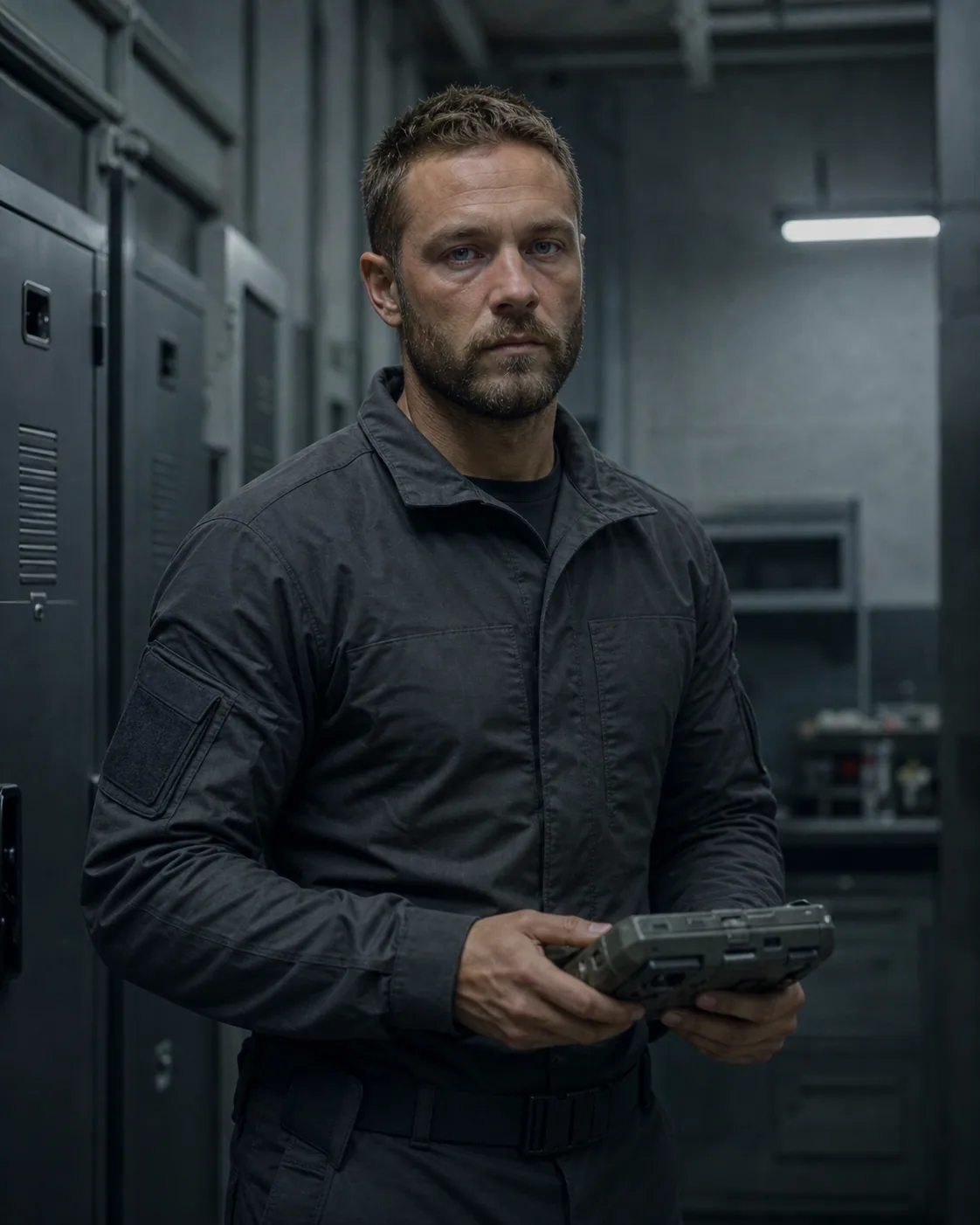
The cited material does not provide enough consistent physical description to construct a canonical portrait. Public art should therefore be interpretive.
A suitable rendering would present Stonier as a modern Unit operative in unmarked tactical clothing, with a detector or scanner incorporated into his kit. A separate non-combat portrait could show him during counseling, visually emphasizing the contrast between operational competence and private grief.
Status and fate
Stonier remains involved in the novel's later conflict through his connection to the Life Project and Unit investigation. Because the exact terminal status can depend on edition-level scene interpretation, the database should store the final directly confirmed action rather than extrapolate a fate beyond the text.
No comic-continuity status should be assigned. Stonier does not appear in BRZRKR #1-12.
Narrative significance
Stonier is one of the novel's clearest arguments that the cost of B's immortality is distributed among mortal people.
B is tired of dying because he always returns. Stonier is devastated by death because Thakka does not simply return to ordinary life. The two positions are almost inverse. For B, endless continuation is the curse. For Stonier, irreversible loss is the curse.
The Life Project and Shur's hidden agenda exploit the space between those perspectives. A movement promising release from death culture becomes attractive because Stonier's grief is real. The novel's philosophical question is whether the answer to grief can be a world without meaningful change.
Stonier matters because he forces that question to remain human-sized.
Appearances
- The Book of Elsewhere (Del Rey, 2024)
Canon limitations
The following are not established in the cited primary material and should remain unknown:
- first name
- exact age
- rank
- service branch before the Unit
- birthplace
- family outside Thakka
- date of marriage
- complete mission list
- exact model of his detector
References
[1] Keanu Reeves and China Miéville, The Book of Elsewhere, Del Rey, 2024, recorded locker-room sequence naming Stonier among the Unit personnel and showing him working with a detector.
[2] The Book of Elsewhere, “Signs of Life,” Keever and B discover Thakka alive after Keever had believed him dead in the collapsed tunnel.
[3] The Book of Elsewhere, Caldwell's conversation with Stonier after Thakka, including Caldwell's failed attempt to identify or recruit Stonier through coded cult language.
[4] The Book of Elsewhere, Stonier's counseling and Life Project storyline.
[5] The Book of Elsewhere, later revelations concerning Dr. Shur and the force of stillness / the Thowless.