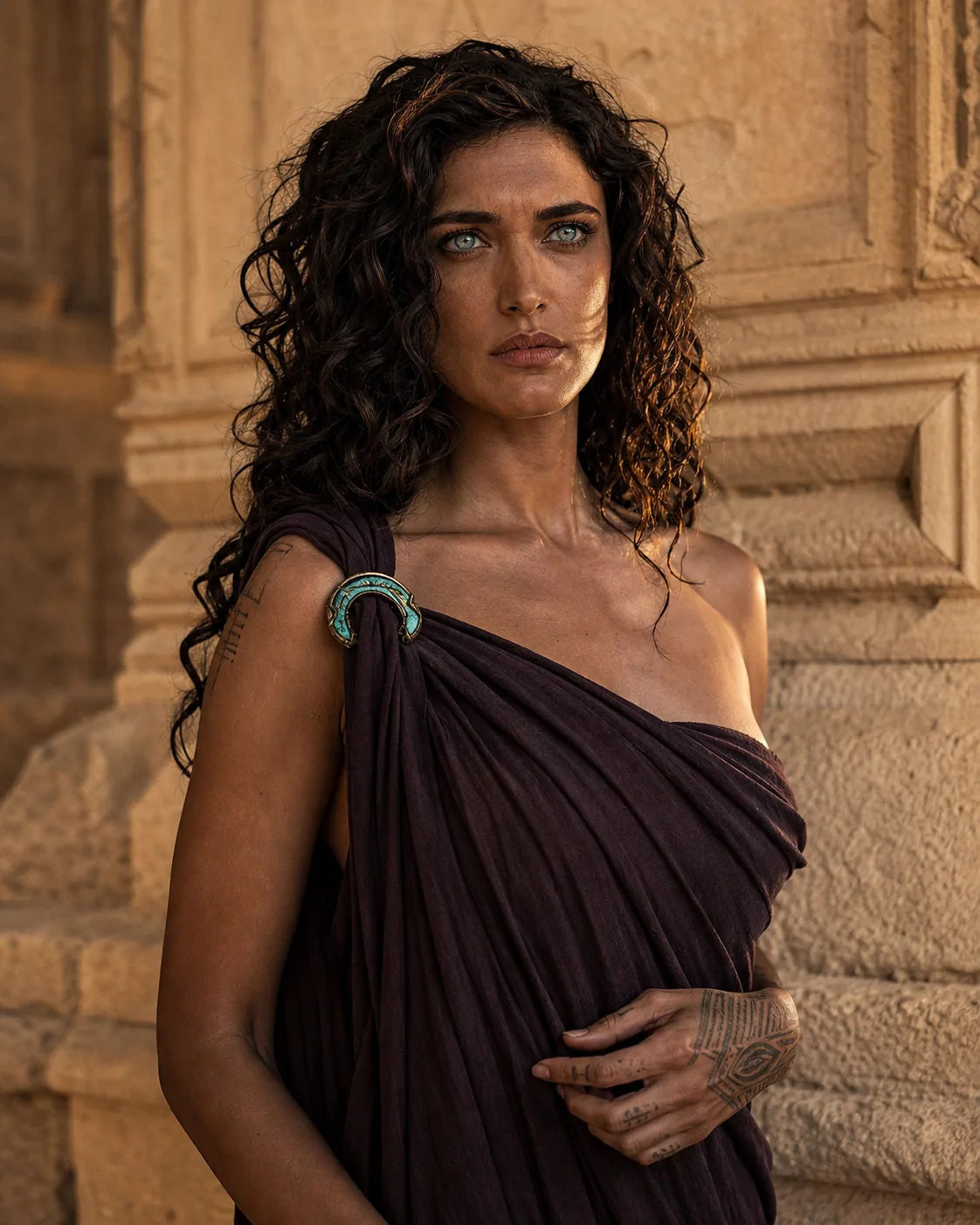
Selected scenes
BRZRKR in pictures.
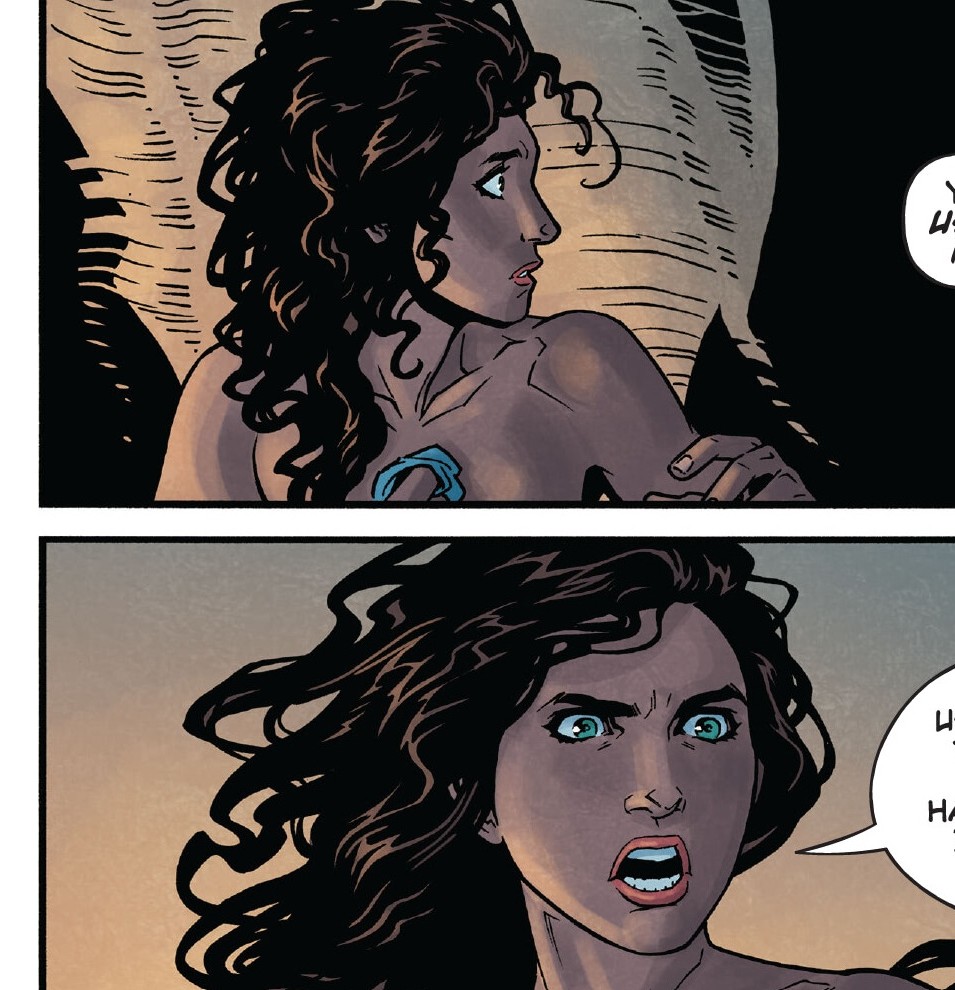
Spoilers: This article discusses the complete events of BRZRKR: Fallen Empire #1.
Overview
Queen Asana is the queen of Olos, a woman born among the desert peoples beyond the kingdom and given to King Arnak as part of a treaty intended to end a long war between Olos and the tribes of the great desert. She becomes the central human figure in BRZRKR: Fallen Empire #1, first appearing in the history as Arnak's politically constrained queen and later revealing herself as the elderly narrator who travels to the Acastan monks to preserve the story of Olos. Her life intersects with B at the moment Arnak brings the immortal warrior into Olos as a captive for the kingdom's public death sport.[1][2]
Asana is one of the most morally complicated figures in the BRZRKR comic continuity. She recognizes B's suffering when the court treats him as an inexhaustible spectacle, secretly enters his prison, helps him escape, becomes his lover, and offers him the possibility of companionship outside the systems that have used both of them. She also deliberately studies B as a weapon, engineers a false abduction, and manipulates his perfect memory so that he will believe the Washukanni have taken her. The deception succeeds beyond anything she appears to have anticipated. B annihilates Washukanni, including its men, women, and children, and then destroys Olos when he learns that Asana used him.[3][4]
The final pages complicate the story still further. The elderly "survivor" who seeks out the Acastan history keepers is not a separate handmaiden. She is Asana herself, living under disguise after the destruction of Olos. She wants the monks to engrave the kingdom's history as a warning so that its failure will not disappear with her death. B discovers the deception, destroys the monks' record, confronts Asana by name, and refuses to let her transform the destruction into a noble legacy. Yet he does not kill her. Instead, he leaves her alive with the knowledge that the peace she once claimed to seek has been achieved through the absence of every people she tried to save or defeat.[5][6]
Biography
Birth among the desert peoples
Asana was not born in Olos. She tells B that she came from the other end of the great desert, far from the kingdom into which she was eventually married. Her people preserved history through tattooing. Women carried histories on their backs, while soldiers were selected at roughly ten years of age and marked with black ink on their hands. The practice is more than decorative in Asana's account. It turns the human body into an archive, preserving stories even when political authorities would prefer them forgotten.[7]
Her grandparents belonged to a council of tribes. Before Asana's birth, Olos expanded outward from its protected city and fought the desert peoples in a prolonged conflict she remembers as a war of sand and blood. Thousands died. Faced with continuing slaughter, the elders of the tribal council sought a political end to the war. Their solution was to make an offering to Olos. Asana became that offering.[8]
She was sent to King Arnak as part of a treaty and became queen of the very kingdom that had fought her people. She later tells B that she never asked to be queen. Her language describes marriage not as personal choice but as political deployment. B immediately recognizes the dynamic and tells her that her people used her. Asana does not deny it. She says she was their instrument to stop violence and that her purpose was to bring peace to the desert.[8]
That statement becomes the tragic organizing idea of her life. Asana has been taught to understand people as instruments in a larger political calculation because she herself was used as one. Her later manipulation of B repeats the pattern. She recognizes the moral injury done to her, yet ultimately reproduces it against someone else.
Queen of Olos
By the time B reaches Olos, Asana has occupied the throne beside Arnak for years, although the comic does not establish the exact duration of the marriage. Olos has been protected by immense walls for centuries and has developed a cruel death sport in which captured enemies are forced to fight for public entertainment. Arnak expands this practice during his wars with Washukanni and neighboring kingdoms. The narration specifically states that he does so against the advice of his queen.[1]
Asana's objection is important because it demonstrates that she is not merely a passive witness to Arnak's policies. She can advise him, but she cannot compel him. The public spectacle continues. Olos brings prisoners inside the walls that had long protected the city from outsiders. One of those prisoners is B.
Asana first sees the immortal warrior in the arena after he has already been hacked, beaten, and treated as disposable human material. He repeatedly survives. Arnak and his officials attempt to explain what they are seeing, but the usual categories fail. B is not simply a formidable prisoner. He can be mutilated and return. What begins as entertainment gradually becomes an experiment in whether Olos can harness a being it does not understand.[9]
Recognition of B's humanity
Arnak becomes fascinated with B as a potential military instrument. He sends wave after wave of soldiers against the captive and repeatedly asks him to fight for Olos. B refuses. The king keeps him chained, beaten, and starved for approximately a year, even though starvation and injury cannot permanently kill him.[10]
Asana watches B differently. The comic describes the moment after one of his violent outbursts when he retreats into "the shell of a man." She understands that the apparent monster contains a person. That distinction becomes foundational to their later relationship. Where Arnak sees an inexhaustible force, Asana sees a prisoner whose violence is not the totality of his identity.[10]
Her compassion is genuine, but later events show that it is not uncomplicated. Asana can see B as a person and still come to believe she has the right to direct his violence when the stakes involve her people. Fallen Empire does not ask the reader to choose between a benevolent and malevolent version of Asana. Both capacities coexist.
Secret visits to the prison
The queen begins secretly visiting B. The narration states that once the queen would visit him and that a handmaiden was sent to distract the prison guards. This detail establishes that Asana had assistance inside Olos and that at least one member of her household was willing to violate the king's security procedures on her behalf.[11]
The prison encounters are intimate because they remove both characters from their public roles. Asana is no longer merely the queen on the royal dais, and B is no longer merely the arena monster. She approaches him face to face. Their escape soon follows.
Arnak initially assumes that B has kidnapped the queen. When the king presses Asana's handmaidens and the dungeon guards, however, the truth emerges. Asana asked B to take her away.[12]
Flight into the desert
Asana and B escape Olos and move into the desert. Away from the court she explains her origin and the political bargain that made her queen. B tells her that she can go wherever she wants and does not need to remain with him. Asana answers that she is safer with B than with anyone in the world. B replies that this will not necessarily be true tomorrow, a warning that reflects his knowledge of what proximity to him eventually costs other people.[13]
The pair nevertheless remain together. Their relationship becomes romantic and sexual. Asana reveals the unfinished tattoo on her back and explains the historical tradition of her people. She hopes the final story written on her body will say that she was both a prisoner and a queen who won her freedom and lived happily.[7]
Her relationship with B is therefore linked to a desire for self-authorship. Her entire early life was written by councils, kings, treaties, and war. With B she imagines a different ending. The irony is that she soon tries to write history again, this time by scripting B's actions for him.
B's periodic violence
B cannot simply settle into domestic life. Twice a month, according to the story, he travels into the desert seeking someone upon whom he can unleash the pressure of his violent compulsion. He journeys farther and stays away longer. Asana is therefore living with someone she loves but cannot make ordinary.[14]
This period gives her time to observe B's patterns. She understands his need to release violence, his extraordinary recovery, and crucially his perfect memory. That knowledge becomes part of her later plan.
The staged abduction
When B returns from one of his journeys, Asana is gone. The scene appears to show a vicious attack. Blood and other evidence remain, including the distinctive black-hand markings associated with Asana's people. Because B remembers everything with extraordinary precision, he interprets the evidence as proof that people from the desert have taken her.[15]
He returns to Olos to confront Arnak and search for information. The king points him toward Washukanni. B then turns his rage on the kingdom that has been fighting Olos.
The result is total destruction. The narration states that Washukanni is obliterated from the face of the earth. B kills its men, women, and children. This is not a conventional military victory. It is genocide within the story's fictional history.[3]
After the destruction, B finds Asana alive. She tells him that the Washukanni released her when they realized they could not defeat him, hoping her freedom would end his rampage. It did not.[16]
Exposure of the deception
B eventually notices the flaw in the evidence. The black ink on the hands he remembers from the attack was fresh. The supposed attackers had only just been marked.[4]
The comic then shows what really happened. Asana's people staged the abduction. Participants deliberately created a convincing crime scene. One woman insists that one death will not be enough to persuade B and that two people must die. The conspirators kill their own participants or accept sacrificial deaths in order to make the attack look authentic.[4]
Asana admits the core truth when B confronts her. She says fate offered them a weapon against the Washukanni. Her husband could not harness B, but she believed she could from the second she saw him. With time, she learned how. She again calls herself the bringer of peace and claims that through B she has fulfilled that purpose.[17]
She simultaneously insists that she cares for B and understands that he is not the monster inside. This confession is central to her character. She did not manipulate him because she believed him to be mindless. She manipulated him while knowing he was a person. Her justification is political necessity: she did what she believed she had to do for her people.[17]
B's answer is devastatingly simple: "What people?" Washukanni is gone. The act intended to secure Asana's people has unleashed a force capable of erasing entire societies.
Destruction of Olos
The narration states that Asana had sentenced them all to death. B returns to Olos and destroys the kingdom. King Arnak, soldiers, officials, and civilians are consumed in the catastrophe. The kingdom that had tried to harness B through imprisonment and the queen who had tried to harness him through intimacy both discover the same limit: neither could control what happened after they turned his violence toward their enemies.[18]
For many pages afterward, the story encourages the reader to believe that a single handmaiden survived. An elderly woman travels to the Acastan monks, calling herself the longest survivor of the fallen kingdom. She asks them to tabulate the story of Olos, not for sentimental legacy but as a warning to those who remain.[2]
That survivor is Asana.
Life in disguise
B discovers the old woman among the Acastan history keepers and contradicts her story. Olos had no survivors, he tells her, except for her. A flashback reveals Asana in the ruins, disguising herself as a handmaiden. She hoped that by no longer being queen, she might disappear into the role of someone too ordinary to pursue.[5]
The disguise has thematic significance. Asana began life as a person whose body and title were used for a treaty. She became queen, escaped the title, reclaimed it when she defended her manipulation of B, and finally tried to survive by surrendering it completely.
Attempt to preserve Olos
As an elderly woman, Asana wants the Acastan monks to preserve the history she has carried for decades. She does not ask them to glorify Olos. She says the record should warn future peoples about what happened and what might happen again. Her motive therefore contains genuine remorse alongside a desire to prevent oblivion.[2]
B refuses to permit the narrative on her terms. He attacks the monks and destroys the record they are creating. His intervention is not framed as denial that Olos existed. It is a refusal to let Asana transform the disaster into a redeeming purpose after having manipulated him into causing it.[19]
Asana finally admits that she did not understand the forces she was meddling with. She says she used B and the power within him, and that tens of thousands died because of what she did. She believes she deserves death and tells B she is ready, but asks him to let the tablets remain so the history can survive. She wants preservation itself to become her purpose.[6]
B tells her she has already fulfilled her purpose. There are no soldiers, nomads, kings, or queens left in the desert. It is empty. She wanted peace, and the absence of everyone has produced it.[20]
He leaves her alive.
Final status
Asana remains alive when B departs. The comic does not show her later death, descendants, travels, or whether she ever succeeds in preserving the history elsewhere. The Acastan record seen in the story is destroyed or taken out of circulation by B, and the monks present at the site are killed. Her final known condition is therefore that of an elderly woman left with memory, remorse, and no surviving political community to which she can return.[20]
Personality and motivations
Asana is intelligent, observant, politically trained, empathetic, manipulative, and capable of extraordinary self-justification. Her history makes those traits inseparable. She understands coercion because she has lived under it. She sees through the dehumanizing language surrounding B because she recognizes what it means to be used for someone else's political objectives.
Her tragedy is that recognition does not prevent repetition. Asana comes to believe that the suffering done to her grants her a clearer understanding of what must be done for her people. In practice, this becomes another system of instrumentalization. B is the weapon, the attackers in her staged abduction are expendable evidence, and Washukanni becomes a target whose destruction is justified by the desired peace.
She is not presented as a simple liar. Her affection for B appears sincere. Her horror after the consequences is sincere. Her later confession is sincere. The moral weight of the story comes from the fact that these truths do not erase the choices she made.
Skills and abilities
Political intelligence
Asana survives for years inside the court of a husband whose decisions she cannot control. She understands treaties, tribal relationships, the strategic geography of the desert, and the psychology of both Arnak and B.
Manipulation and planning
Her staged abduction is elaborate enough to fool B despite his perfect memory. The plan exploits culturally specific tattoos, physical evidence, sacrificial deaths, B's emotional attachment to her, and the preexisting conflict with Washukanni.
Historical knowledge
Asana carries the traditions of her people and later becomes the principal surviving witness to the history of Olos. Her entire narration to the Acastan monks demonstrates long-term memory and a strong desire to preserve historical sequence.
Survival
She survives the destruction of Olos, hides her royal identity for decades, travels to the Acastan history keepers in old age, and remains alive after B discovers her.
The comic does not establish supernatural powers, enhanced longevity, or combat abilities for Asana.
Relationships
B / Unute
B is first a captive she pities, then the person who helps her escape, then her lover, and ultimately the weapon she manipulates. Their relationship moves from mutual recognition to intimacy to betrayal. B's decision not to kill her in old age does not amount to reconciliation. It leaves her alive to confront the consequence of her own idea of peace.
King Arnak
Arnak is Asana's husband through political treaty. She explicitly says she did not choose the marriage. She advises against his death sport and later escapes him. Their relationship embodies the political use of Asana before she begins using B in turn.
Asana's people
Her unnamed desert people are the community on whose behalf she rationalizes her actions. Their elders used her in the treaty with Olos. Later members participate in the staged abduction. Their precise fate after B's destruction of Washukanni and Olos is not individually shown, but B's final statement indicates the desert has been emptied of its former peoples.
Handmaidens of Olos
At least one handmaiden helps Asana visit B by distracting dungeon guards. After Asana's disappearance, Arnak pressures handmaidens for information. Asana later disguises herself as a handmaiden, making the role both a practical instrument of escape and a symbolic rejection of queenship.
Acastan monks
The monks are Asana's chosen custodians of memory. She believes their centuries-old role as history keepers can prevent Olos from vanishing. B interrupts the preservation effort and kills the monks present.
Appearance
Asana is depicted in youth with dark, curly hair and striking light-colored eyes. As queen she wears elaborate Olos clothing and headdress. After leaving the kingdom, she appears in simpler desert garments and carries the tattooed history of her people on her back. In old age she conceals herself under a hood and presents as a former handmaiden until B identifies her.
Public-facing art should distinguish three major visual periods: Queen of Olos, desert exile and lover of B, and elderly hidden survivor.
Status and fate
Alive at last appearance. Asana survives the destruction of Olos and B's later confrontation at the Acastan archive. No later comic has yet established her death or subsequent life.
Appearances
- BRZRKR: Fallen Empire #1 - central character, queen of Olos, lover and manipulator of B, narrator under the guise of Olos's surviving handmaiden.
- BRZRKR: Fallen Empire Pen & Ink #1 - alternate presentation of the same canonical story. Treat as an edition appearance rather than a new event.
- BRZRKR: Bloodlines - collected publication containing Fallen Empire alongside other historical stories.
Canon limitations and unresolved questions
The story does not state Asana's age, the name of her original people, the name of her parents, the exact name of the tribal council, the date of her marriage, the length of her marriage before B's arrival, whether she had children with Arnak, the exact number of conspirators who helped stage the abduction, or what happens after B leaves her with the destroyed Acastan record.
The elderly narrator should not be represented as a separate character. Fallen Empire #1 explicitly reveals that she is Asana in disguise.[5]
References
[1] Mattson Tomlin and Rebekah Isaacs, BRZRKR: Fallen Empire #1 (BOOM! Studios, 2023), history of Olos under King Arnak, the war with Washukanni, and Asana's opposition to Arnak's use of enemies in the death sport, digital page image 0007.
[2] Tomlin and Isaacs, BRZRKR: Fallen Empire #1, elderly survivor's arrival among the Acastan monks and request that the history of Olos be tabulated as a warning, digital page images 0003-0005.
[3] Tomlin and Isaacs, BRZRKR: Fallen Empire #1, B's annihilation of Washukanni, including men, women, and children, digital page image 0037.
[4] Tomlin and Isaacs, BRZRKR: Fallen Empire #1, B's realization that the black-hand ink was fresh and flashback revealing the staged abduction, digital page images 0040-0041.
[5] Tomlin and Isaacs, BRZRKR: Fallen Empire #1, B's confrontation with the supposed handmaiden and revelation that she is Queen Asana in disguise, digital page image 0047.
[6] Tomlin and Isaacs, BRZRKR: Fallen Empire #1, Asana's confession that she used B and caused tens of thousands of deaths, digital page image 0048.
[7] Tomlin and Isaacs, BRZRKR: Fallen Empire #1, Asana's explanation of her people's tattoo traditions, women as history bearers, and black-hand marking of soldiers, digital page images 0025-0028.
[8] Tomlin and Isaacs, BRZRKR: Fallen Empire #1, Asana's account of the war of sand and blood, her grandparents' tribal council, and her use as a treaty offering to Olos, digital page images 0028-0029.
[9] Tomlin and Isaacs, BRZRKR: Fallen Empire #1, B's capture, arena appearances, and the Olos court's attempts to understand his survival, digital page images 0008-0013.
[10] Tomlin and Isaacs, BRZRKR: Fallen Empire #1, Arnak's repeated use of soldiers against B, B's withdrawal after violence, and year-long imprisonment, digital page images 0014-0017.
[11] Tomlin and Isaacs, BRZRKR: Fallen Empire #1, secret visits by the queen and use of a handmaiden to distract dungeon guards, digital page images 0018-0019.
[12] Tomlin and Isaacs, BRZRKR: Fallen Empire #1, Arnak's investigation of the escape and discovery that Asana asked B to take her away, digital page image 0021.
[13] Tomlin and Isaacs, BRZRKR: Fallen Empire #1, Asana's statement that she was born beyond the great desert, was gifted to Arnak in a treaty, and never asked to be queen, digital page image 0022.
[14] Tomlin and Isaacs, BRZRKR: Fallen Empire #1, B's twice-monthly journeys into the desert to release his violent compulsion, digital page image 0030.
[15] Tomlin and Isaacs, BRZRKR: Fallen Empire #1, B's discovery of the apparent abduction scene and black-hand evidence, digital page images 0033-0034.
[16] Tomlin and Isaacs, BRZRKR: Fallen Empire #1, Asana's explanation that Washukanni released her in hopes of stopping B's rampage, digital page images 0038-0039.
[17] Tomlin and Isaacs, BRZRKR: Fallen Empire #1, Asana's admission that she deliberately harnessed B as a weapon and considered herself the bringer of peace, digital page image 0042.
[18] Tomlin and Isaacs, BRZRKR: Fallen Empire #1, destruction of Olos after Asana's betrayal is exposed, digital page images 0043-0044.
[19] Tomlin and Isaacs, BRZRKR: Fallen Empire #1, Acastan monks beginning the record and B's arrival and attack, digital page images 0045-0046.
[20] Tomlin and Isaacs, BRZRKR: Fallen Empire #1, B's final statement that the desert is empty of soldiers, nomads, kings, and queens and that Asana has therefore brought peace, digital page image 0049.
Collected and alternate editions
The same story is republished in BRZRKR: Fallen Empire Pen & Ink #1 (BOOM! Studios, 2024) and in the BRZRKR Bloodlines collected program. These editions are useful for production commentary and collection metadata but should not be treated as separate canonical events.