Spoilers: This article discusses Maybell's American-era encounter with B and the events of BRZRKR: A Faceful of Bullets.
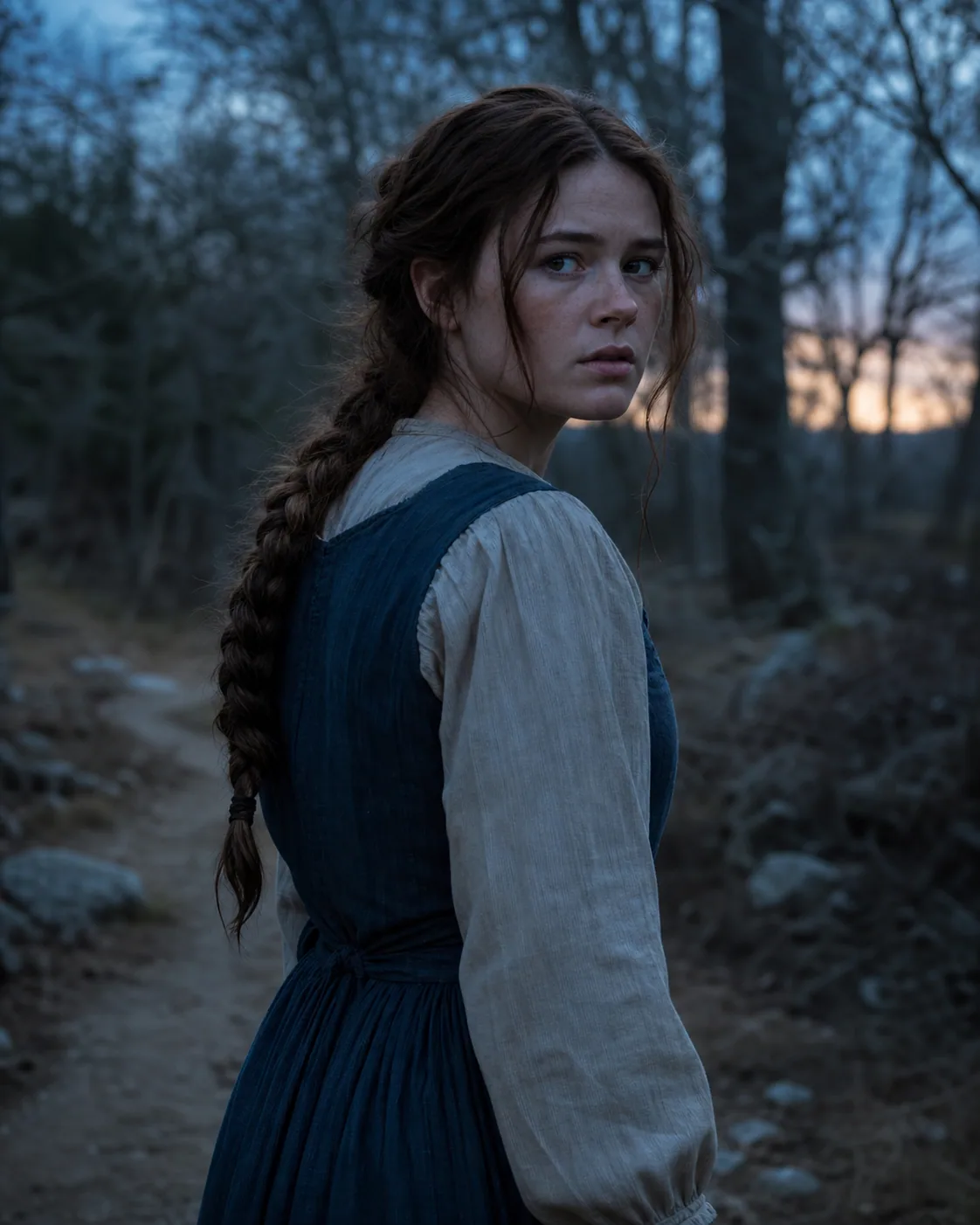
Maybell is a young woman whose flight through the Missouri–Kansas border country brings her into contact with B during one of his nineteenth-century lives. Her story is brief beside B's eighty-thousand-year history, but it gives the American material its human center. She is not a soldier looking for a stronger weapon or a scholar trying to explain an immortal body. She is a person trying to get away from a powerful household before its violence becomes the rest of her life.
Maybell's importance comes from the choice she makes while running. Her escape is connected to fear, anger, and the desire to see the man who controls her punished. B understands all three feelings. He has been trained by his father, owned by rulers, displayed by courts, and recruited by governments. When he meets Maybell, he recognizes the danger of turning her need for safety into another assignment for an immortal weapon. Their encounter asks whether protection can leave room for the protected person to decide what happens next.
The American setting
Maybell belongs to the historical branch of B's life set around Missouri and Kansas during the period of border violence that preceded the Civil War. The region is not a neutral backdrop. Land, family authority, slavery, private armed force, and competing ideas of law overlap. A wealthy man can make a personal demand look like a legal necessity because the people around him depend on his land or his weapons. A person who tries to leave is treated as a threat to the whole order.
The landscape makes escape difficult. Roads, wooded areas, trading posts, estates, and open country connect communities that are close enough to hear rumors but far enough apart for a fugitive to disappear temporarily. B has learned to move through such spaces without belonging to them. He knows how a stranger becomes a story when witnesses see him survive an injury or appear where no ordinary traveler could have arrived. Maybell's experience gives that legend a face and a reason.
The real history surrounding the territory remains important. The comic uses the names and tensions of the nineteenth-century border, but Maybell and B's encounter belong to the fictional layer of BRZRKR. Her story does not replace the history of the people who lived through the conflict. It places one impossible survivor inside a world that already has its own violence and its own victims.
A life under another person's authority
Maybell is associated with a household in which authority has become coercion. The man who controls the estate treats her movement, future, and safety as matters that he can decide. The exact family history is not fully narrated, but the emotional facts are clear: she is afraid of being returned, she believes the powerful man has been protected by the surrounding community, and she is prepared to risk the dangers of the road rather than remain under his control.
Her escape is therefore more than a flight from one bad evening. It is a refusal of a social arrangement that calls possession protection. The land baron or guardian can describe himself as responsible for Maybell while using armed men and property claims to prevent her from choosing where to go. That contradiction echoes B's own past. His father says that training will protect the tribe. Kings say that service gives B purpose. The modern program says that missions will lead to mortality. Each promise contains a demand for control.
Maybell does not need to understand B's complete history to recognize the shape of the demand. She sees a man whose strength could solve her immediate problem and has to decide whether asking for that strength will place her under another authority. The story never treats her as a passive reason for B to fight. Her fear and anger are the forces that bring the conflict into the open.
The prayer and the guardian
Maybell's appeal for help gives the episode its supernatural hinge. A prayer can be a cry for survival, a wish for revenge, or an attempt to make an unbearable situation intelligible. In BRZRKR, prayers rarely produce tidy answers. B's mother asks for protection and receives a child who becomes a weapon. Maybell's request brings an immortal warrior into a frontier conflict where a single act of violence could kill everyone around her.
The phrase “guardian angel” describes the role people want B to play, not a new name that he permanently adopts. Maybell can see him as a protector because he appears when ordinary help has failed and because his body survives what would end another person's life. B knows that the same image can become dangerous. If he is treated as an avenging angel, the people around Maybell may expect him to punish every enemy and may decide that her safety requires an endless campaign.
The emotional tension lies in the difference between being guarded and being directed. B can stand between Maybell and the men pursuing her without claiming the right to choose her future. He can refuse the land baron's demand without telling Maybell that he now owns the answer. Her escape matters because it remains hers even when B's violence makes it possible.
B's recognition
B's sympathy for Maybell is grounded in recognition rather than sentimentality. He has spent millennia being told that his body belongs to a group. The prehistoric tribe calls him a weapon. Atlantis celebrates him as a protector and then uses his blood in a ritual. Olos turns him into a captive spectacle. Genghis Khan makes his endurance part of an imperial campaign. The government calls him an asset. Maybell's situation is not identical to B's, but the underlying question is familiar: who gets to decide what another person's life is for?
That recognition does not erase the differences between them. Maybell is living inside a specific American system of gender, property, and private power. B is an immortal combatant whose body can change the outcome of a gunfight. He cannot simply tell her that his pain is the same. What he can do is refuse to use her vulnerability as a reason to repeat the behavior that has shaped his own life.
Violence and the western gunfight
Maybell's story gives B's violent compulsion a smaller and more intimate battlefield than Atlantis or a siege. The threat has a face. The people pursuing her may be armed men acting for the land baron, but each one also has a body, a fear, and a choice. B can end the conflict quickly by treating the entire group as targets. He can also try to separate immediate danger from vengeance and make a path through which Maybell can escape without turning the countryside into another graveyard.
The Western form sharpens the ethical pressure because guns make violence appear decisive. A revolver can turn a private grievance into a public fact in a second. B's regeneration creates an additional danger: other people may fire more recklessly because they believe his body can absorb the consequences. A face full of bullets is not a joke about invulnerability. It is an image of the way an immortal can make ordinary people forget that injury is still morally serious.
Maybell's presence keeps the focus on what happens after the shooting. A victory that leaves her unable to trust anyone, unable to travel, or defined forever by the land baron's revenge is not complete protection. B has to think about the life she will have when the immediate threat is gone. That is a harder task than winning a fight, especially for someone trained to measure success in enemies removed.
Maybell and the Man in the Tree
The American episodes connect Maybell to the local legend later called the Man in the Tree. The name belongs to the witnesses and storytellers who try to explain B's presence through an image that is more memorable than a stranger's biography. A person who survives violence and appears among the trees can become an angel, a monster, or a boundary-spirit depending on what the community fears.
Maybell's experience supplies one of the human events beneath that legend. She knows that B is a man who chose to help, even if she cannot explain his body. Later observers may remember only the impossible part: the protector who could not be killed. The distance between her knowledge and the public story shows how B's identities are made. “Man in the Tree” is not a secret name B uses to describe himself. It is a community's attempt to hold onto an encounter that exceeds its language.
The legend also changes the risk Maybell faces. If armed men believe B is a supernatural guardian, they may pursue the story rather than the person. If local leaders use the legend to frighten others, Maybell's escape can become evidence in someone else's campaign. B understands that every dramatic rescue leaves an afterlife in memory, and that the afterlife can endanger the people it was meant to protect.
Relationship with B
Maybell and B are connected by a brief encounter, not by a permanent partnership or romance. Their relationship is defined by the situation: she is trying to escape, and he is deciding how to help. The story's restraint is important. Maybell does not become another possession in B's long chain of losses, and B does not become the author of her identity.
She gives him a chance to practice a different form of protection. He can listen to what she wants, recognize the danger of the men pursuing her, and use his strength without asking her to worship him. Maybell, in turn, has to decide whether the stranger who appears to be an answer can be trusted not to become another authority. Trust is practical rather than absolute. It is built through what B does when he has the power to do more.
The relationship also reveals the limits of B's rescue. He cannot repair the entire social order that made Maybell flee. He cannot guarantee that a new town will be safe or that the men who served the land baron will never return. What he can do is interrupt the immediate claim on her body and future. The story treats that interruption as meaningful without pretending it is a complete political solution.
Narrative importance
Maybell matters because she keeps the American branch from becoming a sequence of gunfights remembered only through B's body count. Her fear gives the violence a reason, and her agency gives the ending a standard by which B's choices can be judged. If he kills for the pleasure of solving a problem, he has repeated the pattern of every ruler who has used him. If he protects her ability to leave and choose, he has used his strength in a way that does not require ownership.
Her story also extends the series' interest in inheritance. A child can inherit a name, a property claim, or a legend without consenting to the power attached to it. B carries an inheritance of violence from his father and tribe. Maybell is trying to refuse an inheritance of control from the household that claims her. The parallel is not exact, but it lets the Western episode speak to the family and descendant stories that appear elsewhere in the series.
The episode shows how an immortal person's impact can be measured in a life he does not continue to follow. B may leave the territory, but Maybell's choices after the rescue are part of what his intervention makes possible. Her future does not need to contain another appearance by B to matter. The value of the encounter is that she can become more than the runaway daughter in someone else's story.
What remains unknown
The material does not provide a complete account of Maybell's childhood, her later relationships, or the full fate of the land baron's estate. It does not establish every road she travels after leaving or turn her into a hidden ancestor of a later character. Those gaps are part of the episode's scale. The story gives enough to understand her position and the decision at its center without claiming that B witnessed every consequence.
What can be said with confidence is that Maybell belongs to the American historical branch, that her escape is tied to a powerful man's attempt to control her, and that B's role as guardian forces the distinction between protection and possession. Her name survives because her encounter helps explain the human event beneath the Man in the Tree legend.
References
[1] Jason Aaron, Francesco Manna, and the BRZRKR creative team, BRZRKR: A Faceful of Bullets #1 (BOOM! Studios), Maybell's escape, the frontier setting, the land baron's pursuit, and B's guardian role.
[2] Official BOOM! Studios announcement for A Faceful of Bullets #1, describing the 1800s setting, the runaway daughter, the land baron, and the guardian-angel premise.