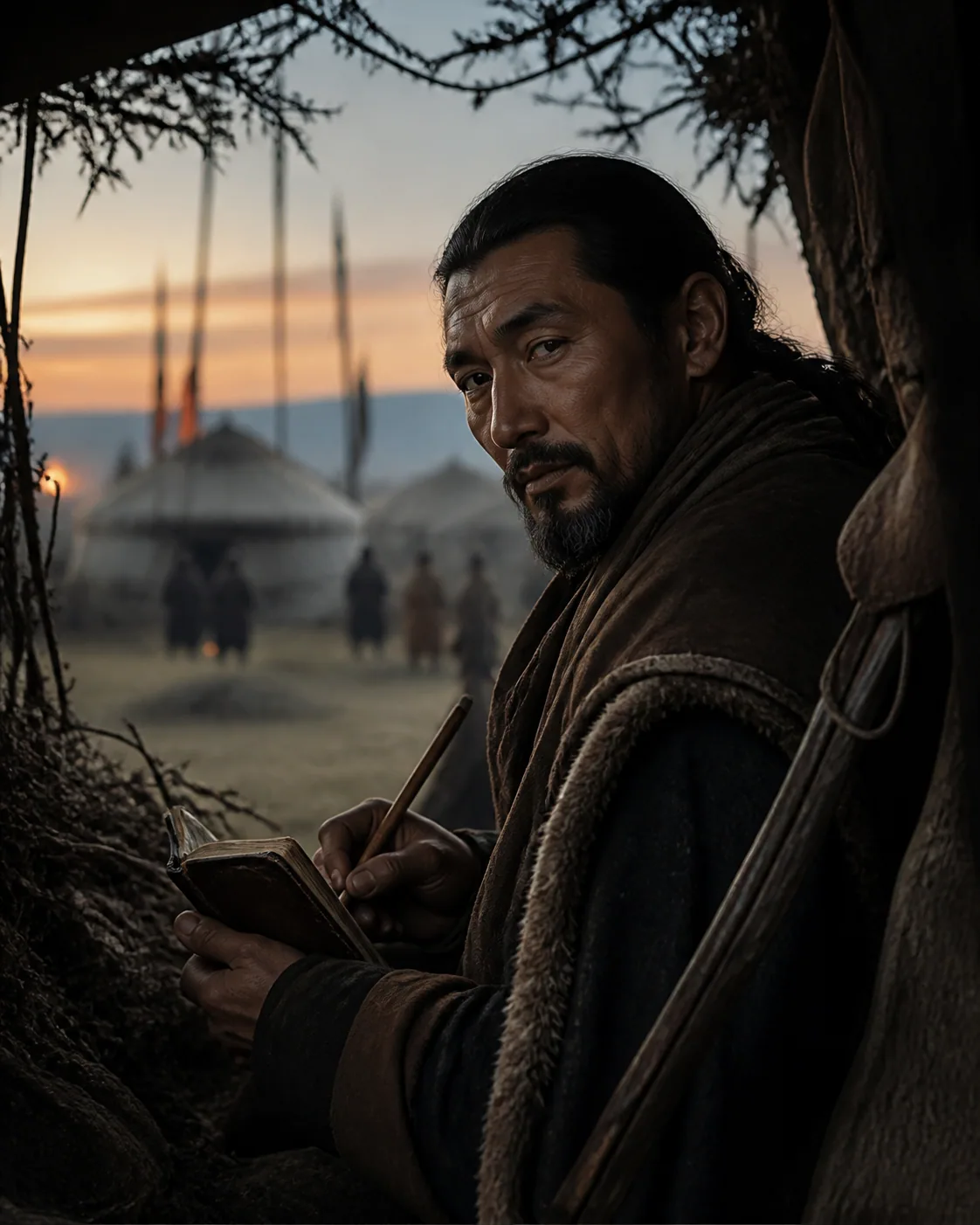
Selected scenes
BRZRKR in pictures.
Spoilers: This article discusses the complete events and historical framing of BRZRKR: The Lost Book of B #1.
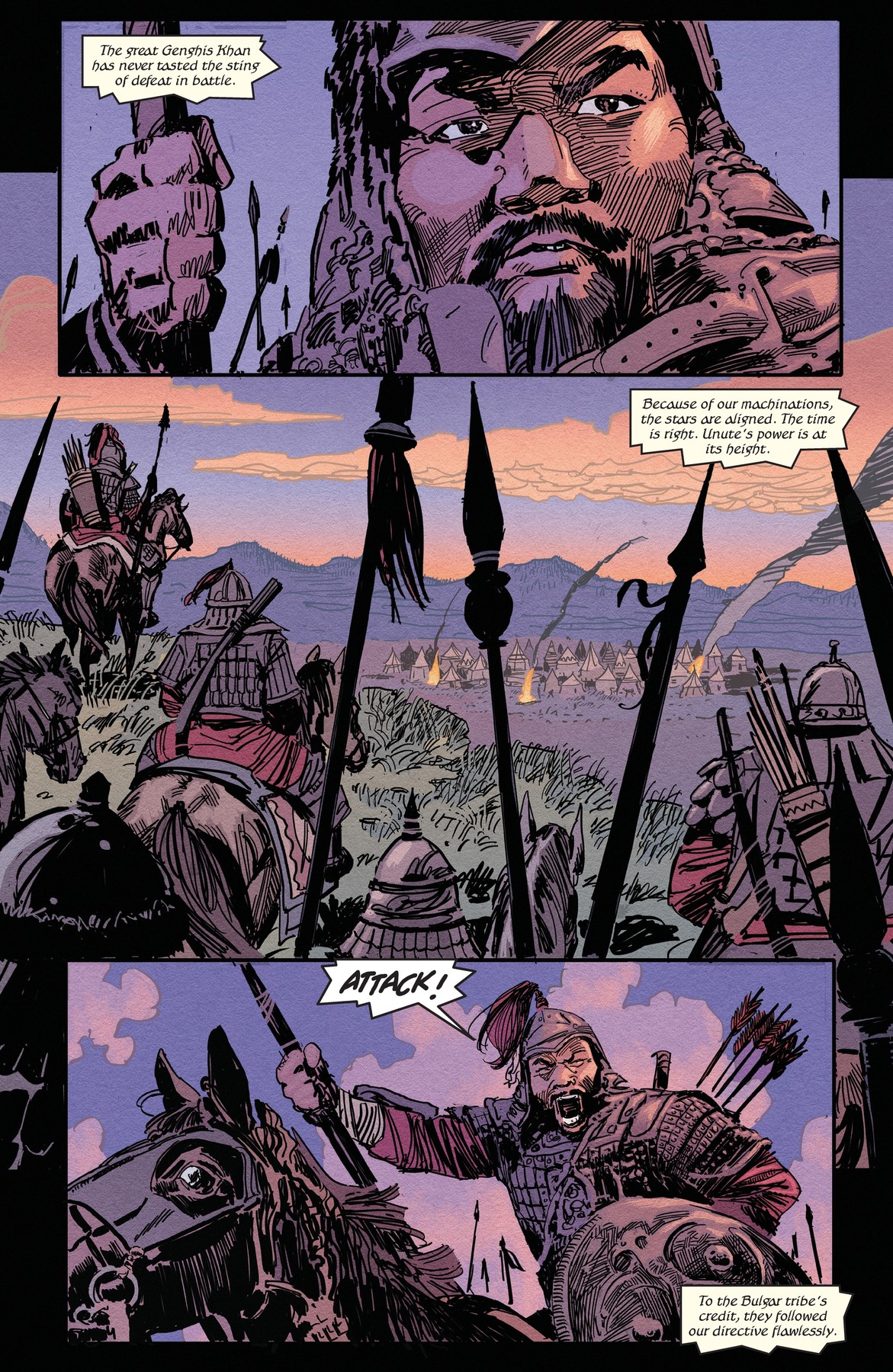
Editorial context reference from the user-supplied digital edition of BRZRKR: The Lost Book of B #1. The extracted page documents the cult's manipulation of the Bulgar and Mongol encounter. It is not being used here as a verified portrait of Layo. A character-specific image should be selected only after the full primary page containing Layo's visible identification is verified.
Overview
Layo is a historical agent of the secret cult that later culminates in Caldwell's ancestral lineage, and the principal attributed cult narrator associated with the events of BRZRKR: The Lost Book of B #1. His importance lies less in direct physical power than in information. The story depicts a cult that has studied Unute, the immortal warrior B, over long periods and believes his cycles of rage, recovery, vulnerability, and memory can be charted. Through that knowledge, the cult manipulates first a Bulgar group and then Genghis Khan, arranging circumstances in which B can be turned into a weapon of imperial conquest.[1][2]
The updated BRZRKR canon inventory identifies the historical narration about Genghis Khan and the Silk Road as Layo's account rather than objective authorial history. That distinction is essential. Layo is not a neutral historian. He belongs to a tradition that observes B in order to exploit him and to shape human events around him. The encyclopedia should therefore tag his claims about motives, historical causation, and long-range plans as narrator testimony even when the comic visually depicts events consistent with those claims.
The Lost Book of B connects this historical cult activity to a broader theme already present in the original twelve-issue series: institutions learn that B cannot be owned in an ordinary sense, but people repeatedly try to manufacture conditions under which his violence will serve their purposes. Layo represents one of the earliest clearly documented forms of that strategy. Instead of placing B in a modern laboratory, he studies patterns, fear, injury, opium, political ambition, and war.[3]
Biography and historical role
A member of the Unute cult
The cult operating in The Lost Book of B treats B as both sacred object and repeatable phenomenon. Its narration describes Unute in cyclical terms, comparing him to tides and the moon and asserting that once the cycle is understood, his weakness can be exploited and his power harnessed.[1]
This language places Layo within an intellectual tradition rather than a spontaneous conspiracy. The cult has accumulated enough observation to believe B's apparently chaotic existence can be modeled. Its members understand that anger can increase his usefulness, that recovery can be manipulated, and that periods of physical or chemical vulnerability create opportunities for control.
The story does not establish the date on which Layo joined the cult, the name of his parents, his place of birth, or whether he inherited membership through family. Those details should remain unknown.
Study of B's cycles
Early in the story, a Bulgar group has B under brutal physical control. They repeatedly injure and boil him, watching him recover. The cult narration treats their fear and behavior as predictable data. The goal is not merely to punish B. The torture is described as a technique for keeping him angry and weak until the desired political moment arrives.[4]
Layo's significance comes from the framework behind that technique. B has survived tens of thousands of years because almost no ordinary enemy can hold him permanently. The cult instead asks a different question: how can a temporary stage of his regeneration be converted into leverage?
Manipulation of the Bulgars
The comic states that the Bulgar tribe follows the cult's directive with precision. Their task is not to defeat B permanently. It is to prepare him. By the time Genghis Khan's forces arrive, the cult considers the timing correct and the conditions aligned.[2]
The Bulgars then step aside rather than fight the Mongols. This behavior makes sense only if their encounter with B was part of a larger plan. They have been used as custodians, torturers, and staging agents rather than as the final beneficiaries of B's power.
Layo's role should therefore connect to both BULGAR_FORCES and HISTORICAL_CULT_MEMBERS. The cult influences the tribe without becoming identical to it.
Engineering the encounter with Genghis Khan
The cult narration presents Genghis Khan as a conqueror who has not tasted defeat and describes the arrival of his forces as a moment the cult has prepared. When the Mongols enter the Bulgar camp, they find B. The encounter is not treated as coincidence.[2]
Khan initially sees an impossible captive. B then demonstrates his violence against Mongol troops. Rather than simply destroy him, Genghis becomes interested in the strategic implications.
Later, Khan speaks to B without keeping him caged and offers him status, belonging, and the possibility of joining a world-conquering project. He tells the immortal that B could kill him if he chose, but proposes alliance instead. The cult narration frames the moment as the taming of a lion or a god.[5]
Layo's historical importance lies in having helped create the conditions for that choice. The cult does not need to command B directly if it can place a sufficiently ambitious ruler in front of him at the right moment.
From coercion to appetite
The Mongol strategy evolves beyond cages and torture. B is supplied with what he wants, including opium and sexual companionship. The narration describes opium as the manufacture of a need and the promise of oblivion.[6]
For an immortal with perfect memory, forgetting has extraordinary value. B cannot normally escape the accumulation of everything he has seen and done. Chemical dulling therefore offers leverage unavailable to ordinary threats.
This is one of the most significant concepts in The Lost Book of B: control does not always require stronger chains. It can be achieved by understanding what an immortal lacks.
The cult narrator's attention to this process implies a sustained interest in the psychology of B, not merely his physical abilities.
Genghis Khan's campaigns
The story follows B as a weapon within Mongol conquest. Official publisher descriptions confirm the basic premise: in the 13th century B serves as Genghis Khan's ultimate weapon, no enemy can withstand him, and the growing war forces B to question his loyalties.[7]
The comic depicts large campaigns, siege warfare, mass death, and B participating in victories attributed publicly to the Khan. The cult narration repeatedly asks how a ruler such as Genghis can be guided. Its answer is appetite. A conqueror is fed conquest, while B is fed forms of oblivion and release.[8]
This makes Layo part of a double manipulation. The cult is not simply helping Genghis control B. It is also using Genghis's own ambition as a predictable force.
The siege of Beijing
The story explicitly calls a major fortified target Beijing, describing it as a city no one could conquer because of its walls and barricades. Mongol horse and arrow tactics are insufficient against the defenses.[9]
The campaign shifts toward siege techniques and psychological or biological warfare. Corpses are loaded into siege engines and thrown over the walls so that disease and stench become weapons. B participates in the broader campaign around the city.[10]
Because the story is fictional historical fantasy, the wiki should not silently replace the comic's terminology with a modern historical correction. If a separate Real History vs. BRZRKR History article discusses whether the city corresponds to Zhongdu or another historical site, that analysis should be clearly labeled as comparison rather than changing the name used in the comic.
The Silk Road claim
Official collected-edition descriptions later summarize B as being used to destroy, devastate, and pave the way for the Silk Road.[11] Within the story's own historical framework, claims connecting B's campaigns to the Silk Road should be attributed to Layo or the cult when they originate in his narration.
The site should therefore use phrasing such as: Layo claims that B's use under Genghis Khan helped shape the routes and political conditions later associated with the Silk Road. It should not present every such claim as independent real-world history.
Narrative reliability
Layo belongs to a cult that has an interest in making itself appear central to history. That alone requires caution. The group wants to demonstrate that its knowledge of Unute can guide rulers and redirect empires. A narrator operating inside such an institution may accurately report events while exaggerating the cult's causal importance.
The wiki's source system should tag Layo material at paragraph or claim level:
Relationship to Caldwell's ancestral cult
The cult can persist institutionally even when biological relationships are unknown.
Personality and methods
Layo is characterized primarily through role: patient observation, confidence in patterns, strategic manipulation, and willingness to expose populations to extreme suffering in order to position B for later use. He participates in a worldview that treats fear, pain, rulers, tribes, and even B himself as variables in a larger design.
The available source does not justify a detailed private psychology, romantic history, childhood, or personal religious conversion narrative. Those should not be invented.
Skills and knowledge
Knowledge of Unute
Layo's greatest asset is accumulated cult knowledge about B's regeneration, rage, memory, and cycles of vulnerability.
Political manipulation
The cult successfully influences a Bulgar group and creates the conditions for Genghis Khan to encounter and recruit B.
Historical observation
Layo's narration situates individual acts inside a long view of conquest and trade. Whether every conclusion is reliable is a separate question from his evident interest in historical causation.
Psychological leverage
The story's shift from physical torture to opium and reward reflects an understanding that B's needs can be exploited as effectively as his injuries.
Relationships
B / Unute
B is the object of Layo's study, reverence, and manipulation. The relationship is not friendship. The cult's language may be devotional, but its behavior is exploitative.
Genghis Khan
Genghis is both beneficiary and instrument of the cult's plan. The cult arranges circumstances in which the ruler can use B, while the ruler's ambition advances the wider historical process the cult claims to understand.
Bulgar leaders and warriors
The Bulgars follow the cult's directive and prepare B for the Mongol encounter. They function as operational intermediaries.
Historical cult members
Layo belongs to a wider group. His exact rank is not stated in the accessible source material. The article should avoid titles such as high priest or grand master unless later page verification establishes them.
Caldwell
Layo and Caldwell are separated by centuries. Their connection is institutional through the Unute cult tradition, not a confirmed personal relationship.
Appearance
A character-specific physical description should be finalized only after the page that explicitly labels Layo is inspected in the full digital issue. The current source-reference image is deliberately a context image, not a portrait assertion.
This conservative approach prevents the wiki from attaching the wrong face to a narrator whose name appears outside the subset of directly extracted stored pages available during this build.
Status and fate
Unknown. The Lost Book of B #1 does not provide a verified later-life endpoint for Layo in the material available for this article. His importance lies in the continuity of the cult beyond one lifetime.
Appearances
- BRZRKR: The Lost Book of B #1 - historical cult agent and attributed narrator connected to the manipulation of the Bulgars, Genghis Khan, and B.
- BRZRKR: Bloodlines Vol. 2 - collected edition containing The Lost Book of B.
- Later BRZRKR Bloodlines omnibus/hardcover collections containing the story - edition appearances only.
Limits of the record
Layo's personal biography is intentionally bounded. The comic supplies his function in the historical cult but does not support invented details about family, birthplace, age, rank, spouse, descendants, or death.
The comic identifies Layo as a historical cult agent and attributed narrator. It does not establish a family history, birthplace, age, formal rank, spouse, descendants, or confirmed death.
unute-cult-historical-network.svg, diagram connecting Layo, historical cult members, Caldwell's lineage, and modern research.
The burden of interpretation
Layo's importance comes from the way he interprets B rather than from any claim that he controls B's life. The Lost Book of B. places Layo near the routes, campaigns, and political stories that turn B's actions into history. He sees an immortal warrior moving through human wars and tries to give that movement a meaning that can survive the moment.
That act of interpretation is never neutral. A ruler can use a story about B to justify a campaign, a defeated people can use it to explain a catastrophe, and a later listener can mistake the explanation for an eyewitness account. Layo stands at the point where experience becomes narrative. His words help the reader understand the historical setting, but they also remind us that B's past reaches the present through people who have reasons to select, compress, or embellish what they remember.
Layo therefore belongs to the same family of witnesses as the chroniclers, monks, and cult historians elsewhere in BRZRKR. He is not interchangeable with them, and the comic does not give him a single doctrine. His value is that he shows how a mortal voice can preserve B while also changing the shape of the preserved story.
References
[1] Keanu Reeves and Matt Kindt, BRZRKR: The Lost Book of B #1 (BOOM! Studios, 2024), cult narration comparing Unute to tides and cycles and asserting that his weakness can be exploited and power harnessed, digital page image 0004.
[2] Reeves and Kindt, The Lost Book of B #1, narration stating the timing is aligned and the Bulgar tribe followed the cult's directive before Genghis Khan's arrival, digital page image 0009.
[3] Reeves and Kindt, The Lost Book of B #1, recurring cult narration throughout the historical campaign. Layo attribution should retain page-level provenance when the full compressed page set is available.
[4] Reeves and Kindt, The Lost Book of B #1, Bulgar use of repeated boiling and injury to keep B angry, weak, and controlled, digital page images 0006-0007.
[5] Reeves and Kindt, The Lost Book of B #1, Genghis Khan releasing B from the cage and offering him alliance and belonging, digital page image 0018.
[6] Reeves and Kindt, The Lost Book of B #1, opium and sexual reward used as a means of manufacturing need and providing oblivion, digital page images 0028-0029.
[7] BOOM! Studios, BRZRKR: The Lost Book of B #1 official synopsis and publication materials, 2024: B serves as Genghis Khan's ultimate weapon in the 13th century and begins questioning his loyalties.
[8] Reeves and Kindt, The Lost Book of B #1, campaign sequence depicting B in Mongol conquest and narration about feeding the conqueror what he desires, digital page image 0026.
[9] Reeves and Kindt, The Lost Book of B #1, description of Beijing as the fortified city Genghis's horse-and-arrow warfare cannot overcome, digital page image 0019.
[10] Reeves and Kindt, The Lost Book of B #1, Mongol use of corpses and disease in siege engines against the city, digital page image 0022.
[11] Keanu Reeves, Matt Kindt, Ron Garney, and collaborators, BRZRKR: Bloodlines Vol. 2 (BOOM! Studios, collected edition), publisher synopsis describing B as a pawn of Genghis Khan used to destroy, devastate, and pave the way for the Silk Road.