Selected scenes
BRZRKR in pictures.
Spoilers: This article discusses the complete events of BRZRKR: Fallen Empire #1.
Overview
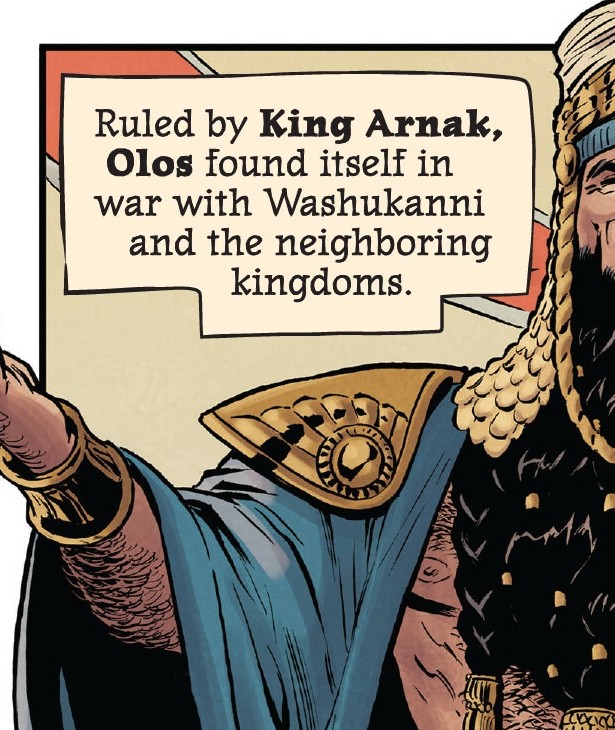
King Arnak is the ruler of Olos, husband of Queen Asana, and one of the principal human antagonists in BRZRKR: Fallen Empire #1. He governs a wealthy fortified kingdom during a period of war with Washukanni and neighboring states. His decision to bring enemy prisoners inside Olos and use them in public death sport creates the immediate conditions for the kingdom's destruction, because one of those captives is B, the immortal warrior known elsewhere as Unute.[1]
Arnak's role is defined by the belief that power can be converted into ownership. He treats captured enemies as entertainment, B as a potentially controllable military resource, and Asana's political status as part of a treaty system that has already turned her into an instrument of statecraft. When B refuses to serve him, Arnak subjects the immortal to prolonged imprisonment, starvation, beatings, repeated combat, and efforts to break his will. Later, after Asana disappears, Arnak attempts to direct B's violence toward Washukanni by supplying information that makes the rival kingdom appear responsible.[2][3]
Although Arnak fails to harness B, his methods anticipate the central tragedy of the story. Asana ultimately succeeds where her husband fails, not because her underlying goal is fundamentally different, but because she understands B emotionally. Both monarchs try to transform the immortal into a weapon for a political objective. The difference lies in technique. Arnak uses chains, spectacle, deprivation, and royal command. Asana uses intimacy, deception, and B's perfect memory. Olos is destroyed after B recognizes the second manipulation, but Arnak's earlier choices are part of the causal chain that brings B within the walls at all.[4]
Biography
Ruler of a fortified kingdom
Olos had endured for thousands of years in the desert before the events that destroyed it. Its immense walls had kept outsiders beyond the city for centuries. When the story turns to the final decades of the kingdom, Arnak occupies the throne and Olos is at war with Washukanni and other neighboring powers.[1]
The comic does not explain how Arnak inherited or seized the crown, how long he had ruled before B's arrival, or whether the war began under his reign. What it does establish is that he embraces aggressive state violence as both strategy and public spectacle. He decides that captured enemies can be used for death sport inside Olos. The narrator explicitly notes that he does this against the advice of Queen Asana.[1]
The decision undercuts the security on which Olos has long depended. The city's walls protect it by keeping danger outside. Arnak instead imports danger, converting prisoners into entertainment and normalizing the presence of conquered outsiders in the heart of the kingdom. The story's narrator identifies this cruelty as the kingdom's undoing.
Marriage to Asana
Arnak's marriage to Asana is a diplomatic arrangement. Asana comes from people who had fought Olos in the desert. Thousands died in a prolonged conflict before the tribal elders sought a settlement. Asana was given to Arnak as part of that peace.[5]
There is no evidence in Fallen Empire #1 that the marriage began as a romance. Asana later tells B she never asked to be queen and describes herself as an instrument used to stop violence. Arnak therefore benefits from a treaty built around the transfer of a young woman from one political community to another.[5]
As queen, Asana can advise him. Her opposition to his death sport shows that she has a voice at court. Yet Arnak ignores the advice, establishing the practical limit of her authority. He remains sovereign.
The comic never states whether Arnak loves Asana, whether they have children, or how he personally understood the marriage. His response to her disappearance initially frames her as a kidnapped queen and triggers an investigation. That reaction can indicate concern, political embarrassment, possessiveness, or all three, but the source does not resolve the motive.[6]
The death sport
Arnak's arenas turn war captives into commodities. The population watches prisoners fight and die, while the monarchy converts military victory into spectacle. B enters Olos through this system.
The immortal has been captured, beaten, and delivered as another body for the games. He survives wounds that should kill an ordinary person. The court quickly realizes that something unprecedented is occurring. B can be hacked apart, recover, and fight again. Arnak's interest shifts from entertainment to utility.[7]
This is the point at which the king begins trying to solve B as a problem of ownership. If a prisoner cannot be permanently killed and is capable of extraordinary violence, then from Arnak's perspective the next logical question is whether the prisoner can be made to fight for Olos.
Attempt to harness B
Arnak repeatedly confronts B and asks or commands him to fight on the king's behalf. B refuses. The king escalates.
Olos soldiers are sent against B in waves. The immortal kills them. After the violence passes, he withdraws emotionally, described as retreating into the shell of a man. The distinction is visible to Asana, but Arnak responds by continuing the effort.[8]
B is kept chained and subjected to beatings and hunger. Because his body heals, the ordinary physical limits that would end torture do not apply. Arnak can continue using pain without losing the captive to death. The arrangement lasts approximately a year.[9]
The king's failure is revealing. Arnak understands B's durability but not his psychology. He assumes enough force, deprivation, fear, or repetition can create obedience. B's immortality makes that coercive model less effective, not more. He can survive the consequences of refusing.
The queen's secret intervention
While Arnak tries to break B publicly, Asana begins visiting the prisoner secretly. A handmaiden distracts guards so that the queen can enter. Eventually Asana asks B to take her away, and the two escape Olos.[10]
Arnak at first believes B abducted her. He questions or pressures the queen's handmaidens and the dungeon guards. The evidence reveals the opposite. Asana left willingly.[6]
The episode humiliates Arnak on several levels. His supposedly secure prison has failed. The captive he could not control has escaped. The queen provided the means. The marriage that helped symbolize political order has broken publicly.
B's return
When Asana later vanishes from her desert refuge, B returns to Olos searching for answers. The apparent abduction scene suggests that the people responsible came from the desert. Arnak becomes one of the few people positioned to direct B toward an enemy.[11]
The king points the immortal toward Washukanni. The exact balance between what Arnak knows and what he assumes should be treated carefully. Asana's later confession reveals that she staged her own abduction with members of her people in order to manipulate B into attacking Washukanni. Arnak is not shown as a participant in her plan. His information nevertheless helps put B on the path she intended.[11]
For Arnak, the opportunity is consistent with his earlier goal. He could not make B serve Olos while B was in chains. Now B is angry, searching for Asana, and can be pointed at the kingdom's existing enemy.
Destruction of Washukanni
B attacks Washukanni with catastrophic force. The story says the civilization is obliterated. Men, women, and children die. The event demonstrates the scale of power Arnak had wanted to harness.[12]
Yet the outcome does not secure Olos. It removes one enemy while making the consequences of manipulating B impossible to ignore.
Asana's betrayal and the fall of Olos
B eventually discovers that Asana staged the evidence of her kidnapping. She admits that she saw him as the weapon her husband had failed to harness. Her statement directly compares her method with Arnak's. She believes she succeeded where he did not.[4]
The comparison turns the royal marriage into one of the story's central structures. King and queen both look at B and see an instrument. Arnak's coercion is obvious and brutal. Asana's is intimate and emotionally sophisticated. Neither respects B's right to decide what his violence is used for.
After the deception is exposed, B destroys Olos. The narrator states that Asana had sentenced them all to death. The city burns, its institutions collapse, and Arnak is lost with the kingdom.[13]
The art depicts the destruction reaching the royal order itself. Arnak does not escape in the surviving narrative. Later, B tells the elderly Asana that there are no kings or queens left in the desert. His statement, combined with the destruction of Olos and the absence of any later Arnak appearance, establishes the king's death as the canonical outcome.[14]
Personality and rule
Arnak is theatrical, cruel, confident in royal authority, and fascinated by power that can be made useful to the state. His introduction presents him publicly presiding over a system in which enemies become entertainment. He appears comfortable turning suffering into civic spectacle.
His treatment of B is not random sadism alone. It is instrumental cruelty. The beatings, starvation, and repeated attacks are attempts to produce military obedience. That makes Arnak important to BRZRKR's broader theme of institutions trying to convert B's body into a strategic asset.
Arnak also appears politically opportunistic. When B returns searching for Asana, the rival Washukanni can be made the target of the immortal's rage. The king's strategic instinct is to redirect a dangerous force toward an existing enemy.
What the comic does not show is a complete inner life. There are no scenes of Arnak alone, no account of his childhood, and no explanation of how he justifies his rule to himself. A comprehensive article should therefore describe his demonstrated methods rather than inventing ideology.
Leadership and resources
Royal authority
Arnak commands Olos's military, prisons, court, and arena system. His orders can place prisoners in death sport, send soldiers into combat, and maintain B's year-long confinement.
Military command
Olos is engaged in regional warfare under his rule. The story identifies Washukanni and neighboring kingdoms as adversaries. Arnak has access to enough troops to send repeated waves against B even after seeing that the attacks are futile.[8]
Prison and arena apparatus
The king controls an institutional system capable of capturing, transporting, restraining, starving, and repeatedly testing prisoners. B's confinement demonstrates both the sophistication and moral brutality of that apparatus.
Political marriage
Arnak's marriage to Asana represents a diplomatic connection between Olos and the desert tribal council. The treaty ended or moderated an earlier war of sand and blood, although later violence shows the settlement did not create stable regional peace.[5]
Relationships
Queen Asana
Asana is Arnak's wife through treaty and his most important political relationship shown in the story. She advises against the death games, secretly visits B, escapes Olos, and later explicitly says Arnak could not harness the immortal but she could. Their marriage therefore frames the parallel attempts to use B.
B / Unute
Arnak first treats B as spectacle, then prisoner, then desired weapon, then escaped threat. He never secures B's loyalty. His year-long coercion becomes one of the clearest historical examples of a ruler trying to weaponize the immortal.
Washukanni
Washukanni is a major military enemy of Olos. Arnak's war with the kingdom predates B's escape. When B seeks Asana, Arnak directs his attention toward the rival power.
Olos officials and soldiers
The officials, guards, torturers, arena personnel, and soldiers execute Arnak's policies. Their anonymity in the comic reinforces the institutional nature of the violence. They are not presented as independent rival power centers.
Appearance
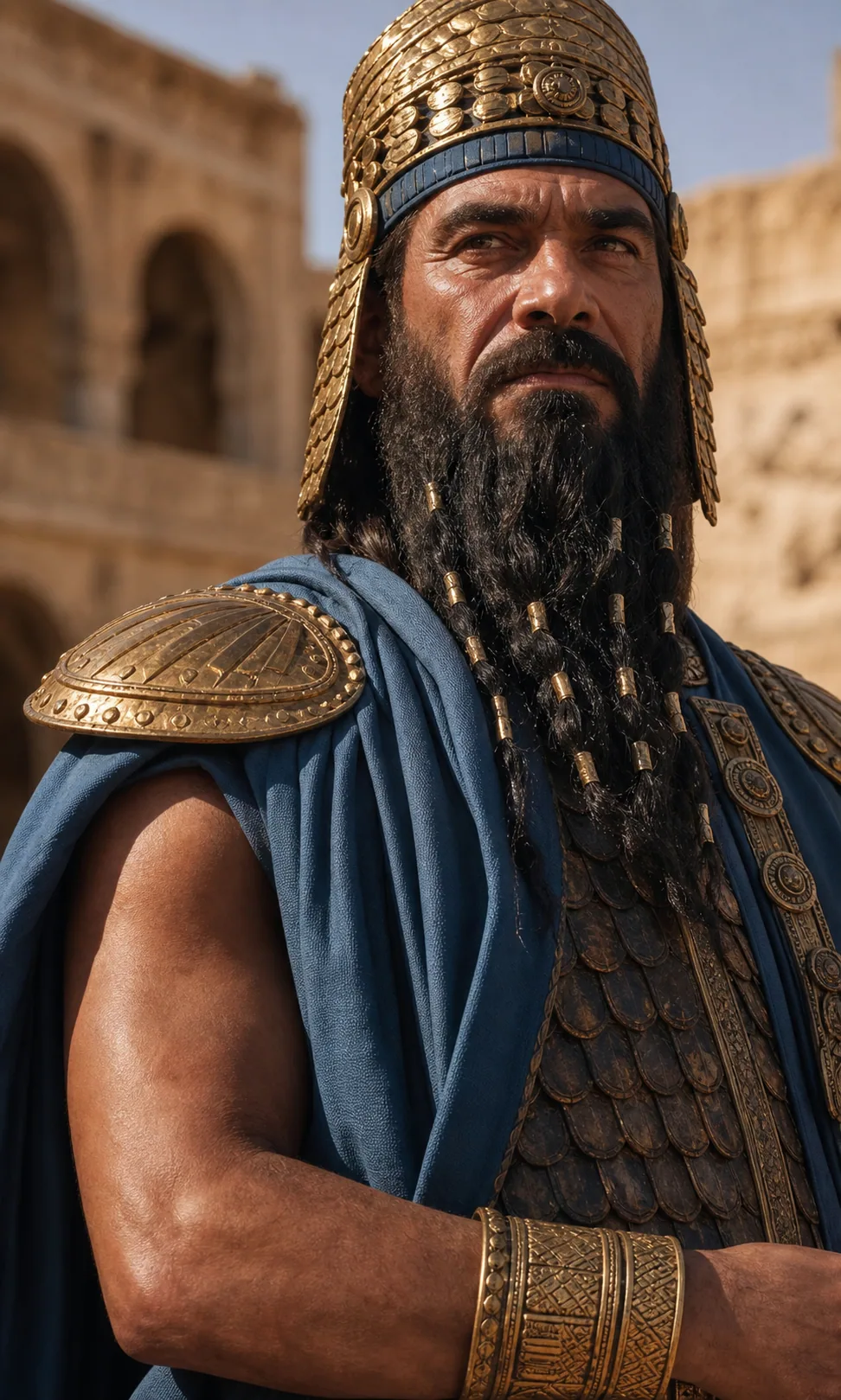
Arnak is depicted as a large, bearded king wearing elaborate gold and blue royal clothing, heavy jewelry, and a distinctive crown or headpiece. His visual design emphasizes wealth and public authority. He is frequently positioned above crowds or prisoners, reinforcing the hierarchy of Olos.
Status and fate
Dead. Olos is destroyed by B after Asana's manipulation is exposed. No source indicates Arnak survives. The ending explicitly describes an emptied desert without kings or queens.[14]
Appearances
- BRZRKR: Fallen Empire #1 - King of Olos, husband of Asana, captor and attempted controller of B.
- BRZRKR: Fallen Empire Pen & Ink #1 - alternate presentation of the same story.
- BRZRKR: Bloodlines - collected edition context for the story.
Canon limitations and unresolved questions
The comic does not establish Arnak's age, parents, ancestry, date of accession, length of reign, whether he has children, exact military rank structure, personal religion, or the names of his ministers. It also does not establish that he participated in Asana's staged abduction. That conspiracy belongs to Asana and the desert people shown assisting her.
References
[1] Mattson Tomlin and Rebekah Isaacs, BRZRKR: Fallen Empire #1 (BOOM! Studios, 2023), introduction of King Arnak, Olos's war with Washukanni, the death sport, and Asana's opposition, digital page image 0007.
[2] Tomlin and Isaacs, BRZRKR: Fallen Empire #1, B's imprisonment, repeated combat, and Arnak's efforts to make him fight for Olos, digital page images 0014-0017.
[3] Tomlin and Isaacs, BRZRKR: Fallen Empire #1, B's return to Olos after Asana's apparent abduction and Arnak's role in directing his attention toward Washukanni, digital page images 0035-0036.
[4] Tomlin and Isaacs, BRZRKR: Fallen Empire #1, Asana's confession that her husband could not harness B but she believed she could, digital page image 0042.
[5] Tomlin and Isaacs, BRZRKR: Fallen Empire #1, Asana's account of being used as a treaty offering after the war of sand and blood, digital page images 0028-0029.
[6] Tomlin and Isaacs, BRZRKR: Fallen Empire #1, Arnak's initial belief that Asana was kidnapped and questioning of handmaidens and dungeon guards, digital page image 0021.
[7] Tomlin and Isaacs, BRZRKR: Fallen Empire #1, B's arrival as a captive in the arena and the court's realization that normal explanations do not fit his survival, digital page images 0008-0013.
[8] Tomlin and Isaacs, BRZRKR: Fallen Empire #1, waves of soldiers sent against B and Asana's recognition of the man beneath the violence, digital page images 0014-0016.
[9] Tomlin and Isaacs, BRZRKR: Fallen Empire #1, continued beatings, hunger, regeneration, and approximately year-long confinement, digital page image 0017.
[10] Tomlin and Isaacs, BRZRKR: Fallen Empire #1, queen's secret visits, handmaiden diversion, and escape with B, digital page images 0018-0020.
[11] Tomlin and Isaacs, BRZRKR: Fallen Empire #1, B's return to Olos and confrontation with Arnak after the staged abduction, digital page images 0035-0036.
[12] Tomlin and Isaacs, BRZRKR: Fallen Empire #1, annihilation of Washukanni, digital page image 0037.
[13] Tomlin and Isaacs, BRZRKR: Fallen Empire #1, destruction of Olos after Asana's betrayal is exposed, digital page images 0043-0044.
[14] Tomlin and Isaacs, BRZRKR: Fallen Empire #1, B's final statement that no kings or queens remain in the desert, digital page image 0049.
Collected and alternate editions
The story is also available in BRZRKR: Fallen Empire Pen & Ink #1 (BOOM! Studios, 2024) and later BRZRKR Bloodlines collections. These editions should be linked under COLLECTED_IN or EDITION_OF relationships rather than treated as new story events.