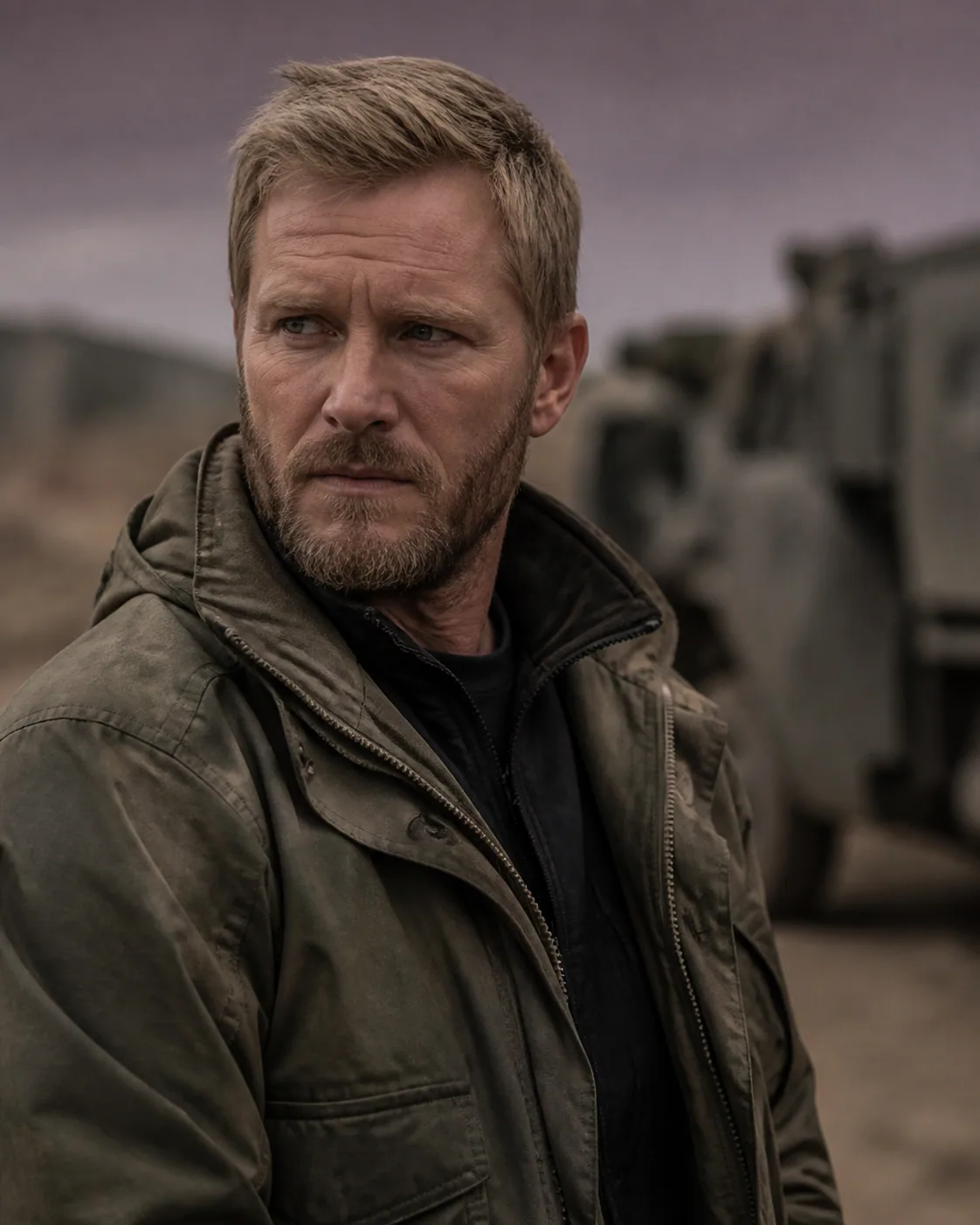
Spoilers: This article discusses Keever's complete role in the original BRZRKR series, including his relationship with B, the government program, Protocol X, his order to execute the newly mortal B and his actions during the final issue.
| Field | Details |
|---|---|
| Full name | Jim Keever |
| Common name | Keever |
| Species | Human |
| Gender | Male |
| Status at end of original series | Alive |
| Occupation | Soldier, field operative and handler attached to the government program using B |
| Affiliation | United States government / black-operations program; later acts independently to protect B and Diana |
| Primary relationship | B's field partner, handler, comrade and friend |
| First appearance | BRZRKR #1 |
| Latest original-series appearance | BRZRKR #12 |
| Creators | Keanu Reeves, Matt Kindt and Ron Garney |
Overview
Jim Keever is the principal military figure in B's modern life and the character who most clearly demonstrates how a relationship that begins inside an exploitative government program can become genuine loyalty. Keever works as B's field handler and combat partner. His job places him on the operational side of the same system in which Dr. Diana Ahuja conducts memory work and Stephen Caldwell directs increasingly ambitious research. Where Diana learns B through conversation and Caldwell studies him through data and history, Keever knows him through missions.[1][6]
That difference shapes their bond. Keever is not initially presented as someone who questions the existence of the program. He escorts B through the undisclosed facility outside Tacoma, participates in deployments and accepts the basic premise that B is the person sent into situations ordinary troops cannot survive. Yet the language and behavior between them are personal from the beginning. In BRZRKR #1, after B returns mutilated from the opening mission, Keever guides him through the facility and calls him “son.”[1] The same word returns near the end of BRZRKR #12, when Keever is ordered to kill B after B finally becomes mortal. The repetition turns a military mannerism into the marker of an entire relationship.
Keever's importance is not that he never follows orders. He does. He helps the institution use B. He accompanies the experiments, participates in dangerous operations and remains in the government structure even after the research becomes increasingly destructive. His importance lies in the point at which obedience becomes incompatible with the man he has come to regard as a comrade. In the finale, Keever receives a direct order to eliminate B and witnesses. He walks into the room armed. He apologizes. He tells B it has been an honor. After Diana demonstrates that she can kill him by interrupting his heart's electrical activity, Keever ultimately chooses to let them go.[12]
He later appears after B has been mortally wounded protecting his family. Keever recognizes that B will not survive and tells him to rest in peace. B's death is the fulfillment of the mortality he sought from the first issue, and Keever, who spent years escorting an indestructible warrior back from missions, becomes one of the people present when there will be no regeneration.[12]
Keever therefore occupies a distinctive position in the series. He is neither B's scientist nor his cosmic connection. He is the ordinary human soldier who shares the practical world of violence with him and gradually refuses to reduce him to the weapon both men were ordered to use.
Early role in the government program
The original series gives relatively little biographical information about Keever before his assignment to B. His age, family history, birthplace, education and pre-program military career are not established in sufficient detail to publish as canon. A definitive wiki should resist the temptation to construct a conventional service record from implication.
What the comic establishes clearly is that by BRZRKR #1, Keever is already integrated into the undisclosed United States government facility outside Tacoma, Washington. He is comfortable around B in a way that suggests an established working relationship. When B returns from the opening covert mission covered in catastrophic injuries, Keever escorts him inside rather than reacting with the shock expected from someone witnessing B's regenerative existence for the first time.[1]
The visual contrast is important. The facility treats B as both operative and specimen. Armed personnel move around him. Scientists wait. The next stage is testing and debriefing. Keever belongs to that machinery, but his demeanor is less clinical. He addresses B directly and personally.
The first issue therefore establishes the two sides of Keever that will remain in tension throughout the series. He is the face of the government in B's operational life, and he is also one of the few people inside that government with whom B has something resembling ordinary camaraderie.
Handler, soldier and field partner
Calling Keever only a handler understates his function. He does not remain in a command room while B fights. The series puts him in the field. He carries weapons, makes tactical decisions, communicates with headquarters and shares physical danger with the man he is assigned to manage.
This matters because B's immortality distorts the normal relationship between handler and operative. A conventional field leader must protect personnel because casualties remove them from the mission. B can be sent through gunfire, explosions and overwhelming opposition precisely because his body is expected to return. The government can therefore treat him with a level of expendability that would be impossible with Keever or any other ordinary soldier.
Keever sees the consequences of that assumption at close range. He watches B injured, reconstructed and sent back out. He also sees the difference between B's usefulness and B's desires. B is not fighting because he loves being the government's perfect weapon. He is fighting because the institution has promised answers and a route to mortality.
The military partnership exposes Keever to a side of B that laboratory researchers can only infer. B may lose control in a berserker state, but he is also tactically sophisticated, capable of restraint and deeply protective of people he recognizes as his own.
Relationship with B in BRZRKR #1
The opening issue already contains the seeds of the final relationship. After B completes an exceptionally violent covert operation, he returns to the government facility in a body that would be a medical impossibility for anyone else. Keever meets him in the corridor and guides him toward the next stage of processing, calling him “son.”[1]
The word has multiple possible shades. It can be a veteran soldier's habitual way of speaking to another man. It can suggest age or rank despite the absurdity that B is tens of thousands of years older. More importantly, it introduces paternal language into a story where B's original father treated him as a weapon.
Keever is not a replacement father. The comic never makes that claim. But the difference between the two relationships becomes meaningful over time. B's prehistoric father sees the child's power and expands its use. Keever sees the same power inside a military system and eventually reaches the point where he will not complete the order that would turn B's newly achieved mortality into a convenient execution.
Living with an immortal teammate
One of the understated features of Keever's role is the psychological normalization required to work beside B. Soldiers normally rely on shared vulnerability. Everyone can be killed. B breaks that assumption.
This could make him impossible to relate to, but Keever instead treats B's condition as part of operational reality. He can give him instructions, argue with him and expect answers. The series uses this practical tone to keep the relationship grounded even when the science around B becomes increasingly cosmic.
Keever also gives B a context in which he can behave as a person rather than as a research subject. The two men do not need to spend every scene discussing immortality. They can solve a mission problem, move an objective or get out of a bad situation. For B, whose every encounter with scientists risks becoming a question about what he is, that ordinariness has value.
The mission in BRZRKR #6
BRZRKR #6 is Keever's most important field-focused issue. The government sends B and Jim into a contemporary war zone for what is framed as a recovery operation. The mission takes place amid an active conflict that is not theirs to solve. Keever has to manage the narrow objective while B possesses enough power to intervene on a much larger scale.[6]
The operation deteriorates. Keever is injured during the mission, and B has to prioritize extracting his wounded partner. The episode is significant for both characters because it reverses the usual logic of their deployments. The government normally treats B as the one who can absorb damage for everyone else. Here, B's immortality becomes the means by which he protects a mortal friend.
A later scene shows the pair near a boat as they assess how to move the recovered material. Keever proposes taking it into international waters and sending headquarters the coordinates. B responds not as a mindless weapon but as a partner evaluating the plan.[6]
The issue strengthens the idea that Keever is one of the few modern humans who can interact with B at the level of practical trust. B has no need to impress him with violence. Keever already knows what he can do. Their problem is getting home.
Keever as an observed variable
The mission also matters because Diana and Caldwell are not simply interested in the objective. The government research program treats field behavior as part of its study of B.[6]
Keever therefore occupies an uncomfortable double position. He is B's friend in the field and part of the institutional environment observing him. Even if Keever is not designing the experiments, his relationship can become data.
This distinguishes his moral trajectory from Diana's. Diana directly administers memory protocols and must confront the ethics of trust as a research instrument. Keever participates more indirectly, but he faces the same larger question: at what point does professional duty become complicity in the exploitation of someone he knows personally?
The answer does not arrive all at once. Keever remains with the program through Protocol X and the final Source operation. His break comes only when the institution demands an act he cannot reconcile with the relationship built across those years.
World War I and the history of U.S. handlers
BRZRKR #7 reveals that Keever is not the first American assigned to work alongside B. Diana's memory work reaches World War I, when B fights beside his first United States handler. An artillery strike separates a piece from B's body, and the fragment later becomes an artifact Caldwell recovers.[7]
The episode places Keever inside a historical lineage of handlers. The United States has been attempting to use and manage B across generations. Individuals change. The institutional relationship persists.
That context makes Keever's eventual refusal especially important. If the role has existed for decades, perhaps longer in informal form, then the handler is part of the mechanism by which institutions repeatedly convert B into a weapon. Keever is the handler who eventually disrupts the expected endpoint.
The World War I material should therefore cross-link from Keever's page to Handlers of B and B and the United States. Keever's significance becomes clearer when he is compared with the earlier people who occupied the same function.
Protocol X
By BRZRKR #7 and #8, the research program has moved beyond ordinary memory recovery. Caldwell proposes Protocol X, an experiment designed to force contact with or reproduction of the phenomena connected to B's origin.[7][8]
Keever remains inside the operational structure surrounding the experiment. His role is not primarily scientific. He represents security, containment and the practical consequences of whatever the researchers unleash.
Protocol X produces exactly the kind of event that exposes the weakness of that division. B disappears from ordinary physical space. Diana is altered by anomalous energy. Personnel are killed or injured. The program acquires data but loses control of its subject.[8]
In subsequent events, Keever helps respond to B's reappearance and violent return. His task becomes nearly impossible. How does a soldier contain the immortal asset when the experiment designed by his own side has destabilized him?
The answer is that conventional force is inadequate. This lesson repeats in different forms until the finale. B can be attacked, but violence alone cannot solve the underlying problem. Diana's relationship with him becomes more effective than weapons, while Keever increasingly understands the limits of treating him as a target.
B's return and Keever's operational dilemma
After Protocol X, B returns in a severe berserker state while trying to reach Diana. Soldiers, security systems and containment plans are overwhelmed.[9]
Keever is positioned between headquarters and the man he has fought beside. His military role requires him to respond to B as a threat. His personal experience tells him that B's violence has context and that Diana may be able to reach him.
This is the kind of situation that gives Keever depth without requiring long exposition about his feelings. He is a professional soldier. He reacts through action. The increasingly impossible orders around B gradually show him that the institution's control is not only failing but becoming morally untenable.
Saudi expedition and final Source operation
In the final third of the series, the program follows the recovered geographical evidence to B's place of origin in Saudi Arabia. The expedition ultimately leads to the bird-shaped object associated with B's mother and to direct Source contact.[10][11]
Keever remains part of the team as the mission changes categories. What began as a military asset program has become first contact with a nonhuman intelligence. For Diana and Caldwell, this is the culmination of scientific research. For Keever, it creates a new scale of operational uncertainty.
He is not given the luxury of remaining a spectator. When Caldwell's cult turns on the government forces and the transfer process gives Caldwell B-like abilities, Keever is again responsible for surviving the consequences of decisions made above his level.
Caldwell's betrayal
The revelation that Caldwell leads a fanatical cult exposes just how compromised the program has become. Keever has spent years following missions organized around scientific and national-security objectives. Caldwell's hidden agenda means that some of those operations also served a private historical project aimed at acquiring immortality and reaching the Source.[11][12]
Keever's relationship to Caldwell is not as intimate as Diana's or B's. This makes him useful as the perspective of the working soldier caught inside institutional betrayal. He has to fight the threat in front of him even as the logic of the mission collapses.
The final battle destroys Caldwell's immediate threat and leaves B mortal. That should have been the point at which the government's promise to B was fulfilled. Instead, B's success changes his value to the institution.
Escort from the final battlefield
In the opening movement of BRZRKR #12, Keever helps B and Diana escape the devastation surrounding the Caldwell confrontation. An aerial strike destroys the battle area after their departure.[12]
The sequence shows that Keever is still functioning as a soldier, but his practical allegiance is now increasingly to the people in the vehicle rather than to the abstract mission. Diana is injured and pregnant. B is mortal. The old assumption that the pair can simply be processed as government assets no longer fits the reality in front of him.
They reach a headquarters safehouse somewhere in Virginia. B undergoes medical examination and is told that his vitals are normal. For the first time in Keever's relationship with him, the man called B can be permanently hurt.[12]
This changes everything about the handler's role. The person Keever used to escort into combat was effectively unkillable. The person sitting in the safehouse now has the vulnerability of any other soldier.
The execution order
The defining moment of Keever's biography occurs at the Virginia safehouse. Headquarters communicates through the Source-powered hypercomputer. Keever receives a direct order to kill B. The rationale is brutally administrative: B served the government for a long time, but there can be no witnesses. When Keever asks about Diana, the answer is to preserve her.[12]
The order reveals the government's hierarchy of value. B has achieved mortality and is no longer the indestructible asset he once was. Diana, by contrast, is Source-altered and pregnant. The institution's interest shifts immediately.
Keever does not openly refuse at first. He walks into the room with a handgun. He apologizes to B and again calls him son. B understands and does not plead. Keever says it has been an honor.[12]
The scene matters because both men know what the order represents. If Keever fires successfully, the government will give B the death he wanted, but not the life or agency that made mortality meaningful. It would turn B's freedom into one final institutional use.
Diana's intervention
Diana realizes what Keever is about to do. Her response makes clear how dramatically the balance of power has changed. She tells Keever not to move and explains that she can stop his heart by interrupting its electrical current. She also tells him that she does not want to hurt him or his men.[12]
Keever is therefore given an opportunity to frame his eventual decision as defeat. Diana can kill him. He could claim he had no choice.
The comic gives him more agency than that. After the immediate standoff, B and Diana prepare to leave. Keever warns that the government will come after them. Diana answers that it will not happen today. Keever lets them walk away and tells B, “Good luck, kid. See you on the other side.”[12]
The line completes the movement that began with “son” in the first issue. Keever is no longer escorting the asset to the laboratory. He is allowing the person to leave.
Breaking with the program
Keever's refusal is not presented as a dramatic ideological speech. He does not announce a revolution against the government or expose the program to the world. His rebellion is local and personal.
That choice is consistent with his character. Keever solves problems directly. He recognizes that B has earned the right to leave and refuses to be the man who denies it.
The distinction is important for a comprehensive biography. Keever does not become anti-military. He becomes unwilling to carry out a particular order that violates the relationship built with B. This narrower moral choice is more convincing than retroactively portraying him as a secret opponent of the program all along.
The Southwest, the family and the final attack
B and Diana eventually reach allies in the Southwest, where Seline and Songaa help them during Diana's accelerated pregnancy.[12] Keever is not part of the domestic refuge in the same way. The separation allows B and Diana to build a family outside the government's immediate structure.
The children grow rapidly and inherit extraordinary abilities. When violence returns, B fights as a mortal to protect them.
Keever appears again during the aftermath of the attack. By then B is catastrophically wounded. The old handler does not try to reclaim him as property or force the family back into custody. He sees that B will not survive.
His response is characteristically blunt. He recognizes that B has finally reached death and tells him to rest in peace.[12]
The moment gives Keever one of the most emotionally important positions in the ending. Diana holds B as he dies. The children witness the loss of their father. Keever, the soldier who knew B through the years when death could never keep him, understands exactly what the event means.
Keever and B's mortality
Keever's entire relationship with B is shaped by the fact that one of them can die and the other cannot. That difference disappears in the final issue.
B's new mortality makes their relationship more equal in one sense. Both are now men who can be killed. Yet the government immediately weaponizes that equality by ordering Keever to shoot him.
Keever's refusal protects the meaning of B's achievement. Mortality is not valuable because B wants someone else to execute him on command. It is valuable because it allows him to live a finite life whose end belongs to the ordinary risks of loving, fighting and protecting other people.
When B later dies from wounds sustained defending his family, the difference is profound. He is not killed because his usefulness ended. He dies because he chose to stand in front of danger while mortal.
Keever's role in preserving that distinction is central to his legacy.
Relationship with Diana Ahuja
Keever and Diana occupy different sides of the B program, but their trajectories converge. Both begin inside the institution. Both develop personal loyalty to B. Both eventually refuse the institution's final claim on him.
Their most direct conflict occurs during the execution order. Diana is willing to use her altered abilities to stop Keever but explicitly says she does not want to hurt him. The exchange implies that she understands the pressure he is under even while refusing to allow him to comply.[12]
After Keever lets them go, the relationship is no longer simply soldier and scientist. They are people who have made the same choice from different positions.
See Diana Ahuja.
Relationship with Stephen Caldwell
Keever's relationship with Caldwell is primarily institutional. Caldwell designs, directs or influences experiments whose consequences Keever has to manage in the field. Keever protects sites, responds to failures and helps move B through operations. Caldwell converts B into a research problem. Keever has to survive what happens when the research problem fights back.
The cult revelation makes Caldwell's actions a betrayal not only of B and Diana but of the soldiers who believed they were serving a government mission. Keever is one of the people left to deal with that betrayal physically.
See Stephen Caldwell.
Personality
Keever is pragmatic, blunt and loyal within the language of a career soldier. He rarely explains his morality in abstract terms. His values are visible through what he does.
He can accept extraordinary circumstances without melodrama. Working beside an immortal warrior becomes another operational fact. This makes him a stabilizing presence in a story increasingly occupied by cosmic intelligence, quantum biology and cult history.
His use of paternal or affectionate military language toward B reveals more emotion than he typically states directly. Calling an eighty-thousand-year-old man “son” is absurd if read literally, but emotionally accurate to the role Keever has developed. He is the person who gets B back through the door after a mission and, in the end, the person who tells him to rest.
Keever is also capable of obedience beyond the point at which other characters might have defected. This should not be softened. He remains in the program through damaging experiments and carries the execution order into B's room. His final loyalty is meaningful because it is a choice made against established habits of duty.
Skills and equipment
Keever has no superhuman abilities in the original series. His usefulness comes from military competence.
Small-arms proficiency
He is repeatedly depicted carrying and using modern military firearms and understands combat procedure.
Tactical judgment
Keever assesses extraction routes, communicates with headquarters and makes decisions under active fire. BRZRKR #6 particularly demonstrates this side of the character.[6]
Field leadership and handling
He can work beside B without either treating him like an ordinary soldier or surrendering all tactical judgment to him. This is a specialized form of experience given B's berserker capability.
Survival and resilience
Keever survives missions that injure him severely and continues operating through the escalating disasters caused by Protocol X, the cult conflict and the final battle.
Government access
His position gives him access to secure facilities, operational communications, transport and classified systems. The finale shows him receiving direct orders through the Source-powered hypercomputer.[12]
A standalone powers page is not appropriate for Keever. Military skills should remain part of the character biography and structured equipment records.
Appearance
Keever is depicted as a muscular Black man with close-cropped hair and facial hair, usually seen in military or tactical clothing during the modern storyline. His physical design communicates the fact that he is a field operator rather than a desk-based handler.
His most useful visual identifiers for the image database are close-cropped hair, broad build, tactical vest and his recurring placement beside B in modern operations. Gallery captions should distinguish him from unnamed government soldiers rather than tagging every Black tactical character as Keever without confirmation.
Original-series appearances
Keever's appearance record should connect him across the modern storyline, with the strongest issue-level material in:
The full appearance database should verify panel-level presence in issues where Keever is not named in dialogue before marking an appearance as confirmed.
Status after the original series
Keever survives the events shown around B's death. The original series does not provide a detailed epilogue for his later career, legal status or relationship with the surviving government program.
This uncertainty should remain explicit. It is reasonable to infer that helping B and Diana escape creates serious institutional consequences, but those consequences are not shown in enough detail to be stated as fact.
His canonical status at the end of the twelve-issue series is alive, with future activities unknown.
Novel and adaptation continuity
A version of Keever appears in The Book of Elsewhere. That material should be maintained separately because the novel's institutional terminology and character history are not automatically comic canon. Use Jim Keever, novel continuity if a full novel-specific article is warranted.
Film and anime versions should receive separate records after release rather than having production speculation inserted into this biography.
References
[1] Keanu Reeves, Matt Kindt and Ron Garney, BRZRKR #1 (BOOM! Studios, 2021), modern government facility outside Tacoma. Around story p. 30, Keever escorts the severely wounded B through the facility and addresses him as “son.”
[6] Reeves, Kindt and Garney, BRZRKR #6 (BOOM! Studios, 2021), B and Jim Keever's modern war-zone recovery mission. The issue establishes their field partnership and B's effort to protect and extract his wounded handler.
[7] Reeves, Kindt and Garney, BRZRKR #7 (BOOM! Studios, 2022), World War I memory involving B's first U.S. handler, providing historical context for Keever's modern role.
[8] Reeves, Kindt and Garney, BRZRKR #8 (BOOM! Studios, 2022), Protocol X and the destructive experimental event that B's military support structure must respond to.
[9] Reeves, Kindt and Garney, BRZRKR #9 (BOOM! Studios, 2022), B's return and containment crisis following Protocol X.
[10] Reeves, Kindt and Garney, BRZRKR #10 (BOOM! Studios, 2022), final origin-investigation phase and Saudi expedition era.
[11] Reeves, Kindt and Garney, BRZRKR #11 (BOOM! Studios, 2022), cult assault, Source contact and collapse of Caldwell's government-facing role.
[12] Reeves, Kindt and Garney, BRZRKR #12 (BOOM! Studios, 2023), complete finale. Key Keever sequences include the escape vehicle after the Caldwell battle; the aerial destruction of the site; the Virginia HQ safehouse; the hypercomputer order to kill B and preserve Diana; Keever's armed confrontation with B; Diana's threat to stop his heart; Keever allowing the couple to leave; and his later presence beside the mortally wounded B.
Collected-book references
- BRZRKR Vol. 1, collecting BRZRKR #1-4.
- BRZRKR Vol. 2, collecting BRZRKR #5-8.
- BRZRKR Vol. 3, collecting BRZRKR #9-12.
- BRZRKR Book One, collecting the complete original BRZRKR #1-12 maxiseries.