Spoilers: This article discusses Caldwell's private killings and his long search for artifacts and information connected to Unute in The Book of Elsewhere.
| Field | Details |
|---|---|
| Name | Josh Barrientes |
| Species | Human |
| Gender | Not explicitly stated in the cited passage; name-based assumptions should not be stored as hard canon |
| Occupation | Unknown; Caldwell's recollection places Barrientes among people who may have been archaeologists, priests, map sellers, dealers in unusual objects, or information brokers |
| Affiliation | None confirmed |
| Connection to B | Possessed, protected, or knew information / material connected to Unute |
| Connection to Caldwell | Victim of Caldwell during his private search for Unute-related knowledge and artifacts |
| First appearance | The Book of Elsewhere, through Caldwell's recollection |
| Status | Deceased |
| Primary continuity | The Book of Elsewhere |
| Creators | Keanu Reeves and China Miéville |
Overview
Josh Barrientes is a minor but significant named character in The Book of Elsewhere, remembered by Caldwell as one of the people he killed while pursuing hidden knowledge and material connected to Unute. Barrientes appears not through a conventional scene of introduction but as one face in Caldwell's memory, alongside Weatherly Knighton and Jon Peters. The passage is brief, yet it reveals a major part of Caldwell's biography that would otherwise remain abstract: his obsession with B has produced a private body count outside the Unit's official operations.[1]
Barrientes' precise occupation is deliberately unresolved. Caldwell's memory groups the three victims among people who could have been archaeologists, priests, map sellers, dealers in unusual objects, or information brokers. The phrasing does not assign one profession to each name, so it does not establish Barrientes as the archaeologist, Knighton as the priest, or Peters as the broker. The novel supplies a range of possible social roles to characterize the clandestine world Caldwell has moved through, not a one-to-one occupational key.[1]
What is certain is more important than what is unknown. Barrientes had something Caldwell wanted. The people in this network possessed artifacts, texts, maps, or accumulated information that helped reconstruct traces of Unute across deep time. Caldwell took those things by killing their holders. The material he acquired included extremely ancient figurines associated with Unute, writings in forgotten scripts concerning a death-linked or silence-linked figure, and other fragments of knowledge he could choose either to feed selectively into the Unit or conceal for his private project.[1]
Barrientes connects Caldwell's named victims, the provenance of objects associated with Unute, and the hidden network of people who preserve ancient knowledge. His significance lies in how his name converts Caldwell's secret research from an intellectual pursuit into a documented history of murder.
What the novel establishes
The novel provides only one explicit naming passage for Josh Barrientes in the material currently verified. It does not supply a childhood, family, birthplace, education, age, physical description, or a scene from Barrientes' own point of view.[1]
The gaps in Barrientes' biography remain unresolved. The established record consists of:
The page can therefore be extensive without pretending Barrientes has a detailed life history the novel never gives him.
Caldwell's recollection
Barrientes is named during a sequence in which Caldwell thinks about people he has killed in the course of his private work. The memory flashes through multiple dead faces and explicitly names Josh Barrientes, Weatherly Knighton, and Jon Peters.[1]
Caldwell's recollection is emotionally revealing. The victims are not remembered as faceless obstacles. He remembers their surprise, fear, and disappointment at the moment they realize what he is about to do. The passage also describes Caldwell using direct, intimate methods of killing, including strangulation and stabbing across the group.[1]
The source does not assign a specific method to Barrientes individually. The database should therefore record:
death_method: homicide by Caldwell, exact method not individually established
rather than choosing strangulation or stabbing.
This distinction is necessary because collective descriptions are easy to over-resolve into false precision.
What Barrientes may have been
The narrative presents Caldwell's victims as people occupying the shadow economy around ancient knowledge. Possible roles include archaeology, religion, map trading, dealing in unusual or discarded objects, and information brokerage.[1]
Each role makes sense within Caldwell's search for Unute:
Archaeologists
An archaeologist might discover objects, burials, cave material, figurines, or inscriptions that predate conventional records of civilization. Unute's existence stretches back tens of thousands of years, so evidence of him could appear in contexts professional archaeology would struggle to explain.
Priests
Religious custodians could preserve myths, ritual objects, oral histories, or traditions that encode encounters with B as divine, demonic, angelic, or otherwise supernatural.
Map sellers
Maps can preserve forgotten routes, sites, ruins, battlefields, old names, and locations of collections. Caldwell's work depends on linking objects to places through time.
Dealers in unusual objects
Black-market or informal artifact dealers would be natural intermediaries for items that legitimate institutions reject, misclassify, or cannot provenance cleanly.
Information brokers
A secret connected to an immortal being has intelligence value. Brokers could connect Caldwell to private archives, archaeological theft, cult records, military files, collectors, or families holding inherited material.
Barrientes could occupy any of these categories or move among several. The novel does not choose one.
Connection to Unute-related artifacts
Caldwell's wider recollection establishes that the people he killed possessed or protected objects and information connected to Unute's long history.[1]
Among the kinds of material Caldwell acquires are figurines far older than ordinary cave-painting traditions and texts written in forgotten alphabets that describe a figure associated with death, silence, or primordial violence. Such materials allow Caldwell to trace recurring patterns across civilizations that never shared ordinary historical contact.
The important point for Barrientes is not that any single listed object can be assigned specifically to him. The source does not establish that. Instead, Barrientes is part of the human chain through which Caldwell accumulates the archive.
Knowledge-graph implementation should therefore use:
Relationship with Caldwell
Barrientes' only confirmed direct relationship is with Caldwell, and it is fatal.
Caldwell pursues information without accepting normal ethical, legal, or institutional boundaries. The passage naming Barrientes shows that murder is one of his research methods.[1]
This is a crucial expansion of Caldwell's character in novel continuity. Inside the Unit, he can present himself as a researcher, administrator, specialist, or authority on ancient systems. Outside official channels, he kills people and takes what they are hiding.
Barrientes therefore functions as evidence of Caldwell's compartmentalization. The Unit may receive selected discoveries, but Caldwell retains control over the full archive.
The relationship should be represented as:
The second edge should carry a confidence note because the text groups several victims together rather than assigning each recovered item individually.
Relationship with the Unit
No direct Unit membership is established for Barrientes.
This point matters because earlier content planning grouped his name with “government scientists, handlers and soldiers.” Primary-source review does not support that classification.[1]
Barrientes belongs to Caldwell's private external network of victims, not the Unit personnel roster, unless future material explicitly establishes employment.
The page should therefore carry:
affiliation: unknown
and a negative editorial rule:
This correction prevents the novel's clandestine intelligence plot from being flattened into a government staff directory.
Possible knowledge possessed by Barrientes
The exact information Barrientes knew is not stated. The fact that Caldwell killed him implies that the information or material was important enough to justify extreme secrecy in Caldwell's own mind.[1]
Responsible possibilities include:
- knowledge of an Unute artifact's provenance
- location of an ancient site
- possession of a rare text or figurine
- knowledge of another intermediary
- awareness of recurring myths describing B
- access to a private collection
- evidence contradicting official archaeology or history
These are categories of information Caldwell sought, not confirmed personal facts about Barrientes. Public prose should preserve the distinction through phrases such as “may have possessed one of the kinds of materials Caldwell was collecting” rather than “Barrientes owned the figurines.”
Death
Barrientes is dead by the time Caldwell remembers him.[1]
Caldwell is responsible for the death. The recollection describes victims being killed by hands closing around throats or by a narrow blade driven between ribs, but it does not map one method to one name.[1]
The death database should record:
| Field | Value |
|---|---|
| Killer | Caldwell |
| Cause | Homicide |
| Specific method | Unknown individually; collective passage describes strangulation and stabbing |
| Location | Unknown |
| Date | Unknown |
| Witnesses | Unknown |
| Reason | Caldwell's pursuit of concealed Unute-related information / material |
Narrative function
Barrientes' narrative function is to give a name to the cost of Caldwell's obsession.
Without the named victims, readers might treat Caldwell's hidden research as a familiar conspiracy-fiction abstraction: secret files, stolen relics, unexplained archives. Barrientes, Knighton, and Peters make clear that the archive was assembled through human violence.
The passage also complicates Caldwell's relationship with institutional authority. He is not merely following orders too aggressively. He is withholding information, privately deciding who may live, and building a personal knowledge base whose existence exceeds legitimate Unit oversight.[1]
This makes Barrientes relevant to several major themes:
- knowledge as possession
- archaeology and violence
- secrecy versus institutional accountability
- the ethics of studying Unute
- cult behavior inside scientific institutions
- the human cost of mythmaking
Relationship with Weatherly Knighton and Jon Peters
The novel names Barrientes, Knighton, and Peters together as part of Caldwell's memory.[1]
No evidence establishes that the three knew each other. Their grouping is Caldwell's, not necessarily a social relationship among the victims.
The wiki should therefore use:
only as an editorial/source relationship if the graph supports that type. Do not use ALLY_OF, COLLEAGUE_OF, or MEMBER_OF_SAME_GROUP without evidence.
A collective article Caldwell's Named Victims should provide the shared context while individual pages preserve identity-specific searchability.
Appearance
The novel does not describe Barrientes' physical appearance in the verified passage.
No original rendering should assign highly specific features as though they are canon. If the site creates a portrait, the caption should state:
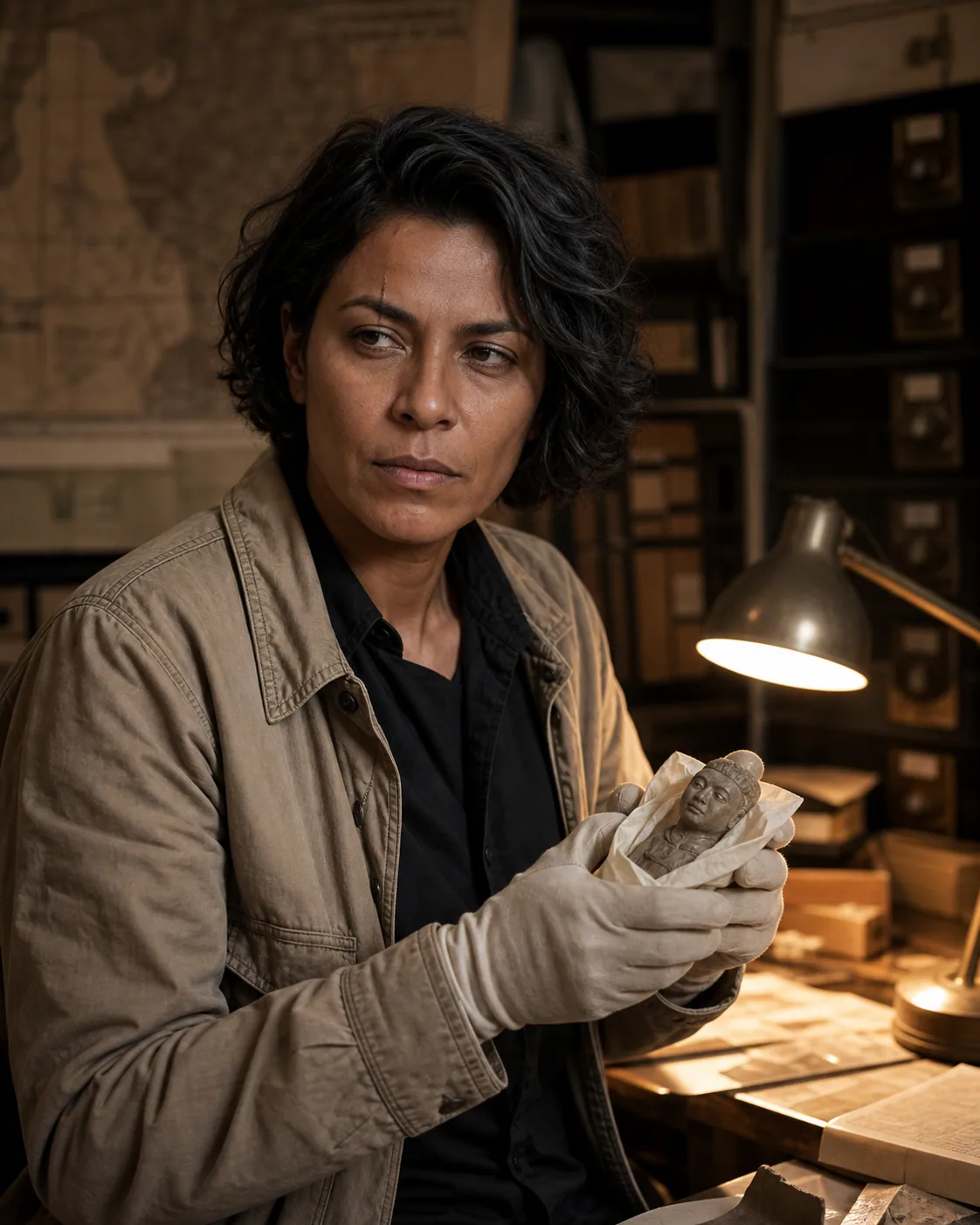
Original interpretation of Josh Barrientes. The novel does not provide a detailed canonical physical description.
An alternative is to avoid a portrait and use an editorial image of Caldwell's recovered archive, with Barrientes represented by a labeled evidence card rather than an invented face.
That second approach may be preferable until adaptation material supplies a visual interpretation.
Personality
The source provides no direct dialogue, point-of-view narration, or behavior from Barrientes before his death.
The only emotional information comes through Caldwell's memory of the victims' final reactions. Barrientes belongs among people who respond to impending death with shock and fear.[1]
A personality section should therefore remain intentionally brief. Describing him as brave, secretive, scholarly, corrupt, religious, or heroic would be invention.
Status
Deceased.
No resurrection, supernatural continuation, family successor, or later appearance is established.
Appearances
- The Book of Elsewhere (Del Rey, 2024), named in Caldwell's recollection of people killed during his search for Unute-related knowledge.
Barrientes does not appear in the original twelve-issue BRZRKR comic series based on the supplied source audit.
Unresolved questions
- What was Josh Barrientes' occupation?
- What object, map, text, or information did Caldwell want from him?
- Where did Caldwell find him?
- When was he killed?
- Did Barrientes understand the true nature of Unute?
- Did he belong to a religious, archaeological, criminal, intelligence, or collecting network?
- Did he know Weatherly Knighton or Jon Peters?
- Did Caldwell report any of the material taken from Barrientes to the Unit?
- Does any surviving archive preserve Barrientes' research?
These questions should remain open rather than be answered through secondary speculation.
Canon confidence summary
| Claim | Confidence |
|---|---|
| Josh Barrientes exists in novel continuity | Confirmed |
| Caldwell killed him | Confirmed |
| He had information or material Caldwell wanted | Strongly supported by grouped passage |
| He was a Unit employee | Not supported |
| He was an archaeologist | Possible category, not individually confirmed |
| He was a priest | Possible category, not individually confirmed |
| He owned a specific ancient figurine | Not individually confirmed |
| Exact murder method | Not individually confirmed |
The person behind the list
Barrientes is easy to overlook because the novel presents him in a sequence governed by Caldwell's memory. The name arrives among several names, and the reader is given no independent scene in which Barrientes can explain what he believed or why he refused Caldwell. That presentation is part of the novel's moral pressure. Caldwell's recollection is detailed enough to prove the killings happened, yet it is still the recollection of the killer. Barrientes survives in the story only through a voice that has already taken his life.
The hidden network around Unute gives Barrientes a larger significance. For eighty thousand years, B's presence has left traces that do not belong to one language or one institution. A fragment may be interpreted as a religious sign in one era, dismissed as an impossible object in another, and recognized as evidence by someone who has learned to compare distant cultures. Barrientes is one of the people who occupy that dangerous middle ground. He may have guarded a clue, understood a pattern, or simply refused to surrender something whose value he knew better than Caldwell did. The novel leaves the exact circumstance open, but it makes the danger concrete.
Caldwell's use of fear
Caldwell's recollection is not only a confession of murder. It is a portrait of how he converts uncertainty into control. He approaches people who hold pieces of a history no institution fully understands. He asks for what they know, decides that their refusal is evidence of guilt or concealment, and then removes the person who can contradict him. The ancient material becomes easier to own once the person who could explain it is gone.
Barrientes's death therefore belongs to the same pattern as Caldwell's later work with the Unit. In both settings Caldwell treats an individual body as a means to reach a larger objective. The difference is that soldiers in the Unit enter a visible chain of command, while Barrientes is killed inside a private investigation whose rules are known only to Caldwell. The novel uses the contrast to show that institutional secrecy did not create Caldwell's violence. It gave an existing impulse a larger budget and more sophisticated equipment.
A victim without invented biography
The most honest way to make Barrientes's character meaningful is to keep the uncertainty visible while exploring the consequences of the known facts. The story does not provide his age, family, appearance, education, nationality, or exact work. It does provide his name, his death, his connection to Caldwell, and his place among people who preserved or circulated knowledge about Unute. Those facts are enough to explain why he matters.
Barrientes also belongs to a group of people whose lives demonstrate that B's history is never only B's. Every clue has a human custodian. Every preserved object has a chain of custody. Every retelling creates an opportunity for someone to claim ownership. The novel's violence begins when Caldwell stops treating those custodians as people and starts treating them as containers.
The final effect is unsettling. Caldwell can continue his investigation after Barrientes is gone, while Barrientes cannot revise the story Caldwell tells about him. The reader is invited to notice that imbalance and to resist the comfort of a complete explanation. Barrientes remains a named human being, not a blank space to be filled with assumptions.
Why the name matters
Barrientes is one of the novel's reminders that B's story is built from human custody. Ancient knowledge does not travel by itself. It passes through people who translate, preserve, doubt, trade, hide, and sometimes destroy it. A name in Caldwell's recollection is therefore a point where the long history of Unute touches an ordinary lifetime. Barrientes may never have seen B, or may have understood more about him than Caldwell realized; either possibility makes the killing more disturbing because it denies him the chance to explain.
The character also complicates the idea of evidence. Caldwell believes that an object becomes more useful when it is removed from its owner. The novel suggests the opposite: meaning can be lost when the person who knows the object's story is gone. Barrientes's absence is not an empty space around the artifact. It is part of the artifact's history, and it changes what the reader is willing to trust about Caldwell's conclusions.
The danger of being useful to a powerful man
Barrientes's death is not presented as the result of a battlefield where danger is visible to everyone. It occurs inside a private search, where Caldwell can decide that a person is valuable and then decide that the same person is expendable. That movement from interest to violence is one of the novel's clearest statements about power. The objects matter, but the person who knows how to interpret them matters more, and Caldwell cannot tolerate that dependence.
The memory also gives Barrientes a place in the novel's wider argument about possession. An artifact can be locked away, but the meaning attached to it may belong to a community or a witness. By killing the witness, Caldwell tries to make the object speak only in his voice. Barrientes remains significant because the reader can see the silence that strategy creates.
His name is brief, but the silence around it is not. Barrientes stands for the lives that a powerful investigator can remove while continuing to call the work scholarship.
The character's effect is cumulative. Once Barrientes has been named, the reader cannot look at Caldwell's discoveries without imagining the people who may have been standing beside them. That is the quiet impact of a minor figure in the novel: he changes the ethics of every later revelation.
Barrientes therefore remains part of the novel's emotional architecture even when his biography is deliberately brief. The absence is not a reason to invent a life; it is the reason the known death matters.
References
[1] Keanu Reeves and China Miéville, The Book of Elsewhere (Del Rey, 2024), Caldwell recollection naming Josh Barrientes, Weatherly Knighton, and Jon Peters and describing the hidden Unute-related materials taken from Caldwell's victims. Exact pagination varies by edition.