Selected scenes
BRZRKR in pictures.
Spoilers: This article discusses the complete events of BRZRKR: The Lost Book of B #1.
Overview
Genghis Khan is the historical Mongol ruler portrayed as one of B's most consequential human commanders in BRZRKR: The Lost Book of B #1. Set in the 13th century, the story depicts the Khan encountering B after a hidden cult manipulates a Bulgar tribe into preparing the immortal for Mongol discovery. Rather than keep B permanently caged, Genghis recognizes that conventional captivity is unnecessary and offers him a place in the Mongol project of conquest. B subsequently becomes what BOOM! Studios describes as the Khan's "ultimate weapon."[1][2]
Within BRZRKR continuity, Genghis is not simply a cameo by a famous historical figure. His relationship with B becomes a study in coercion through appetite. King Arnak in Fallen Empire tries chains and torture. The modern government uses science, contracts, and promises. Genghis instead offers belonging, battle, status, opium, sexual companionship, and the possibility of temporary oblivion. The arrangement works for a time because it provides both men with something they desire: Genghis gains an almost unstoppable combatant, while B gains ways to dull perfect memory and channel his compulsion to violence.[3][4]
The story also complicates the Khan's apparent military genius by introducing Layo and a historical Unute cult. The cult claims to have arranged the conditions under which Genghis finds B and narrates the campaigns as if rulers themselves can be guided by feeding their desires. The encyclopedia should distinguish between Genghis's directly depicted actions and the cult's claim that it is the hidden force directing history.
BRZRKR biography
A conqueror approaching the Bulgar camp
The cult narration introduces Genghis Khan as a ruler who has not tasted defeat in battle. Whether that statement should be understood as literal historical fact is less important than its narrative function: the cult sees Genghis as the ideal human vector for B's destructive potential. It claims the timing has been prepared and the stars aligned.[5]
The Bulgar group holding B has already subjected the immortal to repeated physical torture, including boiling and mutilation, under cult instruction. Their task is to keep B angry, weak, and at a particular stage in his cycle of recovery. When the Mongols arrive, the Bulgars do not attempt a normal defense. They step aside.[5][6]
Genghis therefore encounters B inside a situation designed for discovery.
First sight of B
The Khan sees a captive whose body and survival do not fit ordinary categories. The initial Mongol encounter quickly becomes violent. B demonstrates the same overwhelming physical capacity seen across the franchise, killing warriors who approach him as if he were merely another prisoner.[7]
The importance of Genghis's response is that he does not reduce the problem to execution. He understands that a being who cannot be reliably killed presents a different opportunity.
The offer of alliance
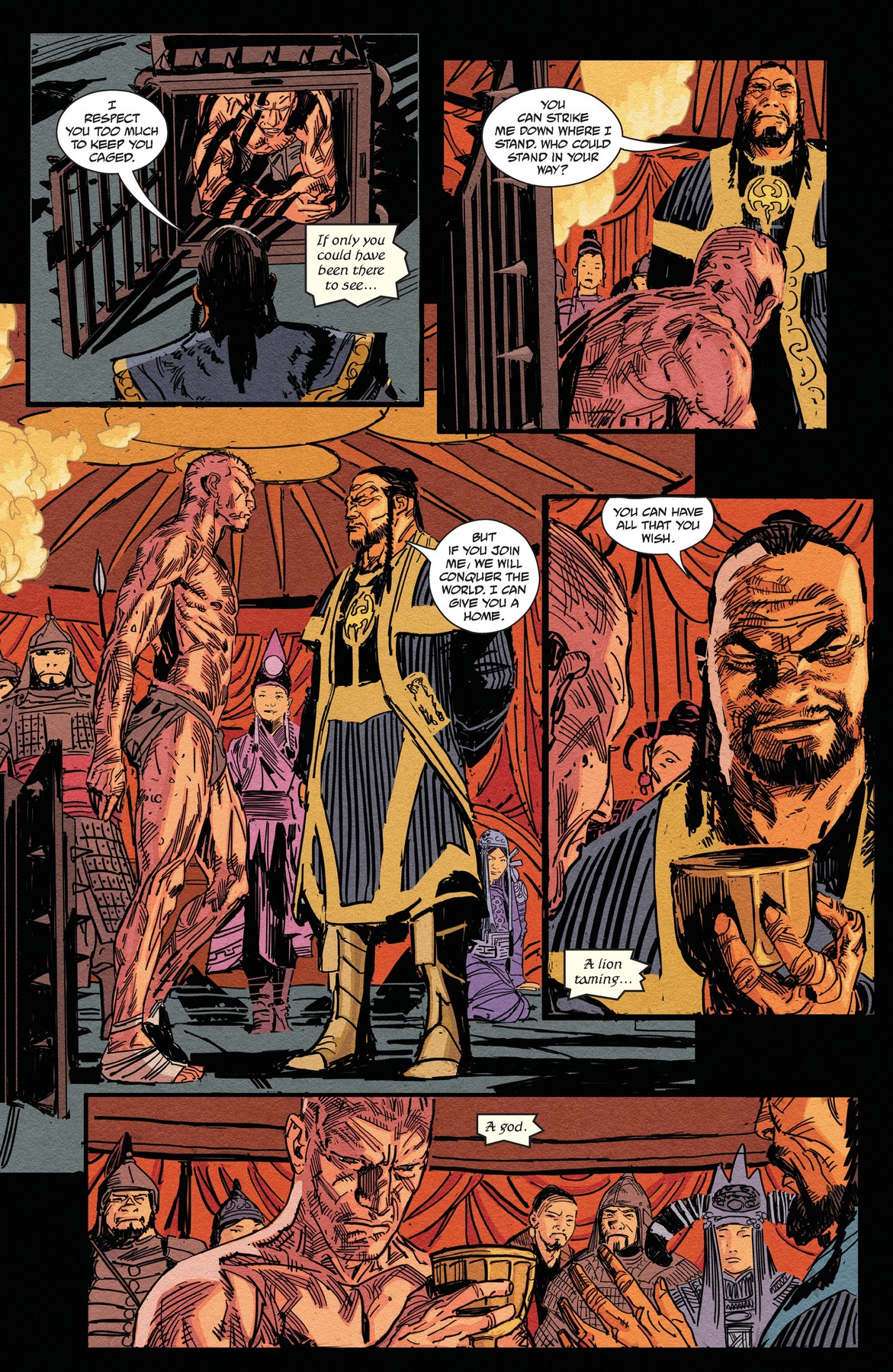
One of the story's clearest character scenes shows Genghis opening B's cage and speaking to him directly. He tells the immortal that he respects him too much to keep him caged. He acknowledges the obvious fact that B could strike him down and asks who could stand in B's way if he chose to do so.[2]
Then he changes the proposition. If B joins him, they can conquer the world. Genghis offers him a home and promises that B can have whatever he wants.[2]
The scene distinguishes Genghis from rulers who think physical restraint is the only form of control. His method depends on recognizing B's autonomy enough to make cooperation possible. That recognition is still instrumental. B is valuable because his violence can transform military campaigns.
The cult narrator describes the scene as taming a lion or a god. The metaphor is revealing, but it should remain attributed to the cult rather than treated as neutral narration.[2]
B as Mongol weapon
BOOM!'s official synopsis states the premise directly: B serves as the ultimate weapon of Genghis Khan, and enemies of the empire cannot withstand the resulting havoc and death.[1]
The comic depicts B in Mongol campaigns amid cavalry, infantry, massed armies, burning cities, and enormous casualties. Publicly, the victories belong to the Khan. Privately, the reader is shown the immortal force helping make those victories possible.
The arrangement benefits Genghis because B solves problems that ordinary soldiers cannot. It also allows B to exist within a social structure where his compulsion to violence is rewarded instead of treated as pathology.
Reward and control
Genghis tells B he can have anything he wants. The story later shows what that promise means in practice. B is supplied with opium, women, drink, and the privileges of a favored warrior.[4]
The narration calls opium a manufactured need and a promise of oblivion. For B, whose memory is effectively perfect, the possibility of dulling recollection has extraordinary psychological value. Genghis's patronage therefore provides more than pleasure. It gives B a temporary method of escape from himself.
The story does not need to depict Genghis as a modern neuroscientist for the system to work. He recognizes appetite. If a warrior wants battle, intoxication, companionship, or status, those wants can become tools of loyalty.
The siege of Beijing
A major campaign centers on Beijing, the name used by the comic. The narration describes it as a city that cannot be conquered by the Mongols' existing strengths. Its walls are too high, its barricades too thick, and Genghis's skill with horse and arrow offers no simple solution.[8]
The siege becomes a demonstration of adaptation. Mongol forces assault the walls and accept significant casualties. The dead are not merely buried. Corpses are loaded into siege engines and thrown into the city, turning disease and decomposition into weapons.[9]
B participates in the larger campaign. His ability to survive catastrophic injury gives the Mongols an assault capability no conventional soldier can match.
The wiki should create separate articles for Siege of Beijing, Mongol Siege Tactics in BRZRKR, and City Defenders and Civilians rather than overloading Genghis's biography with every event detail.
Victory and escalating war
The comic presents campaign after campaign as brilliant victories attributed to the Khan. The cult narrator then asks how a wild beast such as Genghis can be guided and answers that the beast must be fed everything it desires.[10]
That language reframes the conqueror. Genghis appears to command B, but the cult claims Genghis himself can be steered by providing conquest. The hierarchy becomes layered:
- soldiers obey Genghis;
- B fights within Genghis's campaigns;
- the cult believes it has engineered B's availability;
- the cult also believes Genghis's ambition makes him predictable.
A definitive wiki should preserve that structure because it is central to The Lost Book of B.
Opium and B's deteriorating agency
As the wars continue, B's use of opium becomes more important. The drug provides the ability to forget, or at least to dull the memory for a time.[4]
This creates an unstable form of dependence. B can participate in violence and then chemically blunt the experience, which in turn makes continued service easier. The Khan's promise to give B anything he wants becomes a mechanism that reduces B's ability to confront what he is doing.
Official collected-edition copy summarizes the larger trajectory as B becoming a pawn who must battle his violent urges and break free from the warlord's hold.[11]
B questions his loyalties
BOOM!'s official announcement emphasizes that the war grows larger than B imagined and forces him to question where his loyalties should lie.[1]
This moment is significant because Genghis's system succeeds only while B accepts the exchange. Unlike a physical prison, patronage depends on continued participation.
The story's later movement away from intoxicated obedience turns Genghis into another figure in B's long history who discovers that the immortal can be pointed in a direction but cannot be owned indefinitely.
End of the relationship
The complete story depicts the eventual collapse of B's service under the Khan. Secondary summaries of the issue describe B purging the opium through death and regeneration before turning violently against Genghis's system. Because the currently extractable subset of the supplied CBR does not include every final story page, the production article should attach exact page-image citations during final ingest rather than rely on a secondary summary for panel-by-panel wording.
The canonical high-level outcome can safely be stated: B breaks free from the hold Genghis Khan has over him, language confirmed by BOOM!'s collected-edition description.[11]
The wiki should avoid using real-world historical chronology to "repair" the comic's fictional ending. BRZRKR is an alternate fictional history involving an immortal participant and a hidden cult.
Personality and leadership
Charisma and directness
Genghis's most important interaction with B is conversational rather than coercive. He recognizes B's ability to kill him and makes an offer anyway. The confidence helps explain why B listens.
Appetite for conquest
The story consistently depicts the Khan as a ruler driven toward expansion. The cult narrator treats that appetite as both his strength and his vulnerability.
Pragmatism
When ordinary tactics fail at Beijing, the Mongol campaign shifts toward siege technology and disease. Genghis's forces use whatever method can overcome fixed defenses.
Instrumental generosity
The promise that B can have anything he wants is generous on the surface but strategically useful. Pleasure, opium, and status keep a uniquely valuable warrior attached to the empire.
Skills and resources
Military command
Genghis commands cavalry, infantry, siege forces, advisers, and an expanding imperial army.
Strategic adaptation
His campaigns shift tactics when horse archery cannot overcome fortified cities.
Recruitment
He is able to approach B not as a slave alone but as a warrior whose cooperation can be purchased through respect and reward.
Imperial logistics
The army sustains large campaigns across varied environments. The comic shows mass movement, siege engines, camps, rewards, and a system capable of supporting B over time.
Relationships
B / Unute
B is Genghis's greatest weapon and one of the few beings the Khan cannot simply dominate through force. Their relationship combines admiration, strategic use, reward, addiction, and eventual rupture.
Layo and the historical cult
The cult claims to have engineered the encounter between B and Genghis. The Khan does not need to understand the full hidden network for it to shape the opportunity presented to him.
Bulgar leaders and warriors
The Bulgars act as preparatory custodians of B and then step aside when the Mongols arrive. They are part of the cult's staging, not a lasting allied force under Genghis in the source available here.
Mongol advisers and soldiers
The Mongol forces carry out the campaigns publicly attributed to the Khan and fight alongside the immortal. Their mass casualties at fortified targets reveal the limits of ordinary imperial manpower even when B is present.
Beijing defenders and civilians
They are enemies and victims within the siege. The comic's use of diseased corpses deliberately collapses the boundary between attacking soldiers and a population trapped behind walls.
Appearance
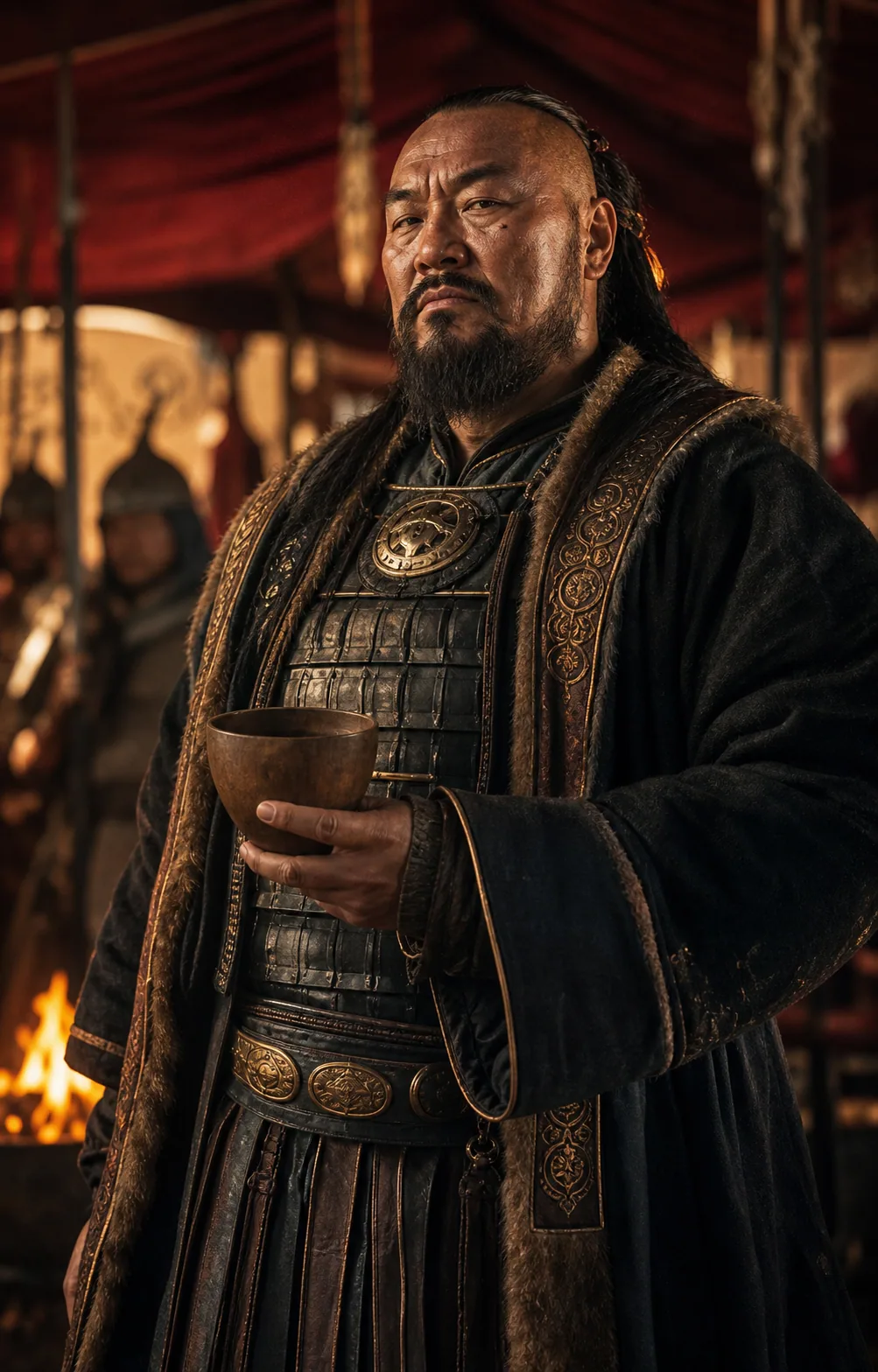
Genghis Khan is depicted as a powerful adult man with long dark hair and facial hair, wearing layered Mongol armor and royal or military clothing. In camp scenes he appears seated in command spaces surrounded by attendants and warriors. He is also shown close to B, visually emphasizing that their relationship is personal as well as institutional.
Historical figure versus fictional character
The wiki should maintain a clear separation:
BRZRKR canon: What The Lost Book of B depicts about Genghis Khan's relationship with B, the cult, and the campaigns.
Real historical context: Short, sourced notes explaining that Genghis Khan was the historical founder of the Mongol Empire and that the comic freely blends fictional events with recognizable historical warfare.
The encyclopedia must never use unsourced real-world history to fill gaps in the fictional character biography.
Status and fate
The story depicts the end of Genghis's ability to control B. Exact final-story mechanics should carry page-level primary citations after full issue ingestion. The article should not infer a BRZRKR-specific date of death from real-world biography unless the comic itself gives one.
Appearances
- BRZRKR: The Lost Book of B #1 - principal historical ruler, patron and controller of B.
- BRZRKR: Bloodlines Vol. 2 - collected edition containing the story.
- Later BRZRKR Bloodlines collected editions containing the same story - edition appearances.
Canon limitations and unresolved questions
The comic does not provide a full biography of Genghis Khan. It does not attempt to document every child, spouse, general, campaign, law, or administrative reform from real history. Those subjects should not be imported into this page merely because the character is based on a real person.
The exact degree to which Genghis knows about Layo's cult and its larger historical agenda should remain carefully sourced. The cult clearly claims to manipulate events around him, but a narrator's claim of control is not the same as the Khan consciously serving the cult.
References
[1] BOOM! Studios, BRZRKR: The Lost Book of B #1 official synopsis and announcement (2024), identifying the story as a 13th-century chapter in which B serves as Genghis Khan's ultimate weapon and begins questioning his loyalties.
[2] Keanu Reeves and Matt Kindt, BRZRKR: The Lost Book of B #1 (BOOM! Studios, 2024), Genghis Khan releases B from the cage, acknowledges B could kill him, and offers alliance, home, and whatever B wants, digital page image 0018.
[3] Reeves and Kindt, The Lost Book of B #1, cult narration concerning the exploitation of Unute's cycles and the transition from captivity to guided service, digital page images 0004-0018.
[4] Reeves and Kindt, The Lost Book of B #1, opium and reward sequence, digital page images 0028-0029.
[5] Reeves and Kindt, The Lost Book of B #1, cult narration describing Genghis as undefeated, the timing as prepared, and the Bulgar tribe as having followed directions, digital page image 0009.
[6] Reeves and Kindt, The Lost Book of B #1, repeated boiling and injury of B by Bulgar captors, digital page images 0006-0007.
[7] Reeves and Kindt, The Lost Book of B #1, Mongol entry into the camp and B's violent first encounter with the arriving warriors, digital page images 0010-0011.
[8] Reeves and Kindt, The Lost Book of B #1, introduction of fortified Beijing and the limitations of horse-and-arrow warfare against the walls, digital page image 0019.
[9] Reeves and Kindt, The Lost Book of B #1, use of corpses in siege engines to spread disease and stench inside the city, digital page image 0022.
[10] Reeves and Kindt, The Lost Book of B #1, campaign montage and cult narration about feeding the Khan what he desires, digital page image 0026.
[11] Reeves, Kindt, Garney, and collaborators, BRZRKR: Bloodlines Vol. 2 (BOOM! Studios), collected-edition synopsis describing B as Genghis Khan's pawn and stating that he must break free from the warlord's hold.