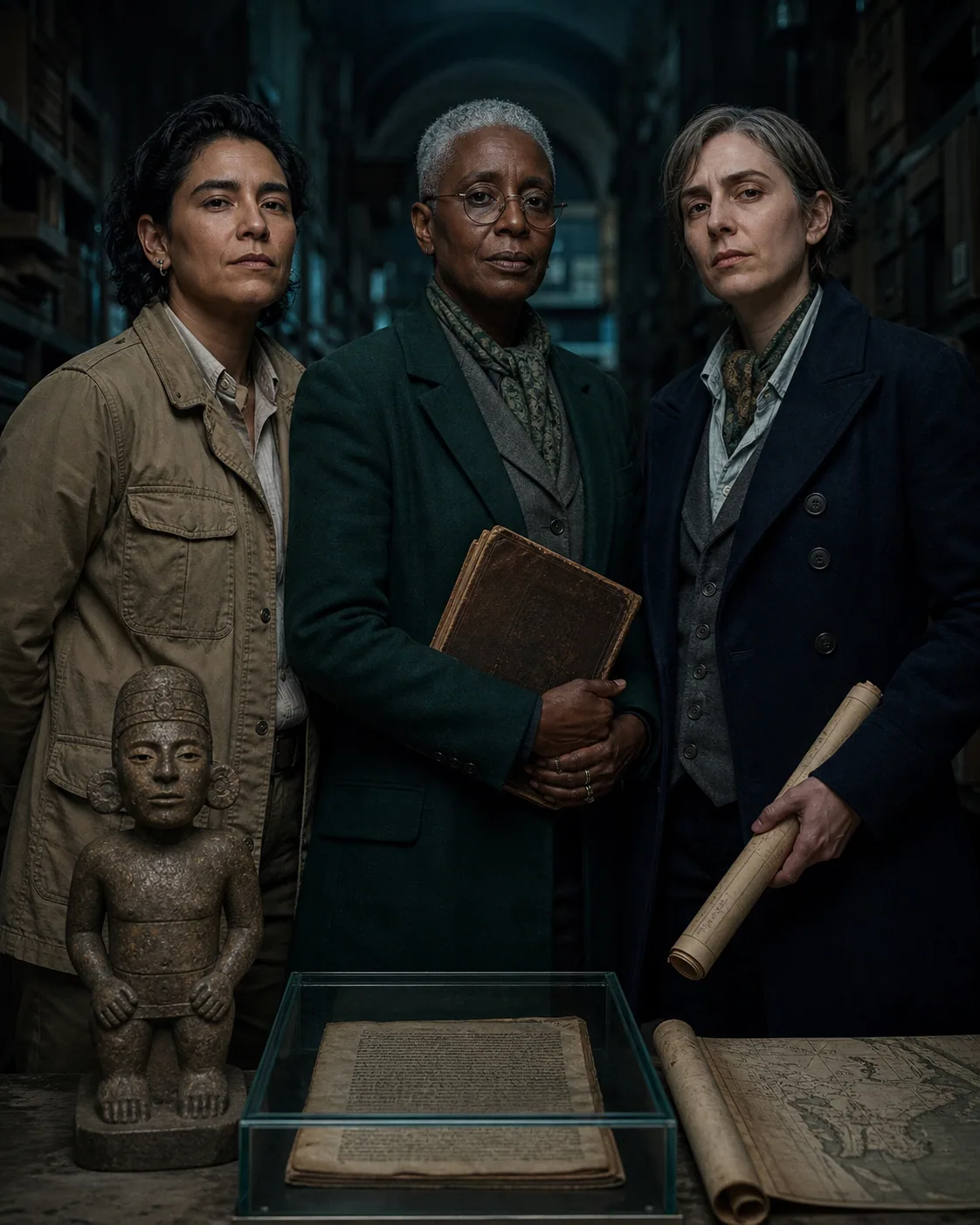
Spoilers: This article discusses Caldwell's secret killings and private archive in The Book of Elsewhere.
| Field | Details |
|---|---|
| Named victims | Josh Barrientes, Weatherly Knighton, Jon Peters |
| Killer | Caldwell |
| Connection | Each is remembered as a person Caldwell killed while pursuing concealed information or material connected to Unute |
| Possible roles | Archaeologists, priests, map sellers, unusual-object dealers, information brokers; the novel does not assign one role to one victim |
| Exact death methods | Not individually assigned; Caldwell's group recollection describes strangulation and stabbing |
| Primary source | The Book of Elsewhere |
| Continuity | Novel continuity |
Overview
Caldwell's Named Victims are Josh Barrientes, Weatherly Knighton, and Jon Peters, three deceased people remembered by Caldwell in The Book of Elsewhere as part of his long, private search for evidence concerning Unute. The novel names them together while revealing that Caldwell has killed people who possessed or concealed artifacts and information he wanted. The passage transforms Caldwell's secret research from an abstract conspiracy into a documented chain of human deaths.[1]
The victims are not identified as Unit personnel. They are associated instead with a clandestine ecosystem around archaeology, religion, maps, unusual objects, and information brokerage. Caldwell remembers that they might have belonged to any of those occupations, but the text does not assign a profession to any one person.[1] That ambiguity must be preserved across the individual biographies and the site's structured data.
Caldwell's memory also identifies the kinds of material circulating through this network. It includes ancient figurines depicting Unute, described as predating the earliest cave-painting traditions, and poems written in forgotten alphabets concerning a figure associated with death and a primordial silence. Caldwell builds a larger collection of information from such sources and then decides for himself what to reveal to the Unit and what to conceal.[1]
The three victims therefore provide a key bridge between character biography, artifact provenance, Caldwell's secret agenda, the Unit, and the deep historical record of Unute. Their collective article should serve as the contextual hub, while individual pages provide searchability, identity records, and space for future expansion.
The victims
Josh Barrientes
Josh Barrientes is named first in Caldwell's remembered sequence of dead faces. No exact occupation, location, age, or artifact is individually linked to him in the verified passage.[1]
His dedicated biography should therefore concentrate on the documented relationship with Caldwell, the hidden knowledge network, and the limits of the evidence. Barrientes should not be classified as a government scientist or soldier unless another source explicitly does so.
See Josh Barrientes.
Weatherly Knighton
Weatherly Knighton is the second named victim. The source gives this form of the name. The project planning form “Weatherly Kallina Knighton” is not verified by the BRZRKR text reviewed for this article and should remain an unverified redirect rather than canonical metadata.[1]
Like Barrientes, Knighton has no individually assigned occupation or artifact in the passage.
See Weatherly Knighton.
Jon Peters
Jon Peters is the third named victim in Caldwell's recollection. The novel does not establish whether Peters knew Barrientes or Knighton, worked in the same field, or lived in the same place.[1]
The three are connected by Caldwell's memory and by his pursuit of Unute-related knowledge, not by a confirmed shared organization.
See Jon Peters.
Caldwell's private research project
The victims appear in a larger meditation on secrecy inside the organization that studies and deploys Unute. Caldwell assumes that a clandestine government institution naturally attracts people with overlapping loyalties and private agendas. Some may serve ideological, religious, political, or occult causes while outwardly contributing to the Unit's missions.[1]
Caldwell's judgment is not detached. He is describing a system in which he himself participates. He is conducting research for the Unit, but his real goals extend beyond the government's stated purpose. He gathers material privately, tests other personnel for hidden sympathies, and anticipates a point at which his plans may diverge openly from those of his superiors.[1]
The memories of Barrientes, Knighton, and Peters demonstrate what “private research” means in practice. Caldwell is willing to kill people in order to obtain what they are hiding.
That makes the victims central to the ethical history of the Unit. Even if they never worked for it, knowledge taken from them can enter its research program through Caldwell. The Unit's archive is therefore potentially contaminated by evidence obtained through crimes its leadership may not know occurred.
Possible occupations and why they matter
Caldwell's recollection places the victims among several possible roles. The novel's wording is collective, so the wiki must not assign one to each person. The categories are still important because they reveal where traces of Unute's life can survive.
Archaeologists
Unute's history extends far beyond conventional written records. An archaeologist could encounter an object or site that contradicts accepted chronology, especially if it depicts a recurring human figure in a period where no such continuity should be possible.
An ancient Unute artifact would be difficult to interpret without the knowledge that the same being has survived across eras. It might be catalogued as ritual art, mythic symbolism, forgery, anachronism, or an unexplained anomaly.
Priests and religious custodians
Religious traditions are another way encounters with B can survive. A community that sees an apparently immortal warrior die and return may preserve the event as theology rather than biography. Across centuries, a memory of Unute could become a god, demon, angel, avatar, cursed warrior, child of death, or sacred agent.
A priest connected to such a tradition might control texts or ritual objects that preserve information unavailable to secular archives.
Map sellers
Maps can retain knowledge of places after names and political boundaries disappear. Routes to caves, temples, ruins, battlefields, tombs, private collections, or forgotten settlements can all matter to a researcher trying to reconstruct Unute's movements.
A map seller might also operate outside formal scholarship, making it easier for old, disputed, stolen, or privately held geographical material to circulate.
Dealers in unusual objects
The novel's wording allows for people who trade in objects considered junk, curiosities, or marginal antiquities. That category is especially relevant to impossible artifacts. Objects that do not fit established chronology can be pushed out of legitimate institutions and into informal markets.
Information brokers
Information brokerage connects all the other categories. A broker can know which archaeologist found an object, which family owns it, which religious archive mentions it, which border it crossed, or which collector is willing to sell it.
The victims may have occupied any of these roles or several at once. The site should preserve the possibilities without presenting them as settled biography.[1]
The ancient figurines
One category of material Caldwell obtains consists of figurines representing Unute that are described as older than the earliest known cave paintings.[1]
If taken literally within the novel's continuity, such objects would be extraordinary evidence of B's prehistoric existence. They would also raise major questions of provenance, dating, cultural context, and how the image of one individual could persist across immense spans of time.
The passage does not identify which victim possessed the figurines. The artifact database should therefore attach the items to Caldwell's victim network rather than Barrientes, Knighton, or Peters individually.
Recommended record structure:
artifact_type: figurinedepicted_subject: Unuteclaimed_age: predates earliest cave-painting traditionsmodern_acquirer: Caldwellprior_holder: one or more of Caldwell's unnamed/named external sources, exact individual unknownacquisition_context: violent / clandestinecontinuity: The Book of Elsewhere
This lets future editors narrow the provenance if new material identifies a holder.
The forgotten poems
The recollection also refers to poetic texts written in long-forgotten alphabets. These tell of a figure associated with death and the “first silence” or an equivalent primordial concept in the translated source used for verification.[1]
The poems are significant because they suggest that memories of B have moved through language, religion, and literature, not only through physical artifacts. They may represent historical testimony transformed into myth.
Again, the source does not assign a specific scroll or poem to one of the named victims. The content should therefore link from all three biographies to a common article such as Ancient Texts About Unute rather than listing one victim as the confirmed owner.
Caldwell's secret archive
Caldwell accumulates information gradually and controls its circulation. Some is given to the Unit in small portions. Other material is kept from the organization.[1]
This makes Caldwell's Secret Archive a necessary future page. It should not be treated simply as a room full of objects unless the novel explicitly describes such a physical archive. Conceptually, it is the body of information Caldwell controls outside normal Unit transparency.
The archive can include:
- physical artifacts
- copied inscriptions
- maps
- provenance chains
- translated texts
- names of intermediaries
- site locations
- oral or religious traditions
- intelligence about private collectors
- links between historical manifestations of Unute
Barrientes, Knighton, and Peters belong in the provenance history because their deaths are part of the process by which Caldwell accumulates that knowledge.
Methods of killing
The passage remembers Caldwell killing members of the group through hands closing around throats or a narrow blade driven between ribs.[1]
The source does not state:
- Barrientes was strangled
- Knighton was stabbed
- Peters was strangled
or any other one-to-one mapping.
The wiki's death system should support collective evidence. Each individual record should say:
killer: Caldwell
cause: homicide
method: not individually resolved; source group includes strangulation and stabbing
This is a small but important example of the site's canon-confidence model. An automated death counter or character infobox should never generate more precision than the source provides.
The victims' final reactions
Caldwell remembers the victims experiencing shock, terror, and disappointment as they realize what is happening. He also remembers their hands reacting as he takes the things they tried to keep from him.[1]
Those details humanize the group without establishing separate personalities. The wiki may say that the remembered victims as a group respond with fear and disappointment. It should not say that Knighton trusted Caldwell, Peters begged him to stop, or Barrientes fought back unless another passage says so.
The emotional description nevertheless suggests betrayal or violated expectation. These were not anonymous battlefield opponents. Caldwell came close enough to kill them by intimate means and take what they were holding.
Relationship to Caldwell's cultic agenda
The victim passage sits beside Caldwell's thinking about his own hidden lodge or cultic network. He uses coded language to identify people who share beliefs about Unute and the possibility of extracting power from him.[1]
The named victims are not confirmed members of that lodge. They should not be placed in the cult roster.
Their material, however, contributes to the same private project: reconstructing Unute's true nature and using knowledge that the government does not fully control. Their deaths therefore belong in the historical background of Caldwell's Cult / Secret Lodge even when the victims themselves are external to it.
Relationship to the Unit
The Unit is the institutional beneficiary and target of Caldwell's selective disclosure.
Caldwell shares some information with the Unit and withholds some.[1] This means the victims' knowledge can affect Unit research indirectly. The correct graph model is:
not:
or equivalent edges for Knighton and Peters.
This distinction should also govern category pages. The three belong under Caldwell's Victims, Novel Characters, and Hidden Knowledge, not under Government Personnel.
Narrative significance
Making Caldwell's violence concrete
The three names turn an implied pattern into documented murders. Readers see that Caldwell's obsessive research has victims beyond Unit missions.
Establishing a hidden world around Unute
If multiple people across different possible professions possess material about B, then the Unit is not the only institution reconstructing his history. There is a dispersed, often unofficial information ecosystem around him.
Corrupting provenance
Caldwell's research is epistemically useful and ethically compromised. The information may be true even though the method of acquiring it is criminal.
Demonstrating selective truth
Caldwell controls what the Unit knows. This is one of the novel's most important reminders that a secret institution's records are not automatically complete simply because they are classified.
Themes
Knowledge as power
Caldwell treats information about Unute as something worth killing for. Knowledge does not merely explain power in this story. It becomes a form of power.
Archives and violence
The named victims force the reader to ask how archives are built and what histories of theft or coercion sit behind apparently neutral collections.
Mortality
B can survive almost anything. The people who preserve his history cannot. The search for an immortal being is carried out through mortal custodians whose lives Caldwell can erase.
Secrecy
Every organization in the novel contains smaller circles of hidden purpose. The victim network shows secrecy outside the Unit, while Caldwell's private archive shows secrecy inside it.
Timeline treatment
The murders should not receive invented dates.
The timeline database can safely record:
- event: Caldwell kills Josh Barrientes
- date: unknown, before Caldwell's present-day recollection
- continuity: novel
- confidence: confirmed event, unresolved date and method
and equivalent records for Knighton and Peters.
If the timeline interface supports uncertainty bands, the murders can appear as undated pre-main-story events attached to Caldwell's private-research period.
Appearance database
The three should have individual character entities with appearance type:
RECOLLECTION / MEMORY
The collective group article is not a replacement for their entities. It is the contextual event hub that prevents repeated exposition.
Recommended relationships:
Unresolved questions
- Did Barrientes, Knighton, and Peters know one another?
- What were their actual professions?
- Where did each live?
- When did Caldwell kill them?
- How did Caldwell first identify them?
- What precise materials did each possess?
- Which victim, if any, held the figurines?
- Which victim, if any, held the forgotten poems?
- What other unnamed victims existed?
- How much of the stolen information did Caldwell pass to the Unit?
- Did Unit leadership know how the information had been obtained?
- Were any victims connected to Caldwell's own lodge or to rival secret traditions?
These should be tracked as unresolved canon questions rather than converted into theories in the main factual prose.
References
[1] Keanu Reeves and China Miéville, The Book of Elsewhere (Del Rey, 2024), Caldwell recollection naming Josh Barrientes, Weatherly Knighton, and Jon Peters, describing their possible professions, Caldwell's group-level killing methods, ancient Unute figurines, forgotten-script poems, and Caldwell's selective sharing and concealment of accumulated information. Pagination varies by edition.