Selected scenes
BRZRKR in pictures.
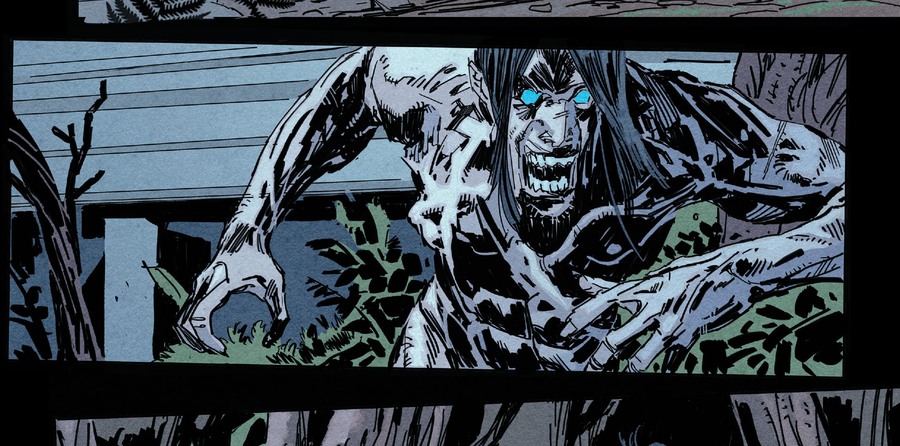
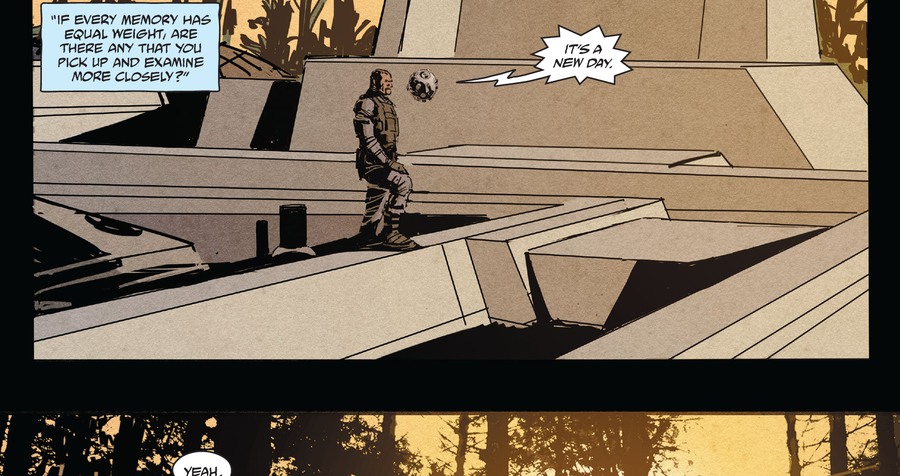
Spoilers: This article covers B-derived material in BRZRKR #7-12 and the related artificial-life stories.
B's tissue and DNA fragments are the physical remains of injuries that become the foundation for modern attempts to reproduce his condition. The material is distinct from B's living body in one crucial respect: it can be separated from him and handled by other people while B remains alive. That fact turns regeneration into an ethical crisis. The body heals, but the material left behind may continue to carry power, information, and the possibility of another life.
From wound to sample
The fragments originate in violence. B is cut, torn apart, or otherwise damaged during a mission, and the healing process restores the body without necessarily recovering every piece. A normal medical system would treat a separated fragment as waste or a sign of catastrophic injury. The government program treats it as a sample.
The change in language hides a change in relationship. B experiences the wound. Researchers receive the material. The fragment's scientific value can make the suffering that produced it disappear from the report. Diana's presence matters because she keeps the connection visible. A sample is still part of the person who lost it.
What the material contains
The comic associates the fragments with B's regenerative biology, unusual amino acids, and the possibility of artificial immortality. The tissue is not ordinary human material, but the issues do not provide a complete molecular description. The fragments may retain conditions that allow them to participate in healing or the creation of another body, yet they do not automatically contain B's memory or personality.
That boundary protects the difference between biology and identity. If every fragment were a complete B, the original character would be infinitely duplicable. Instead, the material is a component in a larger process. It can support life without deciding who that life will become.
Storage and control
Once recovered, the fragments are stored, transported, and studied by people who may not agree about their purpose. Scientists want measurements. Caldwell wants a route to power. The government wants a strategic advantage. B wants the right to remain a person whose body is not public property. The storage room becomes a political space even when it looks clinical.
The program's control is never complete. A sample can be moved, hidden, stolen, or used without every participant knowing. The fragment's history therefore resembles the wider cult history: pieces of B's life travel through institutions that preserve some information and conceal other parts.
Franken-B
Franken-B is the clearest result of the tissue project. B-derived material is combined with other processes and Source-linked equipment to assemble a new being. The name emphasizes the horror of construction, but the character is not simply a monster made from spare parts. Franken-B is a person whose body has been created from someone else's remains.
The creation raises a question the scientists cannot answer by measuring regeneration. Does a derived body have the right to refuse the purpose for which it was built? B recognizes that the answer must be yes because he has lived through the same mistake. His father did not assemble him, but he interpreted a changed child as a weapon and trained him accordingly. Franken-B makes that history visible in a new form.
The relation to B's blood
Tissue fragments are connected to B's blood but are not interchangeable with it. Blood carries clues to the Source and can function as a ritual component in Atlantis. Tissue provides structural and regenerative material for the modern experiments. The series keeps the distinction because each substance has a different history and consequence.
The government may combine them, but combination does not equal understanding. A body can be built from several clues and still lack B's identity. The fragments show why artificial immortality is a chain of conditions rather than a single formula.
Consent and remains
B's consent becomes more difficult to define after an injury. He may agree to a mission without agreeing that every piece of his body can be kept. The contract that authorizes his service cannot automatically authorize experiments on remains whose future use was not explained. The fragments expose the gap between legal language and human consent.
Diana's concern is not that every sample must be destroyed. It is that the people using the material must recognize the person it came from and the person it may help create. A research program can be scientifically careful and ethically careless at the same time. The story holds both possibilities together.
Historical parallels
The alchemical creation of Lugalṭur offers a historical parallel to the modern tissue work. The methods and eras differ, but both stories ask whether B-related material can become another life. Lugalṭur's eventual freedom gives the modern question a moral answer. A creator or source of material may have a relationship to a new being without owning that being.
The comparison also shows why fragments matter to B personally. He has spent thousands of years watching others turn his body into a weapon. When another person is made from his material, he faces the possibility that the cycle will continue through him even if he stops fighting. His responsibility becomes refusing to repeat the logic that shaped him.
Limits of the material
The issues do not state how many fragments exist, how long they remain viable, or whether every injury produces usable tissue. They do not establish that a fragment can regenerate independently or that DNA alone carries the Source's full effect. Franken-B demonstrates a successful construction, not a universal process.
These limits keep the fragments tied to specific scenes and people. A vague claim that “B's DNA makes immortality” would erase the machines, memories, rituals, and moral choices that the story actually shows. The material is powerful because it enters a chain of decisions.
Significance
B's tissue and DNA fragments make the series' body politics concrete. They are pieces of a person that remain valuable after the wound closes, and they can become the beginning of a life B never chose to create. The fragments matter because they force every institution around B to answer the same question: can a body be used without turning the person it came from—and the person it helps create—into property?
[1] Reeves, Kindt, Garney, Crabtree, and Robins, BRZRKR #7-12, separated fragments, tissue, artificial immortality, Franken-B, blood, and Source-linked research.
[2] Reeves, Kindt, Garney, Crabtree, and Robins, The Lost Book of B. #1, Lugalṭur and the historical creation of derived life.