Selected scenes
BRZRKR in pictures.
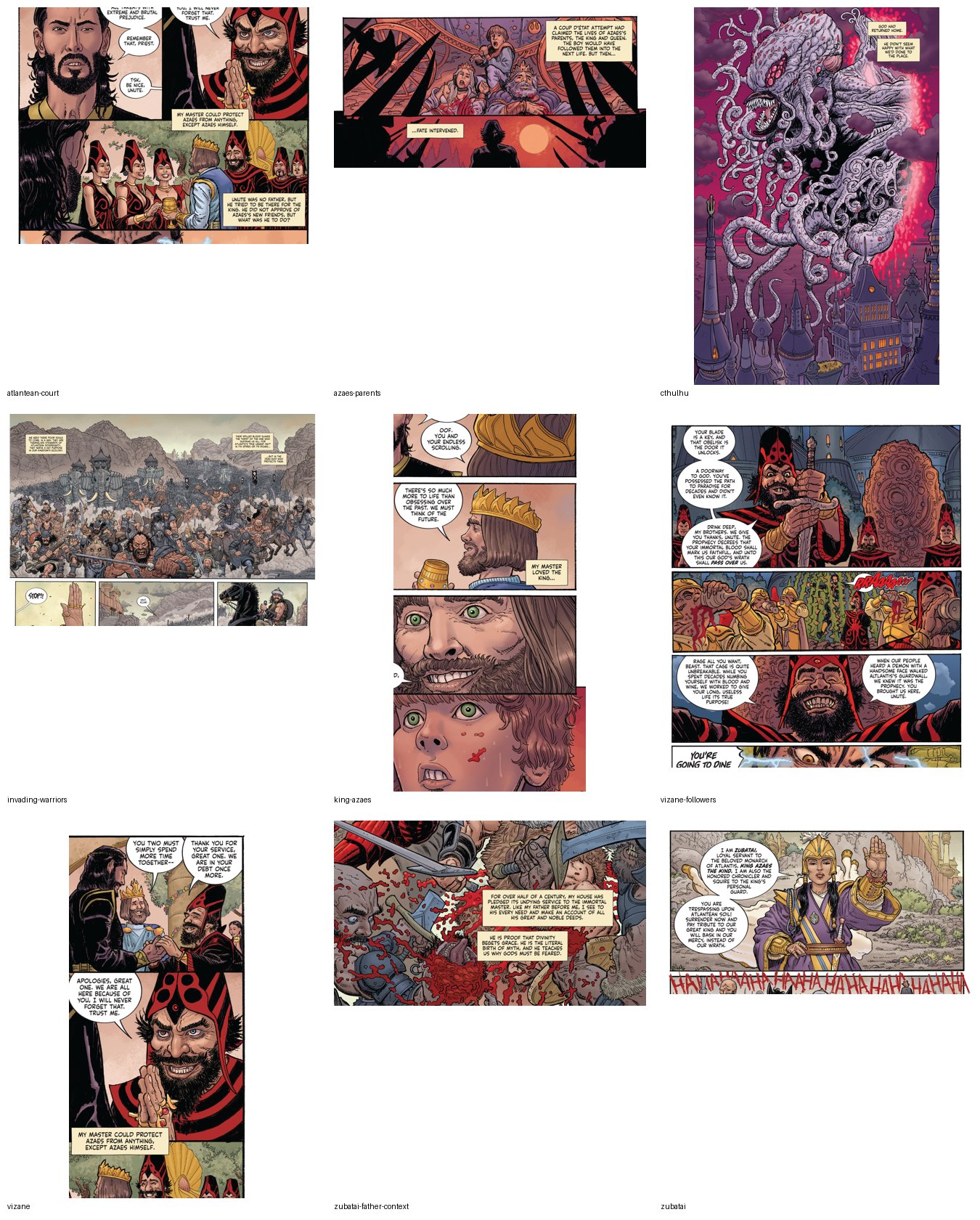
Spoilers: This article covers the stolen writings in BRZRKR: Poetry of Madness #1.
The Aklo scrolls are the forbidden writings removed from Atlantis's reliquary by Vizane's followers. They are the textual half of the gateway ritual that uses B's blood, the primordial-ore sword, the Atlantean obelisk, ritual vessels, and the northeastern tower. The scrolls matter because they give a political movement a language for turning fear of mortality into a promise of cosmic importance. Their words are dangerous not simply because they describe monsters, but because they persuade people that understanding a monster grants the right to summon it.
Kept apart in the reliquary
B stores the scrolls in a guarded collection with objects he considers too dangerous for ordinary use. The placement shows that he has encountered Aklo before and knows that the writings should not circulate through the court. The reliquary does not function as a library open to every scholar. It is a boundary built around context, custody, and restraint.
The scrolls' history before Atlantis is not supplied. The one-shot does not name their writers, the culture that first used the language, or the route by which the documents reached the city. That missing history is part of the danger. The characters can recognize the words and the effects without knowing the intentions of the people who first wrote them.
Vizane's theft
When the reliquary is robbed, the scrolls are taken with the obelisk and other materials. The theft is a political act. Vizane has access to the palace because King Azaes has accepted the promise of a movement that calls itself chosen. The stolen writings allow the priest to convert private knowledge into a public conspiracy.
The scrolls are not valuable because they can be sold. They are valuable because they can make the other ritual objects meaningful. B's blood is a biological substance, the obelisk is an ancient object, and the sword is a weapon. Aklo binds them into a story about a gateway and a returning power. Language supplies the order in which the objects will be used.
A language that claims authority
Vizane treats the scrolls as proof that Atlantis has a destiny. He reads the texts through the needs of the court and the fears of Azaes. Mortality becomes a problem that a god can solve, and B becomes the necessary participant in a ritual chosen by prophecy. The priest's authority grows because he can present the writings as knowledge unavailable to ordinary citizens.
B rejects that authority. He recognizes Aklo and warns that the language can poison mortal minds. His warning is not a claim that every sentence is false. It is a warning about what the language does to people who assume that naming an elder power makes the power obedient. B has lived long enough to see knowledge turn into a demand.
The gateway sequence
The scrolls are used at the northeastern tower with the other ritual components. The issue shows that the arrangement succeeds: a passage opens and Cthulhu arrives. That success does not validate Vizane's larger theology. A mechanism can work while the people using it misunderstand the consequences.
The scrolls therefore function as instructions without becoming a complete manual. The comic does not translate every passage or explain each symbol. It presents enough language for B and Vizane to recognize one another's knowledge and for the ritual to be legible as an intentional act. The gaps keep the writings dangerous rather than turning them into a solved puzzle.
B's fluency
B's knowledge of Aklo is one of the most revealing details in the one-shot. He can challenge Vizane's grammar and question the priest's confidence. The exchange shows that B has encountered the language in an earlier era or through a history the reader has not yet seen. His fluency also undercuts the idea that Vizane is uniquely chosen.
The knowledge does not make B responsible for the ritual. He did not steal the scrolls or choose to use them to summon Cthulhu. His familiarity gives him a chance to identify the danger, not a duty to participate. The distinction echoes the wider series: knowing how a weapon works does not mean agreeing that it should be fired.
The scrolls and the fall of Atlantis
The gateway's result destroys the city. B kills Cthulhu, but the entity's death dissolves Atlantis. The scrolls are therefore linked to both the arrival and the defeat of the power. They are not a simple evil object. Their danger comes from the decisions made around them, the people who interpret them, and the belief that prophecy can justify catastrophe.
After the fall, the fate of the scrolls is unknown. They may be destroyed, scattered, or carried into another tradition. The uncertainty explains why later characters can inherit fragments of forbidden knowledge without possessing the original collection. A text can survive as a copy, a translation, or a rumor even when Atlantis does not.
Relation to other BRZRKR systems
Aklo scrolls belong to the Atlantis branch and should remain distinct from the Source, the government program, and Zosimus's alchemy. The series contains several ways of describing extraordinary bodies and powers. The scrolls connect B to elder gods through language and ritual; they do not prove that all later supernatural events use the same mechanism.
Their relationship to B's blood is similarly limited. Blood participates in the gateway, but the scrolls do not make B a god or establish that his body was created for the ritual. Vizane's interpretation is part of the conflict, not a neutral explanation.
Open questions
The one-shot leaves the authorship, age, complete contents, and survival of the scrolls unresolved. It does not say whether B can translate every text or whether Vizane possesses the only surviving copies. It also does not explain whether the language itself causes mental harm or whether the danger comes from the ideas and entities the writings describe.
Significance
The Aklo scrolls represent knowledge that becomes dangerous when separated from responsibility. B hides them because he understands that the wrong reader can turn a warning into an invitation. Vizane steals them because he believes the invitation is his destiny. The scrolls help bring down Atlantis, but their deeper role is to show how language can convert a human fear of death into a political demand for apocalypse.
[1] Reeves and the creative team of BRZRKR: Poetry of Madness #1, Aklo texts, reliquary robbery, B's warning, gateway ritual, Cthulhu, and Vizane's death.